
▶ Read transcript
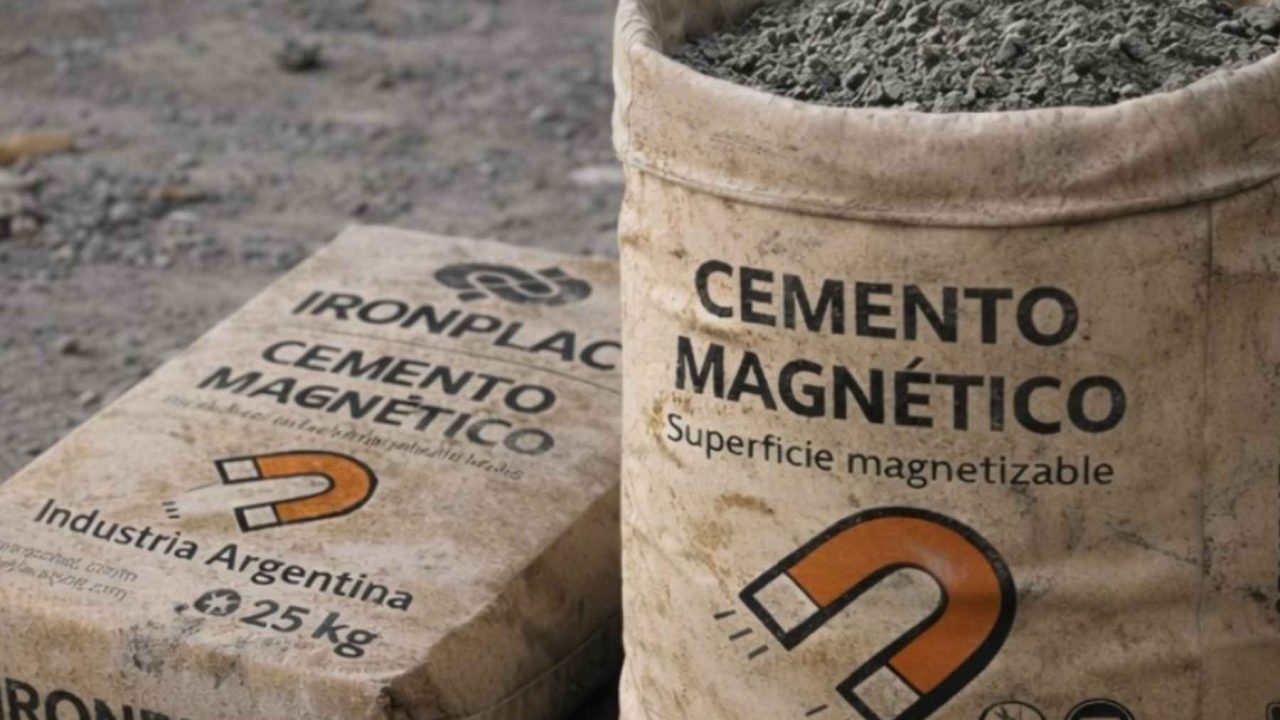
Here’s what you need to know about a potentially game-changing construction material. A 29-year-old Argentine inventor named Marco Agustín Secchi has created Ironplac, a cement-like product that magnets stick to. It’s not an active magnet or electrical system. It’s a passive surface made with mineral and ferrous fillers that only responds when a magnet-backed object is placed against it. That means no holes, no screws, no anchors, and no wall damage. What makes this especially promising is that it fits seamlessly into existing construction workflows. It ships in standard 25 kg bags, mixes with water, and applies with the same trowels plasterers already use. That’s critical in an industry where productivity has grown just one percent per year over the past two decades despite generating 13 trillion dollars annually. If you work in construction or interior design, this is worth watching closely. Keep an eye on load-rating certifications and pricing data as they emerge, because those will determine whether Ironplac moves from impressive demos to real-world adoption.
Eight billion pounds. That’s the estimated weight of nails, screws, anchors, and wall fasteners consumed by the global construction industry every single year. Each one punches a hole. Each one leaves a mark. And each one represents a method of attaching things to walls that hasn’t fundamentally changed since the Roman Empire mixed volcanic ash with lime. Now a 29-year-old Argentine inventor wants to make every last one of them optional.
His name is Marco Agustín Secchi. His invention is called Ironplac. And it is, in the simplest terms, cement that magnets stick to.
What Ironplac Actually Is (and What It Isn’t)
Let’s clear up the most common misconception first. Ironplac is not a giant magnet embedded in your wall. It doesn’t generate a magnetic field. It won’t wipe your credit cards or interfere with your phone.
Instead, Ironplac is a passive surface. It uses a proprietary blend of mineral and ferrous fillers mixed directly into a cement-like compound. When an object carrying a magnet touches the treated wall, it holds. Remove the magnet, and the wall is inert again. No electricity. No wiring. No active components.
The product ships in standard 25 kg bags. For wet construction, it mixes with water and applies like a traditional skim coat or final plaster finish. For dry construction, it integrates with panel-based interior systems. In both cases, the workflow mirrors what builders already know. No special training. No exotic equipment.
That last detail matters more than it might seem. Construction is an industry famously resistant to new materials. If a product doesn’t fit existing workflows, it dies on the shelf.
A Stagnant Industry Worth Trillions
The global construction sector generates roughly $13 trillion in annual revenue. Yet its productivity growth over the past two decades has averaged just 1% per year, lagging behind nearly every other major industry. Manufacturing doubled its productivity in the same period. Construction barely moved.
Part of the reason is material inertia. Portland cement, the backbone of modern construction, was patented in 1824. Drywall became standard in the 1950s. Screws and anchors have been the default attachment method for over a century. Innovation in the sector tends to happen at the margins: better insulation, stronger rebar, more efficient machinery. The fundamental way we build and finish interior walls has barely budged.
Secchi’s insight was to attack the problem at the surface level, literally. Rather than reinventing the wall itself, he modified the final layer that humans interact with every day.
| Feature | Traditional Plaster + Fasteners | Ironplac + Magnets |
|---|---|---|
| Wall damage | Holes from nails, screws, anchors | None; magnets attach and detach cleanly |
| Repositioning objects | Requires patching old holes, drilling new ones | Instant; move magnet-backed item anywhere on surface |
| Application method | Standard plaster/skim coat + tools | Standard plaster/skim coat + water (same process) |
| Works on existing walls | N/A (already in place) | Yes; can be applied as a new finish layer |
| Electrical components | None | None; fully passive system |
| Packaging | Standard bags | Standard 25 kg bags |
From Demonstration Videos to Real-World Proof
Secchi’s demonstrations have drawn attention for their sheer visual impact. In videos circulating online, Ironplac-coated walls hold kitchen knives, heavy tools, decorative panels, and even a full-sized shovel. All suspended by small magnets pressed against the surface. No brackets. No mounting hardware.
“The wall becomes the tool. You don’t need to think about where to drill, because you can place things anywhere and move them whenever you want.”
— Marco Agustín Secchi, inventor of Ironplac
The demonstrations are compelling, but the real test for any construction material is adoption. Builders need to trust it. Suppliers need to stock it. And end users need to understand it without a manual.
Ironplac’s design addresses all three barriers. It ships in the same 25 kg bags that every construction worker already handles. It mixes with water the same way traditional plaster does. And it applies with the same trowels and techniques plasterers have used for decades. The only difference is what happens after it dries.
Secchi Isn’t the Only One Betting on Magnetizable Construction
The idea of embedding magnetic properties into building materials isn’t entirely new. MAGMENT, a German startup, has developed magnetizable concrete designed primarily for wireless charging of electric vehicles. Their material uses cement- or asphalt-based compounds embedded with ferrite particles, enabling roads and parking surfaces to transfer energy to EVs through inductive charging pads.
But where MAGMENT targets infrastructure and energy transfer, Secchi’s Ironplac targets something far more personal: the interior walls people live and work inside every day. The applications diverge sharply. One charges cars. The other holds your kitchen knives.
Meanwhile, other young inventors are pushing the boundaries of magnet technology in different directions. Robert Sansone, who was just 17 when he began exploring rare-earth-free motor designs, and Tyler Fever, a self-taught engineer developing permanent magnets engineered to retain roughly 80% of their strength for a thousand years, represent a broader trend. A new generation of inventors is rethinking magnetic materials from the ground up.
The Economics of Eliminating the Drill
Consider the hidden costs of the current system. Every time a tenant moves out of a rental apartment, the landlord typically patches and repaints walls pocked with screw holes. Every time a retail store redesigns its display layout, workers spend hours removing old fixtures and mounting new ones. Every time a hospital reorganizes a ward, maintenance crews drill into walls that may contain electrical conduits or plumbing.
Ironplac eliminates the drill from all of these scenarios. Objects attach, reposition, and detach without leaving a trace. For commercial spaces that undergo frequent layout changes, the savings in labor, materials, and downtime could be substantial.
For residential users, the appeal is more intuitive. Renters who can’t drill into walls get full functionality. Homeowners who rearrange frequently never face a constellation of patched holes. And in seismic zones, magnet-mounted objects that can detach cleanly during shaking may prove safer than rigidly screwed fixtures that shatter or become projectiles.
You’re renovating your apartment kitchen and want flexible wall storage that can be rearranged easily. Your contractor offers three options for the wall finish.
Challenges Standing Between Ironplac and Global Adoption
No material innovation reaches global scale without clearing significant hurdles. Ironplac faces several.
First, holding strength. Demonstrations with shovels and knives are impressive, but construction professionals will want certified load ratings. How much weight can a magnet-backed shelf hold per square centimeter of Ironplac surface? The answer will determine whether the product stays in the realm of light decor or enters structural territory.
Second, cost. If Ironplac costs significantly more per square meter than standard plaster, adoption will be limited to premium applications. Secchi’s decision to package it in standard 25 kg bags suggests he’s targeting price parity, but confirmed pricing data isn’t yet widely available.
Third, magnet standardization. The system requires users to have magnet-backed accessories. That means either a robust aftermarket of compatible products or a standardized magnet specification that accessory manufacturers can design around.
Why a 25 kg Bag Might Matter More Than a Patent
The most underrated detail about Ironplac might be its packaging. Construction supply chains are built around standardized units. Cement comes in bags. Plaster comes in bags. Grout comes in bags. Warehouses, trucks, and job sites are all organized around this reality.



Leave a Reply