
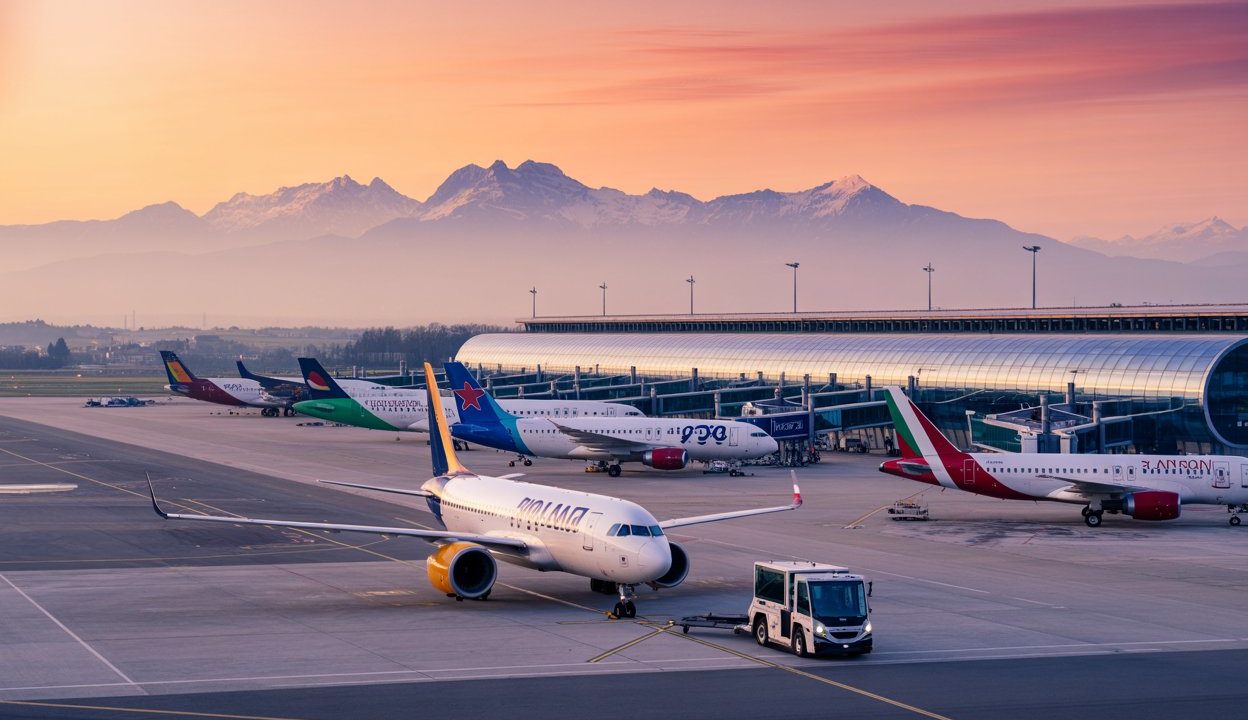
Nearly 5 million travelers passed through Milan Bergamo Airport in the peak summer months of 2025 alone — and the airport is now positioning itself to go significantly further in 2026, with a double-digit percentage increase in total seat capacity on the way.
The Summer 2026 schedule, managed by airport operator SACBO, represents one of the most ambitious expansions in the airport’s recent history. It is not just about more seats. The strategy this year is built around three deliberate pillars: diversification of destinations, increased frequency on existing routes, and infrastructure improvements designed to handle the growing volume of passengers.
For travelers flying in and out of northern Italy, this matters. Bergamo has long been the go-to airport for budget European travel, but 2026 is shaping up to be something different — a moment when the airport steps into a broader role on the continental and even intercontinental stage.
(function(){var wrp=document.getElementById(“paap_stat_69c6d944dd07c3.29366910”);if(!wrp)return;var ids=[“paap_stat_69c6d944dd07c3.29366910_c0”];var dur=1800;function ease(t){return 1-Math.pow(1-t,3);}function anim(){ids.forEach(function(id){var el=document.getElementById(id);if(!el)return;var tgt=parseFloat(el.getAttribute(“data-target”))||0;var pfx=el.getAttribute(“data-prefix”)||””;var sfx=el.getAttribute(“data-suffix”)||””;var dec=parseInt(el.getAttribute(“data-decimals”))||0;var st=null;function step(ts){if(!st)st=ts;var p=Math.min((ts-st)/dur,1);var v=ease(p)*tgt;el.textContent=pfx+v.toFixed(dec)+sfx;if(p<1)requestAnimationFrame(step);}requestAnimationFrame(step);});}if("IntersectionObserver" in window){var obs=new IntersectionObserver(function(e){e.forEach(function(en){if(en.isIntersecting){anim();obs.disconnect();}});},{threshold:0.2});obs.observe(wrp);}else{anim();}})();
What Is Driving the Milan Bergamo Airport Summer 2026 Expansion
The growth story at Bergamo is not happening in isolation. Northern Italy is one of Europe’s most economically active regions, home to a mix of business travelers, tourists heading to the lakes and mountains, and a large diaspora population with strong ties to destinations across Europe and beyond.
SACBO’s 2026 strategy reflects a recognition that the airport’s catchment area has outgrown the purely low-cost, short-haul model that defined it for years. The two dominant carriers, Ryanair and Wizz Air, remain the backbone of operations. But the schedule is increasingly being shaped by a wave of mid-range and long-haul partners who see the northern Italian market as underserved and commercially attractive.
The framing inside the airport’s planning is notably different from previous years. Officials have described the new additions as “lifestyle” and “business-hybrid” routes — a phrase that signals a deliberate move away from the purely price-driven traveler toward passengers who are choosing Bergamo for convenience and connectivity, not just cost.
New Routes and Where You Can Fly in Summer 2026
The headline addition for many travelers will be the expanded reach into the Nordic region. Building on the success of existing services to Oslo and Bergen, the Summer 2026 schedule strengthens connections to Copenhagen, Helsinki, and Stavanger. These routes serve both leisure travelers and the growing business corridor between northern Italy and Scandinavia.
Beyond the Nordics, the airport’s 2026 network stretches toward Central Asia — a direction that marks a genuine strategic shift for a hub that has traditionally focused on European short-haul flying. The specific routes into that corridor have been highlighted as among the most significant new additions in the schedule.
Here is a summary of the key elements confirmed for the Summer 2026 schedule:
| Category | Detail |
|---|---|
| Airport operator | SACBO |
| Peak summer 2025 passengers | Nearly 5 million |
| Projected capacity change (2026) | Double-digit percentage increase |
| Anchor carriers | Ryanair, Wizz Air |
| Strengthened Nordic routes | Copenhagen, Helsinki, Stavanger |
| Existing Nordic routes expanded | Oslo, Bergen |
| New route direction | Central Asia |
| Strategy pillars | Diversification, frequency, infrastructure |
What This Means for Travelers Flying Through BGY
If you are a regular user of Bergamo airport, the practical upside of all this is straightforward: more choices, more often. Increased frequency on popular routes means more flexibility when booking, and the addition of new destinations reduces the need to transit through Milan Malpensa or other larger hubs to reach certain cities.
The Nordic expansion is particularly useful for business travelers who have historically had to connect through major hub airports to reach cities like Helsinki or Stavanger. Direct or more frequent links from Bergamo cut journey times significantly and reduce the cost overhead of connecting flights.
The arrival of mid-range and long-haul partners alongside Ryanair and Wizz Air also signals a shift in the passenger experience on offer. Low-cost carriers dominate, but a broader airline mix typically brings more competition on fares and a wider range of cabin options — which is good news for travelers with specific needs around luggage, flexibility, or comfort.
For the wider northern Italian economy, the expansion reinforces Bergamo’s role as a genuine international gateway rather than a secondary overflow airport for Milan. That distinction matters for regional businesses, tourism operators, and anyone whose work or family life involves regular international travel.
What Comes Next for the Airport and Its Passengers
The Summer 2026 schedule is already set, with SACBO having confirmed the route additions and capacity projections as part of the airport’s forward planning cycle. Travelers looking to take advantage of the new Nordic and Central Asian routes should expect seats to become available for booking through the respective airlines — primarily Ryanair and Wizz Air for European destinations, with other carriers handling the longer-haul additions.
The infrastructure element of SACBO’s three-pillar strategy suggests that behind-the-scenes improvements are also underway to support the higher passenger volumes. While specific terminal or operational changes have not been detailed, the emphasis on “seamless infrastructure” points to investments designed to prevent the capacity growth from creating bottlenecks at the airport itself.
Longer term, the direction of travel is clear. Bergamo is not trying to compete with Malpensa on scale — it is carving out a distinct identity as a fast, accessible, well-connected hub that serves the full range of northern Italy’s travel needs, from a budget weekend in Stavanger to a business trip connecting into Central Asia.
Frequently Asked Questions
Who operates Milan Bergamo Airport?
Milan Bergamo Airport is operated by SACBO, which manages the scheduling and development strategy including the Summer 2026 expansion.
Which airlines are leading the Summer 2026 growth at Bergamo?
Ryanair and Wizz Air are the airport’s largest carriers and the primary drivers of capacity growth, though mid-range and long-haul partners are also joining the network.
What new destinations are being added for Summer 2026?
Confirmed additions include strengthened Nordic connections to Copenhagen, Helsinki, and Stavanger, as well as new routes extending toward Central Asia.
How much is seat capacity expected to grow in Summer 2026?
Total seat capacity is projected to see a double-digit percentage increase compared to previous years, building on the nearly 5 million passengers recorded in peak summer 2025.
Are there infrastructure improvements planned alongside the route expansion?
SACBO has identified seamless infrastructure as one of three core pillars of its 2026 strategy, though specific details of terminal or operational changes have not been confirmed in available information.
Is this expansion focused only on budget travel?
No — the 2026 strategy explicitly targets what officials describe as “lifestyle” and “business-hybrid” routes, representing a shift beyond the purely low-cost model that has historically defined the airport.


Leave a Reply