
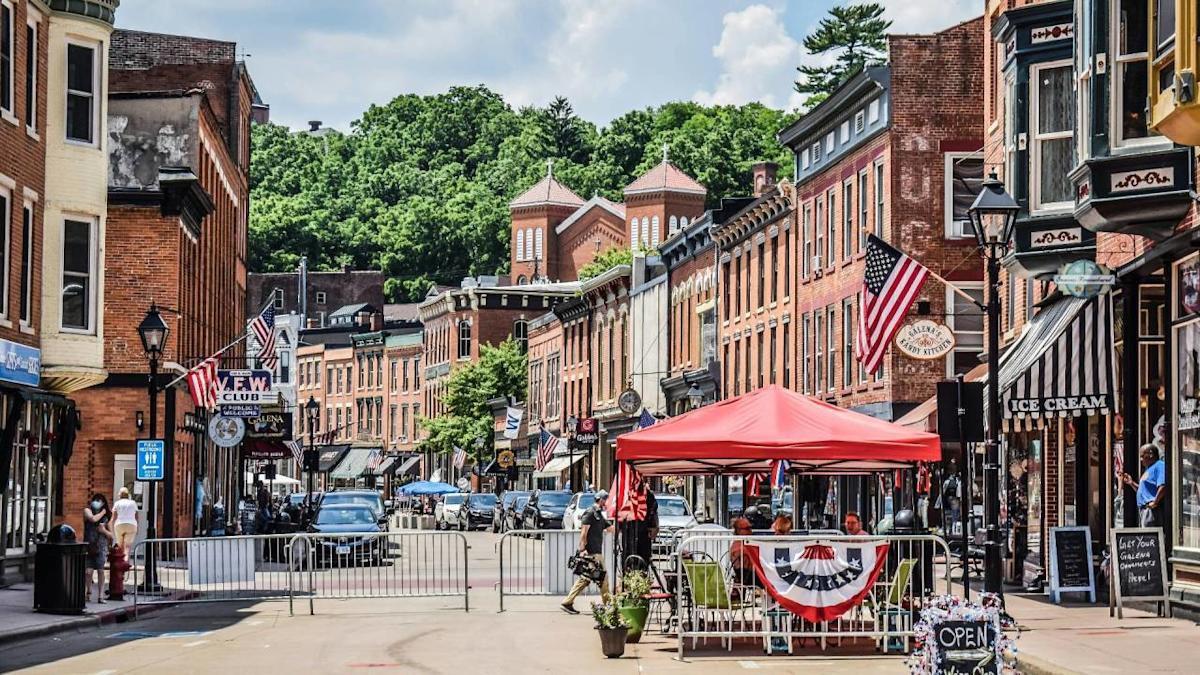
Why are you still planning a trip to a place you’ve already seen on thirty Instagram feeds? The most honest travel question of 2026 isn’t where should I go — it’s why do I keep going where everyone else goes? America’s second-tier cities and overlooked towns are having a moment that the travel industry is slow to admit. For retro road trips, outdoorsy getaways, and citywide revivals, these are the best places to go in the United States in 2026. But “best” rarely means “most crowded.” The places worth your time right now sit just outside the algorithm.
The eight most underrated towns in America right now — including Bisbee, Arizona and Bardstown, Kentucky — combine genuine local culture, affordable overnight costs under $150, and experiences you simply cannot replicate in Nashville or Sedona. Two of these towns are compared in full depth below. Both are worth the drive. Only one is right for your specific trip.
Eight Towns That Keep Showing Up on Serious Travelers’ Lists
Read more: 4 Hidden U.S. Towns Saving Travelers $935 in 2026
Ten underrated American towns repeatedly appear in 2026 travel research: St. Augustine, Florida; Leavenworth, Washington; Fredericksburg, Texas; Solvang, California; Taos, New Mexico; Bardstown, Kentucky; Hood River, Oregon; and Bisbee, Arizona. What’s striking is the geographic spread. These aren’t cluster destinations. They’re lone outliers — a Bavarian village in the Cascade foothills, a copper-mining ghost town in Cochise County, a bourbon capital tucked into the Kentucky knobs.
America’s best-loved attractions are popular for a reason — but those seeking something beyond the obvious find rewards in under-the-radar spots. That tension — between validation and discovery — is exactly what drives travelers toward towns like these. And it’s why two of them deserve more than a bullet point.
Option A — Bisbee, Arizona: A Copper Town That Refuses to Be Forgotten
Bisbee sits in Cochise County, southeastern Arizona, 92 miles southeast of Tucson and 7 miles north of the Mexican border. Its current population hovers around 5,200 residents. The town was founded in as a copper mining settlement in the Mule Mountains. At its peak in the early 1900s, Bisbee was the largest city between St. Louis and San Francisco. That fact still catches people off guard.
The Lavender Pit Mine — an open-pit copper excavation half a mile wide — sits right at the edge of town like a geological scar you can’t look away from. Entry to the overlook is free. The Queen Mine Tour runs $13 per adult and takes you 1,500 feet underground by mine cart. It operates Tuesday through Sunday and lasts roughly 75 minutes. Book ahead; it sells out on weekends between March and May.
Old Bisbee’s downtown is a compact grid of Victorian-era buildings crammed into a canyon. There are no chain restaurants on Main Street. The Copper Queen Hotel, opened in , charges around $120 per night for a standard room — that’s roughly what a Motel 6 costs in Phoenix right now, but with 124 years of character built in. The Bisbee Grand Hotel offers rooms from $85.
The artistic community here is real, not curated. Roughly 40 independent galleries and studios operate within walking distance of Brewery Gulch. The annual Bisbee 1000 stair climb — held each October — draws over 1,200 participants who run the town’s 1,034 outdoor stairs carved into hillside neighborhoods. This isn’t a manufactured festival. The stairs exist because there was no other way to build houses on these slopes.
One traveler described arriving somewhere unexpected after a difficult life transition and simply looking up at the scenery — that moment of perspective shifting everything. Bisbee has exactly that quality. The sky above the Mule Mountains at dusk does something to your sense of scale that Sedona, with all its red rocks and resort spas, simply doesn’t replicate. And your dollar goes roughly 40% further here.
Weather note: Bisbee’s elevation keeps summer highs in the mid-80s°F when Tucson hits 108°F. It’s one of the few Arizona destinations that’s genuinely comfortable from June through September. Average annual rainfall is 15 inches — more than Tucson, enough to keep the hills green.
Option B — Bardstown, Kentucky: The Bourbon Capital the World Still Underestimates
Bardstown is the county seat of Nelson County, Kentucky. Population: approximately 14,000. It sits 40 miles southeast of Louisville on U.S. Route 31E. Founded in , it’s one of the oldest cities west of the Allegheny Mountains. Bourbon has been distilled in Nelson County continuously since the late 1700s — longer than most American states have existed.
The Kentucky Bourbon Trail runs directly through Bardstown. Within a 20-minute drive, you’ll find Heaven Hill Distillery, Barton 1792 Distillery, Willett Distillery, and Maker’s Mark (in nearby Loretto, 18 miles away). Heaven Hill’s Bourbon Heritage Center offers tastings starting at $12. The Barton 1792 distillery tour is free. Free. That’s a rare word in experiential travel in 2026.
Downtown Bardstown’s courthouse square is genuinely handsome — a Federal-style courthouse from surrounded by independent restaurants and antique shops. The Old Talbott Tavern on Court Square has been operating since and claims to be one of the oldest western stagecoach stops in America. A full bourbon dinner for two at Old Talbott runs approximately $65 including drinks — roughly what you’d pay for one cocktail at a trendy Louisville rooftop bar.
My Old Kentucky Home State Park sits on the edge of town. It houses Federal Hill mansion, the antebellum estate that inspired Stephen Foster’s My Old Kentucky Home. Admission is $12 for adults, $7 for children. The outdoor musical drama staged here each summer draws crowds from across the state — tickets run $30. It’s the kind of regional culture that simply doesn’t exist elsewhere.
Overnight costs are modest. The Hampton Inn Bardstown runs around $109 per night. The Maple Hill Manor B&B — a Greek Revival estate built in , 13 miles from downtown in Springfield — charges $135 to $165 per night and includes a farm breakfast with eggs from their own chickens. That’s the same price point as a generic Hampton Inn in Nashville, except it comes with 174 years of architecture and alpacas on the front lawn.
Lesser-visited spots across America are well worth the trek, and some offer experiences that famous destinations actively cannot provide. Bardstown’s authenticity is the product of genuine history, not a tourism rebrand. The distilleries were here before the Bourbon Trail signs. The tavern predates the United States Constitution.
The “underrated” label has a shelf life. Bisbee has appeared on so many “hidden gem” lists since that weekend crowds in March now rival Jerome, Arizona. Bardstown’s bourbon tourism has grown fast enough that distillery tours require advance reservations most weekends. Both towns risk losing the very quality that made them worth visiting. If authenticity is your goal, visit on a Tuesday in November. Avoid the curated festival calendar. Walk away from the tour groups.
Natchitoches, Louisiana: The State’s Oldest City Nobody Talks About
Natchitoches Parish, Central Louisiana | Pop. 17,958 | Founded
New Orleans gets the Louisiana spotlight. Always. Meanwhile, Natchitoches — pronounced NAK-uh-tish, a point locals will correct immediately — sits three hours northwest on Cane River Lake with a 33-block National Historic Landmark District and zero line at the front door.
This is the oldest permanent European settlement in the Louisiana Purchase territory. That predates New Orleans by four years. The brick-paved Front Street runs along a 35-mile oxbow lake that was once the Red River. Spanish moss drips from live oaks older than the nation itself.
The town appeared in the 1989 film Steel Magnolias. That cultural moment faded. The town stayed exactly itself. Bed and breakfasts in antebellum homes run $110–$175 per night, roughly half what a comparable property costs in the French Quarter. The Cane River Creole National Historical Park, managed by the National Park Service, protects two working cotton plantations — Oakland and Magnolia — within driving distance. Entry is free.
Eat a meat pie from Lasyone’s on Second Street. The restaurant has operated since . The Natchitoches meat pie — ground beef and pork, fried in a half-moon pastry — is a distinct regional dish with almost no national profile. That’s the point.
- Distance from Shreveport: 67 miles south on US-84
- Average hotel rate (downtown): $119/night
- Cane River Creole NHP admission: Free
- Best months: October–April (summers are brutal at 95°F+)
- Nearest airport: Shreveport Regional (SHV), 1 hr 10 min
Astoria, Oregon: The Pacific Northwest’s Forgotten First City
Read more: 15 Hidden American Towns Locals Love (Most Have Never Heard Of)
Clatsop County, Northwest Oregon | Pop. 9,477 | Founded
Portland absorbs every travel dollar headed to Oregon. Astoria, perched at the Columbia River’s mouth where it meets the Pacific, sits 96 miles northwest of Portland and operates in near-total obscurity. It was the first American city established west of the Rocky Mountains. Most Americans couldn’t place it on a map.
The city climbs steep hills lined with Victorian houses in various states of restoration. The Astoria Column rises 125 feet above Coxcomb Hill and has stood since . Climb 164 interior steps. The view spans the river, the bridge, and the open Pacific on clear days. Admission costs $5 per vehicle for parking. The climb itself is free.
The 4.1-mile Astoria-Megler Bridge — completed in — is the longest continuous truss bridge in North America. You drive across it into Washington State. That crossing alone is worth stopping for.
Fort Clatsop, where Lewis and Clark wintered in –, sits six miles southeast. The Lewis and Clark National Historical Park charges $15 per adult for entry. Rangers lead demonstrations in the reconstructed fort. There are almost never crowds.
Hotel rates downtown average $139–$180 per night. The local food scene punches far above its weight. The Wet Dog Café and Astoria Coffeehouse both draw regulars from Portland who make the two-hour drive specifically for a weekend here. Rain is the constant companion — pack accordingly.
Astoria averages 66 inches of rain annually. July and August offer the only reliably dry windows. The fog can be theatrical — or maddening, depending on your tolerance for gray.
The Goonies () filmed here. The house still stands on 38th Street. Fans make pilgrimages. Locals tolerate this with measured patience.
Paducah, Kentucky: A UNESCO Creative City in the American Interior
McCracken County, Western Kentucky | Pop. 26,970 | Founded
In , UNESCO designated Paducah a Creative City of Crafts and Folk Art — one of only a handful of American cities to hold that distinction. It sits at the confluence of the Tennessee and Ohio Rivers in the far western corner of Kentucky, roughly equidistant between Nashville and St. Louis at about 150 miles from each.
The Lower Town Arts District contains more than 80 artist studios, galleries, and live-work spaces built through a city-backed redevelopment program that started in . The program offered artists deeds to vacant lots for $1 in exchange for building or renovating within a set timeline. It worked. The neighborhood transformed from abandoned to genuinely vital.
The National Quilt Museum — yes, an entire museum dedicated to quilts — opened here in and draws 35,000 visitors annually. The collection is legitimately remarkable. Admission runs $12 for adults. Dismiss it at your own loss.
The riverfront has been rebuilt with a floodwall mural stretching more than 50 panels depicting local history. Dinner at Kirchhoff’s Bakery or Freight House will run you $18–$28 per person. Hotel rooms downtown average $105–$140 per night.
“Paducah doesn’t try to be anything other than what it is. That’s increasingly rare in American travel.”
— Undiscovered America field notes,
Truth or Consequences, New Mexico: The Strangest Town Name in the Country Earns It
Sierra County, South-Central New Mexico | Pop. 5,846 | Renamed
The town was called Hot Springs until , when a radio game show offered to broadcast its 10th anniversary episode from any town willing to rename itself after the program. Hot Springs, New Mexico took the offer. The show was called Truth or Consequences. The name stuck.
Beneath the joke is a genuinely compelling destination. The town sits on Elephant Butte Lake, New Mexico’s largest reservoir, with 36,500 surface acres of turquoise water ringed by desert. The Rio Grande flows through here on its way south to the Texas border. The thermal springs that gave the town its original name still run hot at 98–115°F and feed dozens of small bathhouses along Broadway.
A private thermal soak at one of the downtown bathhouses runs $15–$25 per person per hour. The mineral content — calcium, magnesium, sodium bicarbonate — has attracted people for at least 5,000 years. The Geronimo Springs Museum documents Indigenous history and the region’s geology for $4 admission.
Spaceport America, humanity’s first purpose-built commercial spaceport, sits 28 miles east near Upham. Virgin Galactic has operated launch missions from the site since . Tours cost $59–$75 per adult. The contrast between ancient thermal springs and an active commercial space facility, both within a half-hour of each other, is the kind of American weirdness no travel algorithm generates.
T or C sits at 4,242 feet elevation. Summers hit 100°F but humidity stays below 20%. Winters are mild by national standards — January lows average 28°F. Spring and fall are close to perfect. Drive time from Albuquerque: 2 hours 15 minutes south
Frequently Asked Questions

You Might Also Like

Hohhot Shengle Airport Just Unlocked Something Northern China Never Had
On March 10, 2026, Inner Mongolia crossed a threshold it had never reached before in…
SkyWest and Gulf Air Cancel Flights Across Multiple Days Leaving Passengers Stranded
Five flights cancelled. Two airlines. Two countries. And hundreds of passengers left scrambling across routes…
Puligundala Is Quietly Becoming Telangana’s Most Talked-About Birdwatching Escape
A 20,000-hectare forest tucked across the districts of Khammam and Kothagudem in Telangana has quietly…
Leave a Reply