
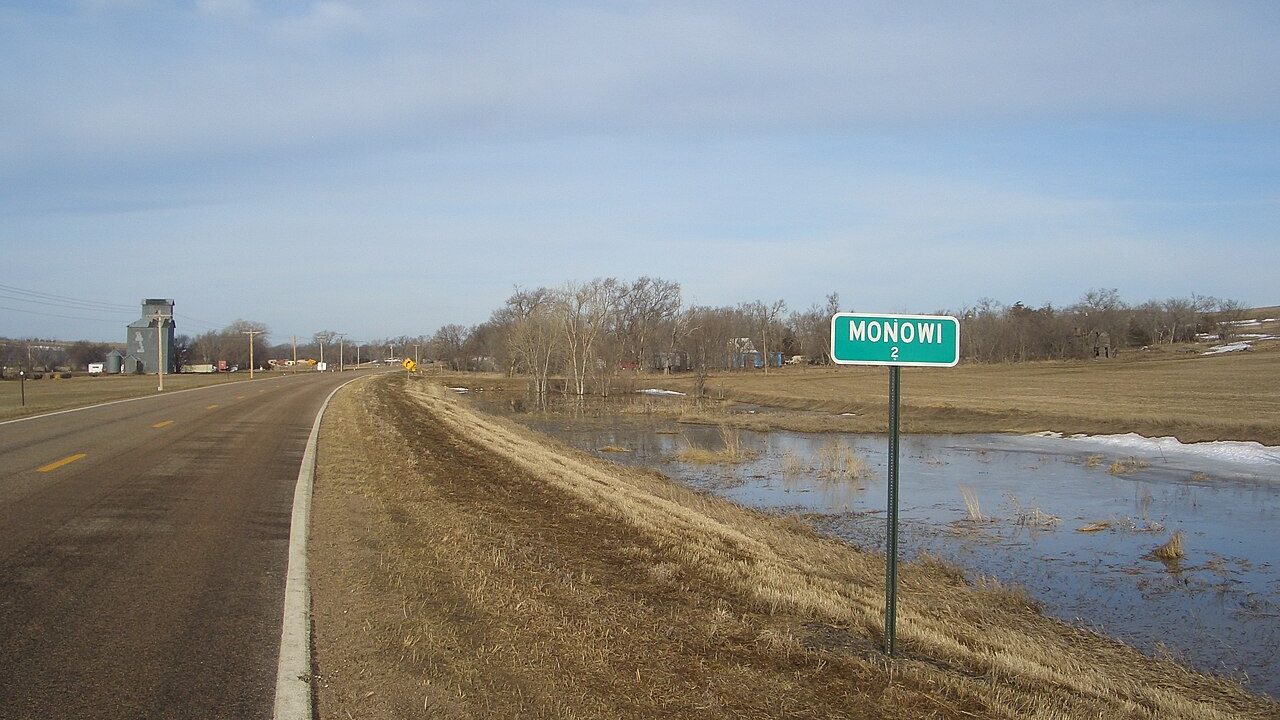
In 1930, the town of Monowi, Nebraska counted roughly 150 residents on its census rolls. By 2020, according to the U.S. Census Bureau, that number had fallen to exactly one — making Monowi the only incorporated municipality in the United States with a single full-time resident.
That resident is Elsie Eiler, who at approximately 87 years old serves simultaneously as the town’s mayor, city clerk, city treasurer, librarian, and sole proprietor of the Monowi Tavern. Each year, she submits a liquor license application to the state of Nebraska — and then, in her official capacity as mayor, approves it herself.
A Town That Shrank for a Century, Then Stopped at One
Monowi sits in the rolling sandhills of Boyd County in north-central Nebraska. The village was platted and incorporated in the early twentieth century, reaching its demographic peak during the agricultural boom of the 1920s and 1930s, when it supported a school, a post office, and several commercial businesses.
What followed was a trajectory familiar across the rural Great Plains: outmigration driven by mechanized farming, the consolidation of small schools into larger regional districts, and the loss of local rail service. By the 1980s, Monowi’s population had fallen into single digits. By 2004, when Rudy Eiler died after a prolonged illness, Elsie was the last resident remaining.
Nebraska state law permits incorporated municipalities to retain their official status regardless of population size, provided they continue fulfilling basic civic functions. According to the Nebraska Secretary of State’s office, Monowi remains a legally recognized incorporated village. Eiler files the required annual municipal reports, adopts ordinances, and conducts what amount to one-person town meetings to satisfy state requirements.
Rural demographers at the University of Nebraska-Lincoln have documented dozens of Nebraska communities with populations under 100, but none match Monowi’s singular legal status. The broader contraction reflects decades of farm consolidation and the shifting economics of large-scale row-crop agriculture across the interior West.
The Job Description: Mayor, Clerk, Treasurer, Bartender, and Librarian
Eiler has operated the Monowi Tavern for decades, functioning as its cook, bartender, and only employee. The bar draws a modest but consistent stream of visitors — farmers from the surrounding Boyd County area, tourists who have read about the town, and journalists from outlets as far away as Germany and Japan. On a busy afternoon, the tavern’s gravel parking lot holds more vehicles than the town has residents.
Beyond the tavern, Eiler maintains Rudy’s Library — a small standalone building adjacent to the bar that houses approximately 5,000 books collected by her late husband throughout his lifetime. Rudy Eiler was a dedicated reader, and the library stands as a public memorial to him, accessible to any visitor who stops in. Admission is free. There is no formal librarian on staff — except, again, Elsie.
The annual liquor license cycle illustrates the peculiar logic of Monowi’s governance. Under Nebraska law, a municipality must formally approve any liquor license issued within its borders. Eiler submits the application, convenes a municipal meeting with herself in attendance, and votes to approve. She has repeated this process every year since 2004 without interruption.
How One Woman Keeps a Ghost Town Legally Alive
Nebraska’s municipal code does not establish a minimum population threshold for maintaining incorporated status — a legal reality that has allowed Monowi to persist on official maps long after comparable communities in neighboring states were formally dissolved. Kansas and Iowa have each decommissioned dozens of small municipalities over the past three decades when civic functions lapsed.
The practical benefits of maintained incorporation are limited but real. Monowi qualifies for certain state infrastructure allocations — including road maintenance funding — that unincorporated rural areas cannot access. Eiler applies for those funds annually through the same process she uses for the liquor license: she submits the application and then, as the municipal authority, certifies the request.
Civic law scholars have cited Monowi as an edge case that exposes the structural assumptions embedded in American municipal governance — frameworks built for communities of hundreds or thousands that contain no provisions for a population of one. The University of Nebraska’s Rural Futures Institute has referenced the town in ongoing research into demographic collapse across the Great Plains region.
What Monowi Looks Like on the Ground — and Who Still Shows Up
The physical footprint of the village is sparse: the tavern, the library, a cluster of deteriorating structures, and a grain elevator that has stood silent for years. Boyd County itself — Monowi’s home county — has a total population of approximately 1,900 people distributed across roughly 540 square miles, making it among the least densely populated counties in the contiguous United States.
International media attention has brought a measurable uptick in tourism over the past decade. BBC News, the German magazine Der Spiegel, and multiple Japanese television broadcasters have produced segments on Eiler and Monowi, drawing visitors from Europe and Asia to a stretch of north-central Nebraska that most Americans could not locate on a map. The tavern charges no cover fee; a meal and a drink run under $20 for most orders, consistent with rural Nebraska pricing.
What draws people to Monowi is not amenity or spectacle. It is the specific weight of a place that by every demographic projection should no longer exist — kept alive by one woman’s refusal to abandon the town where she and her husband built their lives. Whether Monowi survives beyond Elsie Eiler is a question that Boyd County officials and state administrators have not publicly addressed. For now, the village holds: one resident, one bar, one library, and a municipal government of exactly one.
Frequently Asked Questions

You Might Also Like
Bisbee, Arizona: The Copper Ghost Town 90 Miles From Tucson Nobody Talks About
Bisbee, Arizona — a copper ghost town 92 miles from Tucson — offers Victorian architecture,…
A Montana Town of Fewer Than 500 People Has Kept the Same General Store Running for 125 Years — Until Now
The Fishtail General Store, Montana's oldest continuously operating general store at 125 years, is preparing…
Bisbee to Bardstown: 8 Hidden US Towns Under $150/Night
8 underrated US towns — including Bisbee, AZ and Bardstown, KY — offer real local…
Leave a Reply