
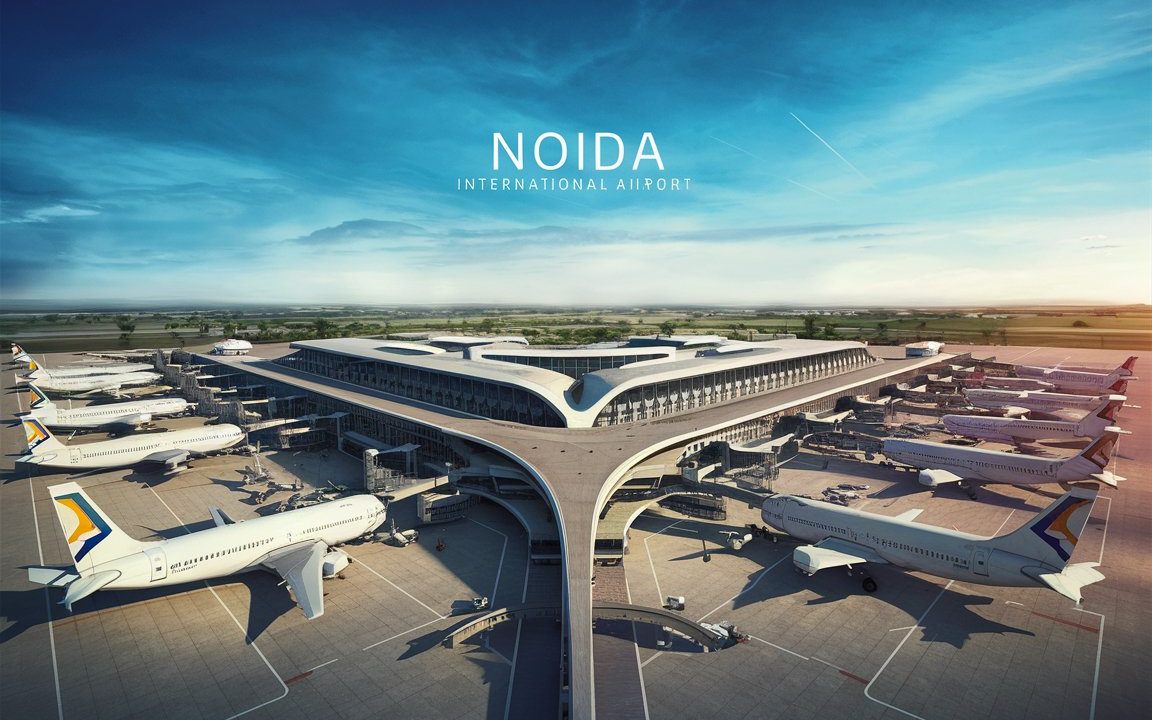
Within the next 45 to 60 days, one of India’s most anticipated new airports is expected to welcome its first commercial passengers — and the scale of what’s being built in Jewar, Uttar Pradesh is genuinely striking. Noida International Airport, inaugurated by Prime Minister Narendra Modi, is preparing to launch flight operations with a capacity that will eventually serve up to 70 million passengers annually once fully developed.
For now, the airport enters its first phase with the ability to handle 12 million passengers per year — a significant number in its own right, and a strong foundation for what planners envision as a major aviation hub for northern India. The project has attracted an investment of Rs 11,200 crore, and IndiGo has already expressed interest in operating flights from the new facility.
For travellers in and around the Delhi-NCR region, this is more than just a new terminal. It represents a genuine shift in how millions of people may access air travel in the years ahead.
(function(){var wrp=document.getElementById(“paap_stat_69cb35e2f06574.80171650”);if(!wrp)return;var ids=[“paap_stat_69cb35e2f06574.80171650_c0″,”paap_stat_69cb35e2f06574.80171650_c1”];var dur=1800;function ease(t){return 1-Math.pow(1-t,3);}function anim(){ids.forEach(function(id){var el=document.getElementById(id);if(!el)return;var tgt=parseFloat(el.getAttribute(“data-target”))||0;var pfx=el.getAttribute(“data-prefix”)||””;var sfx=el.getAttribute(“data-suffix”)||””;var dec=parseInt(el.getAttribute(“data-decimals”))||0;var st=null;function step(ts){if(!st)st=ts;var p=Math.min((ts-st)/dur,1);var v=ease(p)*tgt;el.textContent=pfx+v.toFixed(dec)+sfx;if(p<1)requestAnimationFrame(step);}requestAnimationFrame(step);});}if("IntersectionObserver" in window){var obs=new IntersectionObserver(function(e){e.forEach(function(en){if(en.isIntersecting){anim();obs.disconnect();}});},{threshold:0.2});obs.observe(wrp);}else{anim();}})();
What Noida International Airport Actually Is — and Why It Matters Now
Located in Jewar, Uttar Pradesh, Noida International Airport has been in development as a long-term solution to the growing air travel demand around the Delhi metropolitan region. The airport is distinct from Indira Gandhi International Airport and is designed to serve as an alternative gateway for passengers in Noida, Greater Noida, and surrounding areas who currently face long commutes to catch flights.
The first phase of the airport features a 3,900-meter runway — long enough to accommodate wide-body international aircraft — which signals that the airport’s ambitions extend well beyond domestic routes. With modern amenities built into the design from the ground up, the facility is positioned to compete with established hubs on both passenger experience and operational efficiency.
Prime Minister Narendra Modi inaugurated the airport, lending the project significant political and national visibility. The inauguration marked a milestone after years of planning, land acquisition, and construction work that drew attention from across India’s aviation sector.
The Key Numbers Behind the Airport’s First Phase
Understanding what the airport offers right now — versus what it is ultimately designed to become — helps frame just how large this project really is.
| Detail | Specification |
|---|---|
| Location | Jewar, Uttar Pradesh, India |
| Expected Launch Timeline | 45 to 60 days from inauguration |
| Phase 1 Annual Capacity | 12 million passengers |
| Full Development Capacity | 70 million passengers annually |
| Runway Length | 3,900 meters |
| Total Investment | Rs 11,200 crore |
| Airline Interest Confirmed | IndiGo |
(function(){function loadChartJs(cb){if(window.Chart){cb();return;}var s=document.createElement(“script”);s.src=”https://cdn.jsdelivr.net/npm/chart.js@4.4.0/dist/chart.umd.min.js”;s.onload=cb;document.head.appendChild(s);}function initChart(){var cv=document.getElementById(“paap_chart_69cb35e2f06d81.74353858”);if(!cv)return;var dv=[“12 Million/year”,”70 Million/year”];new Chart(cv,{type:”bar”,data:{labels:[“Phase 1 Capacity”,”Full Development Capacity”],datasets:[{data:[12,70],backgroundColor:[“#3b82f6″,”#10b981″],borderRadius:6,borderSkipped:false}]},options:{indexAxis:”y”,responsive:true,maintainAspectRatio:false,animation:{duration:1200,easing:”easeOutQuart”},plugins:{legend:{display:false},tooltip:{callbacks:{label:function(ctx){return dv[ctx.dataIndex]||ctx.formattedValue;}}}},scales:{x:{grid:{color:”#e5e7eb”},ticks:{color:”#6b7280″}},y:{grid:{display:false},ticks:{color:”#1a1a1a”,font:{weight:600}}}}}});}var cv=document.getElementById(“paap_chart_69cb35e2f06d81.74353858”);if(!cv)return;if(“IntersectionObserver” in window){var obs=new IntersectionObserver(function(e){e.forEach(function(en){if(en.isIntersecting){loadChartJs(initChart);obs.disconnect();}});},{threshold:0.1});obs.observe(cv);}else{loadChartJs(initChart);}})();
The gap between 12 million and 70 million passengers is not just a number — it represents multiple future phases of construction, additional terminals, and expanded airline networks that will unfold over the coming years as demand grows and infrastructure catches up.
What This Means for Passengers and the Region
For everyday travellers, the most immediate benefit is access. Anyone living in Noida, Greater Noida, or the surrounding districts of western Uttar Pradesh currently has to travel considerable distances to reach Indira Gandhi International Airport in Delhi. A functioning airport closer to home reduces travel time, road congestion, and the general stress of catching a flight.
IndiGo’s expressed interest in operating from the airport is an encouraging early signal. As India’s largest domestic carrier by market share, IndiGo’s presence at a new airport typically brings competitive fares and a wide network of domestic routes — which would make the airport genuinely useful for the average traveller from day one, rather than just a facility waiting for airlines to commit.
The 3,900-meter runway also opens the door to international operations, which could eventually allow passengers to fly directly to overseas destinations without routing through Delhi. That would be a meaningful shift for business travellers and the diaspora communities in the region.
From an economic standpoint, airports of this scale tend to catalyse development in surrounding areas — logistics hubs, hotels, commercial zones, and employment opportunities often follow. The Rs 11,200 crore investment signals long-term commitment, not a short-term project.
What Happens Between Now and the First Flight
With commercial operations expected within 45 to 60 days of the airport’s inauguration, the remaining weeks will be critical for finalising airline schedules, completing regulatory clearances, and ensuring all ground operations are ready for passenger handling.
IndiGo’s interest in the airport suggests that route announcements could come relatively soon, though specific schedules and destinations have not yet been confirmed. Passengers interested in flying from Noida International Airport should watch for official route and schedule releases from airlines in the coming weeks.
Over the longer term, the airport’s growth from its Phase 1 capacity of 12 million passengers toward its eventual ceiling of 70 million will depend on additional phases of construction and continued airline investment. That journey will likely unfold over years, but the foundation — a world-class runway, modern terminal infrastructure, and serious financial backing — is now in place.
For a region as large and economically active as the Delhi-NCR corridor, the arrival of a second major airport is not a small event. It is a structural change to how the area connects with the rest of India and the world.
Frequently Asked Questions
When will Noida International Airport start commercial flights?
The airport is expected to begin commercial flight operations within 45 to 60 days of its inauguration by Prime Minister Narendra Modi.
Where exactly is Noida International Airport located?
The airport is located in Jewar, Uttar Pradesh, India, within the broader Delhi-NCR region.
Which airlines will fly from Noida International Airport?
IndiGo has expressed interest in operating flights from the airport, though specific routes and schedules have not yet been officially confirmed.
How many passengers can the airport handle?
In its first phase, the airport can handle 12 million passengers annually. Once fully developed across all phases, total capacity is expected to reach 70 million passengers per year.
Will the airport handle international flights?
The airport’s 3,900-meter runway is capable of accommodating wide-body international aircraft, suggesting international operations are part of the long-term plan, though this has not been confirmed for the initial launch period.
How much did it cost to build Noida International Airport?
The airport has been developed with a total investment of Rs 11,200 crore.



Leave a Reply