
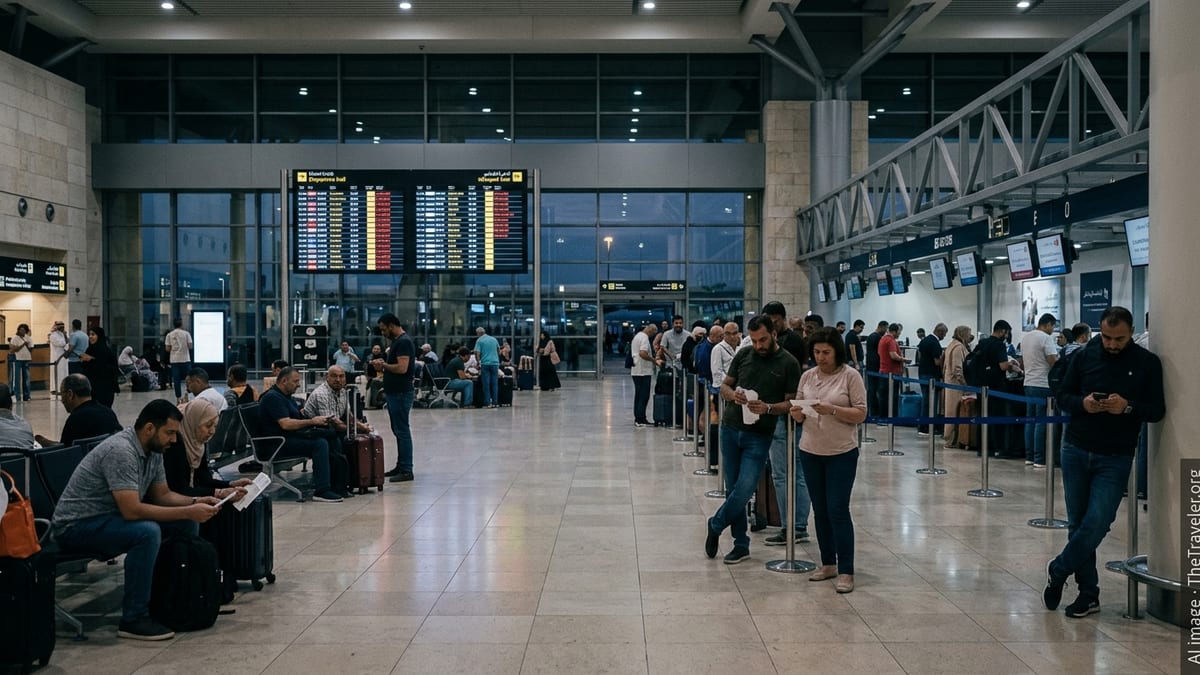
Twenty-eight flights canceled. Twenty-seven more delayed. Hundreds of passengers left waiting, rerouting, and scrambling for answers at one of the Middle East’s busiest transit hubs — that’s the scale of disruption that hit Queen Alia International Airport in Jordan, creating a ripple effect across some of the region’s most-traveled air corridors.
The chaos unfolded as severe weather conditions and operational challenges converged at the Amman airport, halting connections to major cities including Cairo, Doha, Damascus, Beirut, and Baghdad. For the passengers caught in the middle, the experience meant hours of uncertainty, missed connections, and no clear timeline for when normal service would resume.
Airlines including Royal Jordanian, Saudia, Emirates, Flynas, and Egypt Air were all affected, leaving travelers from multiple countries stranded with few immediate options.
What Happened at Queen Alia Airport
Queen Alia International Airport serves as a critical gateway connecting the Middle East, North Africa, and the Levant. On the day of the disruption, the combination of severe weather and operational strain pushed the airport’s capacity to a breaking point.
The scale was significant — 28 outright cancellations and 27 delays represent a substantial portion of daily flight operations, effectively grinding travel across multiple regional routes to a halt. Passengers heading to some of the busiest destinations in the Arab world found themselves stuck, with airlines struggling to accommodate the backlog.
The disruption was not isolated to a single carrier or a single route. It cut across the full spectrum of regional aviation, from budget carriers like Flynas to full-service operators like Emirates and Royal Jordanian, the country’s national airline.
Airlines and Routes Hit Hardest
The breadth of the disruption is what made this event particularly difficult to manage. When multiple airlines operating multiple routes all face simultaneous cancellations and delays, rebooking options shrink quickly — and passenger frustration rises sharply.
| Airline | Status |
|---|---|
| Royal Jordanian | Flights canceled and delayed |
| Saudia | Flights canceled and delayed |
| Emirates | Flights canceled and delayed |
| Flynas | Flights canceled and delayed |
| Egypt Air | Flights canceled and delayed |
Routes affected by the disruptions included connections to:
- Cairo, Egypt
- Doha, Qatar
- Damascus, Syria
- Beirut, Lebanon
- Baghdad, Iraq
These are not minor regional routes. Cairo, Doha, and Beirut in particular are high-frequency corridors used by business travelers, families, and transit passengers moving between continents. A disruption at this scale doesn’t just affect the people sitting in Amman’s terminal — it sends a shockwave through connecting itineraries across Europe, Asia, and beyond.
Why This Kind of Disruption Hits Harder in the Middle East
Regional airports in the Middle East serve a unique dual function. They are both origin-and-destination hubs for local travelers and critical layover points for long-haul passengers routing between Asia, Africa, and Europe. When a hub like Queen Alia experiences mass cancellations, the downstream effects multiply quickly.
A passenger flying from Amman to Beirut may have an onward connection to London. A traveler from Baghdad transiting through Amman to Cairo may be connecting to a flight to West Africa. Each canceled flight doesn’t just affect one journey — it can unravel an entire travel chain.
The involvement of a carrier like Emirates — which operates some of the world’s busiest long-haul routes — underscores how quickly a regional weather event can become an international travel problem.
Severe weather disruptions also tend to disproportionately affect passengers who have fewer resources to absorb the cost of rebooking hotels, meals, and alternative flights. For many travelers on this day, the disruption wasn’t just an inconvenience — it represented a real financial and logistical burden.
What Stranded Passengers Were Facing
When dozens of flights are canceled simultaneously at a single airport, the immediate pressure falls on airline ground staff and airport services to manage hundreds of frustrated travelers at once. Rebooking queues grow long. Hotel accommodation for stranded overnight passengers becomes scarce. Communication from airlines — always a pressure point during mass disruptions — often lags behind what passengers need to make decisions.
Passengers affected by the Queen Alia disruptions were left scrambling to find alternative travel arrangements amid ongoing uncertainty, according to reports. With five major airlines all simultaneously affected, the usual option of switching to a competing carrier on the same route became significantly more difficult.
Travelers with time-sensitive commitments — medical appointments, business meetings, family emergencies — faced the sharpest consequences. In disruptions of this scale, there are rarely easy answers, and the burden of finding solutions often falls on the passengers themselves.
What Travelers Should Know Going Forward
If you’re planning travel through Queen Alia International Airport, or on any of the affected routes, there are practical steps worth taking in the aftermath of a disruption like this.
- Check your airline’s rebooking policy — most major carriers offer fee-free rebooking during weather-related disruptions, but you typically need to proactively request it.
- Monitor flight status in real time — airport and airline apps are often faster than gate announcements during high-disruption periods.
- Know your passenger rights — rules vary by country and airline, but travelers on many international routes are entitled to meals, accommodation, or compensation depending on the cause and length of delay.
- Consider travel insurance — events like this are exactly the scenario travel insurance is designed for, particularly policies that cover trip interruption and accommodation costs.
There is no confirmed timeline yet for when full normal operations resumed at Queen Alia, and the full extent of passenger impact — including how many travelers were rebooked and how quickly — has not been officially detailed.
Frequently Asked Questions
How many flights were canceled at Queen Alia Airport during this disruption?
Twenty-eight flights were canceled and an additional 27 were delayed, according to reports on the incident.
Which airlines were affected by the Queen Alia Airport disruptions?
Royal Jordanian, Saudia, Emirates, Flynas, and Egypt Air were all reported to have had flights canceled or delayed.
Which destinations were most affected by the cancellations?
Routes to Cairo, Doha, Damascus, Beirut, and Baghdad were among those disrupted during the event.
What caused the flight cancellations and delays?
Reports indicate the disruptions were primarily caused by severe weather conditions combined with operational challenges at the airport.
Were passengers offered alternative flights or compensation?
This has not yet been confirmed in available reporting. Passengers are advised to contact their airline directly regarding rebooking and compensation options.
Is Queen Alia Airport back to normal operations?
A confirmed timeline for the full restoration of normal operations has not been officially detailed in available reports.



Leave a Reply