
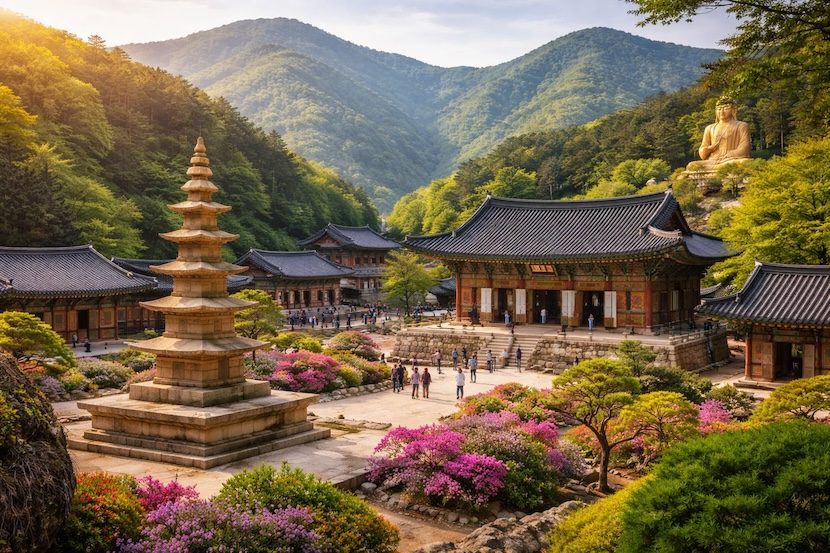
South Korea’s Buddhist temples have stood for more than a thousand years — and for travellers willing to step off the beaten path, they offer something that no city skyline or shopping district can replicate: genuine stillness in places of extraordinary beauty.
Whether perched on forested mountain slopes, tucked beside mountain rivers, or set against dramatic coastal cliffs, these sacred sites draw visitors from across the globe not just for their architecture, but for the living culture still thriving inside their walls. Monks still chant here at dawn. Incense still drifts through pine-scented courtyards. And for those who want to go deeper, many temples open their doors to overnight guests through formal temple stay programmes.
South Korea’s temple landscape is one of Asia’s most underrated travel experiences — and understanding what makes these sites special is the first step to planning a journey worth taking.
Why South Korea’s Temples Are More Than a Photo Stop
Buddhism arrived on the Korean peninsula more than 1,600 years ago, and its influence is written into the landscape itself. Temples were deliberately built in remote mountain settings — partly for spiritual reasons, partly to survive centuries of conflict and invasion. That isolation is now one of their greatest gifts to travellers: you have to make some effort to reach them, and that effort is always rewarded.
What separates South Korea’s temples from similar sites elsewhere in Asia is how actively they engage visitors. These aren’t frozen museum pieces. Ceremonies happen on a regular calendar. Resident monks maintain daily routines that visitors can observe, and in many cases, participate in. The cultural programming is real, structured, and genuinely immersive.
The temple stay programme — offered at dozens of sites across the country — is perhaps the most compelling example. Participants sleep in traditional monks’ quarters, wake before sunrise for meditation, share communal meals, and experience a pace of life that feels entirely removed from modern South Korea’s famously fast tempo.
What to Know Before You Visit South Korea’s Most Beautiful Temples
Every temple has its own character, setting, and practical requirements. Some are easy day trips from major cities. Others require hiking trails and mountain roads. Here’s a general framework for what travellers should understand before planning their route.
| Feature | What to Expect |
|---|---|
| Setting | Mountain forests, riverside locations, and coastal cliffs — most require some walking to reach |
| Age of Sites | Many temples are several centuries old; some date back over a thousand years |
| Visitor Activities | Meditation sessions, traditional ceremonies, guided cultural tours, and temple stay programmes |
| Temple Stay Programmes | Available at dozens of temples; include overnight accommodation, meals, and structured activities |
| Best Access | Varies by site — some are reachable by public transport, others require private travel or hiking |
| Cultural Sensitivity | Dress modestly, follow posted rules, and observe silence in worship areas |
One thing consistent across all these sites: the architecture. Traditional Korean Buddhist temple design follows a recognisable pattern — tiered wooden halls painted in deep reds, greens, and blues, stone pagodas rising above courtyard walls, and lanterns strung between ancient trees. The visual language is distinctive and immediately striking, even for visitors with no background in Buddhist art.
The Real Experience: Spirituality, Nature, and Living Culture
For many international visitors, the appeal of South Korea’s temples lies in the combination of natural and spiritual immersion. These aren’t sites you walk through in twenty minutes with a selfie stick. The mountain settings mean that simply reaching a temple often involves a walk through forested trails, past streams and stone bridges — a journey that feels intentional before you even arrive.
Travellers who participate in temple stay programmes consistently describe it as one of the most memorable parts of any South Korea itinerary. The structured nature of the experience — early mornings, communal silence, simple food, guided meditation — creates a counterpoint to the intensity of cities like Seoul or Busan that many visitors find genuinely restorative.
Cultural preservation is another dimension worth noting. These temples aren’t maintained purely for tourism. They are active religious institutions, and the ceremonies, rituals, and monastic routines visitors observe are real — not staged. That authenticity is what gives them their lasting impression.
Planning Your Temple Journey Through South Korea
The most practical advice for travellers is to treat temple visits as the centrepiece of a trip, not an afterthought. Build time around them. Stay overnight if the opportunity exists. Allow for the approach — the walk through the forest, the sound of the mountain — to be part of the experience rather than something to rush through.
Spring and autumn are widely considered the best seasons for temple visits in South Korea. Cherry blossoms frame temple gates in April. Maple and ginkgo leaves turn the mountain forests gold and red in October and November. Winter visits, while colder, bring a particular quiet that suits the meditative atmosphere of these places.
For travellers coming from outside Asia, South Korea’s temples represent a form of cultural immersion that requires no prior knowledge of Buddhism to appreciate. The beauty is accessible. The welcome is genuine. And the experience of standing in a centuries-old courtyard, listening to bells echo across a mountain valley, is one that stays with you long after the trip ends.
Frequently Asked Questions
What is a temple stay programme in South Korea?
Temple stay programmes allow visitors to spend one or more nights at a Buddhist temple, participating in activities such as meditation, traditional ceremonies, and communal meals alongside resident monks.
Do I need to be Buddhist to visit South Korea’s temples?
No. South Korea’s temples welcome visitors of all backgrounds, and no prior knowledge of Buddhism is required to participate in cultural or temple stay programmes.
Are South Korea’s temples easy to reach from major cities?
Access varies significantly — some temples are reachable by public transport, while others require private travel, hiking trails, or mountain roads to reach.
What is the best time of year to visit South Korean temples?
Spring and autumn are generally considered the most scenic seasons, with cherry blossoms in April and vivid foliage in October and November framing many temple settings.
How old are South Korea’s Buddhist temples?
Many temples are several centuries old, and some date back over a thousand years, reflecting Buddhism’s arrival on the Korean peninsula more than 1,600 years ago.
What should visitors wear to a South Korean temple?
Modest dress is expected at all temple sites — shoulders and knees should be covered, and visitors should follow any posted guidelines about appropriate attire in ceremonial spaces.


Leave a Reply