
Most people who visit Sri Lanka go for the beaches. They spend a week in Mirissa or Unawatuna, eat good seafood, and fly home thinking they have seen the country. They have not. They have seen the hem of a much larger garment.
Sri Lanka is, in fact, one of the most layered destinations in all of Asia. Within a single, compact island, you can stand inside a 2,000-year-old royal capital, spot wild elephants at a waterhole, drink fresh-picked tea at 6,000 feet of elevation, and watch the Indian Ocean turn gold at sunset — all in the span of four days. No other destination in the region offers that density of experience at that geographic scale.
The country is experiencing a travel resurgence in 2026, as visitor numbers recover and new boutique lodge infrastructure opens across the Cultural Triangle and the highlands. This is the right moment to understand what Sri Lanka actually contains.
The Ancient Capitals: Anuradhapura, Polonnaruwa, and the Staggering Weight of 2,500 Years
Travelers who skip the Cultural Triangle make a serious mistake. The ruins of Anuradhapura and Polonnaruwa are not dusty footnotes to a beach holiday. They are among the most significant archaeological sites in all of Southern Asia.
Anuradhapura served as Sri Lanka’s capital for over a thousand years, from roughly the 4th century BCE until the late 10th century CE. The ruins spread across a vast area and include enormous dagobas (Buddhist stupas) that still dominate the skyline, ancient irrigation tanks, and the sacred Sri Maha Bodhi — a fig tree said to be a cutting of the original Bodhi Tree under which the Buddha attained enlightenment. It is reputedly the oldest living human-planted tree on record.
Just two hours away by road sits Polonnaruwa, the medieval successor capital. Its entry fee is $25, and it is worth every cent. Wandering among the ruins of palaces, stupas, monastic gardens, and sculptures carved with extraordinary precision almost a thousand years ago delivers the kind of historical jolt that very few places on earth still provide. The site is compact enough to explore by bicycle or tuk-tuk, which keeps the experience intimate rather than exhausting.
| Site | Era | Entry Fee | Best Way to Explore |
|---|---|---|---|
| Anuradhapura | 4th century BCE – 10th century CE | ~$25 | Bicycle or tuk-tuk |
| Polonnaruwa | 10th – 13th century CE | $25 | Bicycle or guided walk |
| Sigiriya | 5th century CE (Kashyapa’s reign) | ~$30 | Guided climb |
| Temple of the Sacred Tooth Relic | 17th century CE (current structure) | ~$10 | Walking |
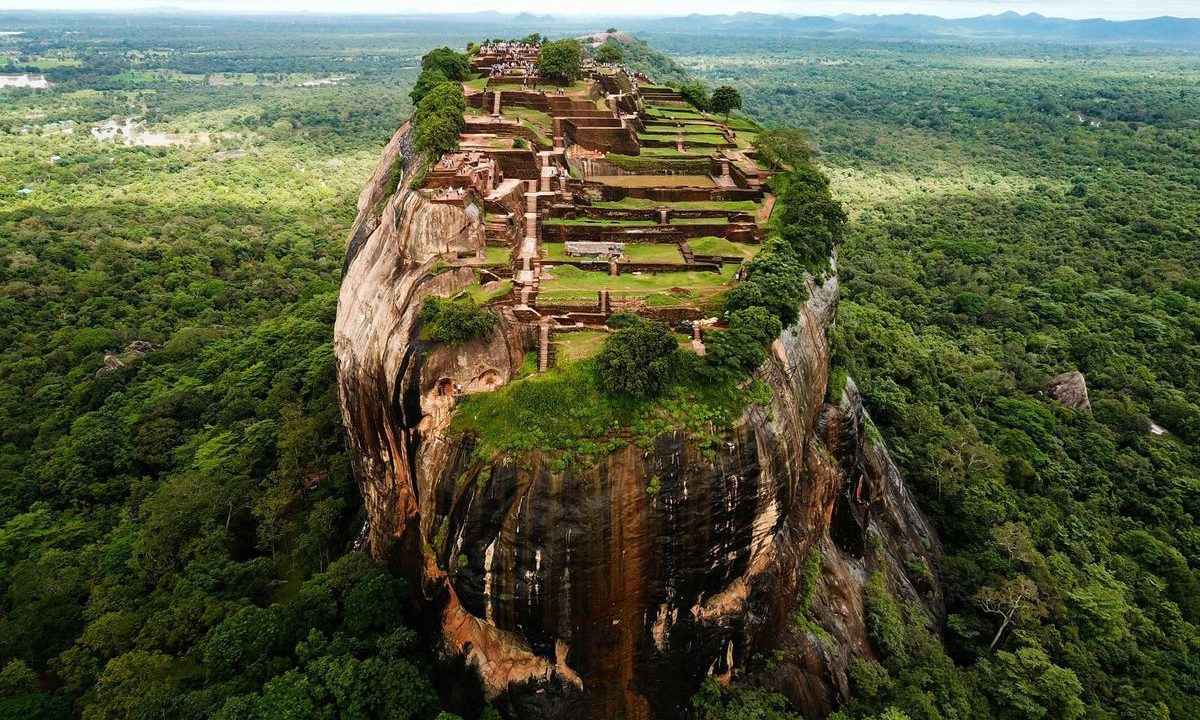
Then there is Sigiriya. Originally built as a royal palace by King Kashyapa in the 5th century CE, the fortress rises 200 meters above the surrounding jungle on a single volcanic rock. After Kashyapa’s death, it became a Buddhist monastery, and it is now a UNESCO World Heritage Site. The climb involves ancient staircases, galleries of frescoes painted directly into the rock face, and two enormous lion paws carved in stone that mark the final ascent. At the top, the ruins of a palace garden, bathing pools, and throne platform spread out across a space that feels surreal given its elevation.
Nearby Pidurangala Rock, with a rating of 4.8 out of 5 from over 2,600 reviews, offers the best panoramic view of Sigiriya itself and has become a popular alternative climb for photographers seeking the full-rock silhouette at sunrise.
National Parks and Wildlife: Sri Lanka’s 26-Park System Punches Well Above Its Weight
Sri Lanka has 26 national parks covering roughly 14 percent of its total land area. That is a remarkable conservation commitment for a densely populated island nation.
Udawalawe National Park, rated 4.6 from more than 3,800 visitor reviews, is widely considered the best place in Asia to observe wild Asian elephants in their natural habitat. The park was created specifically to protect elephants displaced by the Udawalawe Reservoir construction in 1972, and its open grassland terrain makes sightings far more reliable than in the denser jungles of India or Myanmar. A morning jeep safari here routinely yields herds of 20 to 50 elephants moving freely across the floodplain.
Yala National Park in the southeast is famous for having one of the world’s highest densities of wild leopards. Sightings are not guaranteed, but the park’s dry-zone landscape of lagoons, scrub forest, and rock outcrops makes it a genuinely exciting safari environment. Minneriya National Park, in the Cultural Triangle, hosts the famous Gathering, an annual congregation of hundreds of Asian elephants around the receding Minneriya Tank between July and October.
Sri Lanka also offers whale watching off the southern coast near Mirissa from December through April, with blue whales and sperm whales regularly sighted just a few nautical miles offshore. These are among the largest animals ever to have existed on Earth, and the accessibility of the viewing here is extraordinary.
“An adventure through the spellbinding South Asian nation of Sri Lanka, from ancient fortresses and temples to luxurious tea plantations, reveals a country that rewards travelers willing to move beyond the obvious.”
— Outdoor Journal
Hill Country and Tea Plantations: Nuwara Eliya and the Landscape That Doesn’t Look Like Asia
Few first-time visitors expect what they find when they climb into Sri Lanka’s central highlands. The landscape shifts dramatically above 4,000 feet. Temperatures drop to jacket weather. Waterfalls thread through steep valleys. And the hillsides are blanketed in the precise geometric green of tea bushes as far as the eye can reach.
Nuwara Eliya sits at roughly 1,868 meters above sea level and carries an unexpected colonial atmosphere, with Tudor-style architecture, a horse racing track, and a hill station sensibility that feels transplanted from another continent. The surrounding landscape is best explored over two days, allowing time for both the tea factory tours and the hiking trails across Horton Plains National Park.
Horton Plains is a highland plateau at 2,100 meters, famous for World’s End, a sheer cliff that drops 870 meters into the southern lowlands. On clear mornings, the view is unobstructed across what feels like half the island. The plateau is also one of the few places in Sri Lanka where you can spot sambar deer, purple-faced langurs, and if you are patient, the Sri Lankan leopard.
The Nine Arches Bridge near Ella, rated 4.4 from nearly 3,000 reviews, has become one of the most photographed structures in the country. Built in 1921 entirely from brick and stone without a gram of steel, it carries the highland railway through the tea country at a height that, when a blue train passes over it against a backdrop of jungle, creates an image that stops conversations.
Coastal Villages and the Southern Shore: Beyond the Resort Strip
The beaches get the headlines, and some of them deserve it. Bentota Beach, rated 4.5 from over 2,370 reviews, is a genuinely beautiful stretch of pale sand along a lagoon that makes it safe for swimming and water sports year-round on the west coast calendar. Mirissa, with a 4.3 rating from over 3,100 reviews, remains the go-to spot for whale watching and a relaxed evening scene without the scale of Hikkaduwa.
But the more interesting coastal experience is often found in the smaller fishing villages between the main resort towns. Places like Tangalle on the far south coast, or Hiriketiya, a small bay that has developed quietly as a surfing and yoga destination without losing its village atmosphere. These spots offer the most authentic version of Sri Lankan seaside life, where fishing boats still leave before dawn and the catch is sold directly on the beach by midmorning.
The southern coast between Galle and Tangalle is anchored by the old Dutch fort town of Galle, a UNESCO World Heritage Site where 17th-century colonial ramparts surround streets lined with boutique hotels, independent bookshops, and spice merchants. The fort is small enough to walk in an afternoon but rich enough to justify two days if you move at the right pace.
What Sri Lanka Looks Like in 2026 and Where It Goes Next
Sri Lanka’s tourism sector endured severe stress between 2019 and 2023, first from the Easter Sunday attacks, then from the COVID-19 shutdown, and then from the 2022 economic crisis that grounded the country’s infrastructure. The recovery has been steady and, in some respects, structurally better than what existed before.
New eco-lodge developments across the Cultural Triangle and the southern coast have raised the ceiling on accommodation quality without erasing the budget-friendly options that make Sri Lanka accessible to long-stay independent travelers. The government’s ongoing investment in protected areas and wildlife corridors signals a longer-term commitment to conservation-based tourism that should preserve the parks’ integrity even as visitor numbers grow.
Traveler interest in the hill country has risen sharply since 2024, driven partly by a broader appetite for cooler, more active destinations. The Ella region in particular has seen a proliferation of small guesthouses and trail-focused operators catering to hikers who want genuine wilderness rather than a guided resort experience.
The island is also investing in its cultural infrastructure. Museum upgrades in Anuradhapura and expanded interpretation at Polonnaruwa are making the ancient capitals more legible to international visitors who arrive without a background in South Asian history.
The Case for Slowing Down and Staying Longer
The standard Sri Lanka itinerary runs seven to ten days. It is enough to glimpse the major highlights but not enough to understand what the country actually is. The travelers who leave most satisfied are typically those who stayed three weeks and moved slowly, choosing depth over breadth.
Two days in the Cultural Triangle. Three days in the hill country. A week on the southern coast with day trips to Galle and the national parks. That rhythm allows the landscape to settle and the history to accumulate in a way that a rushed circuit simply cannot provide.
Sri Lanka is not a destination that reveals itself quickly. It is the kind of place where the best moments arrive unexpectedly: a elephant emerging from the tree line at dusk, a novice monk sweeping the steps of a thousand-year-old stupa, the smell of tea leaves drying in a factory high above the clouds. Those moments cannot be scheduled. They require time and a willingness to be somewhere fully.
The beaches are real and the sunsets are as good as advertised. But the country’s deepest value lies in everything that surrounds them, and that part is still, remarkably, undervisited.
Frequently Asked Questions

You Might Also Like
Qeshm Island Quietly Became Iran’s Most Powerful Military Position
Once known for its salt caves, dramatic landscapes, and duty-free shopping, Qeshm Island is no…

Caribbean Crossroads: Why the U.S. Just Flagged Trinidad and Tobago for 2026
The U.S. updated its Trinidad and Tobago travel advisory to Level 3 for 2026. Here's…
Japan’s Sustainable Tourism Model Is Quietly Rewriting How Nations Travel
Japan welcomed a record surge of international visitors in recent years — and the cracks…
Leave a Reply