
▶ Read transcript
Here’s what you need to know about the psychology behind leaving your house dark during the holidays. Research from the Journal of Environmental Psychology found that strangers consistently rate decorated homes as belonging to friendlier, more socially connected people, but here’s the catch: the study only measured perception, not reality. It tells us nothing about the actual warmth of the person behind that dark door.
Meanwhile, research published in Frontiers in Psychology shows that self-authenticity, meaning behavior that matches your real values rather than performing for others, is directly linked to better psychological well-being, less anxiety, and greater life satisfaction. And there’s a physical dimension too. UCLA-connected research found that mothers in cluttered, chaotic home environments showed elevated cortisol stress levels throughout the entire day, and holiday decorations inherently add complexity to living spaces.
So here’s your takeaway: this season, before you drag out the boxes, ask yourself whether you’re decorating because you genuinely love it or because you feel watched. Choosing authenticity over social pressure is one of the strongest predictors of well-being research has found.
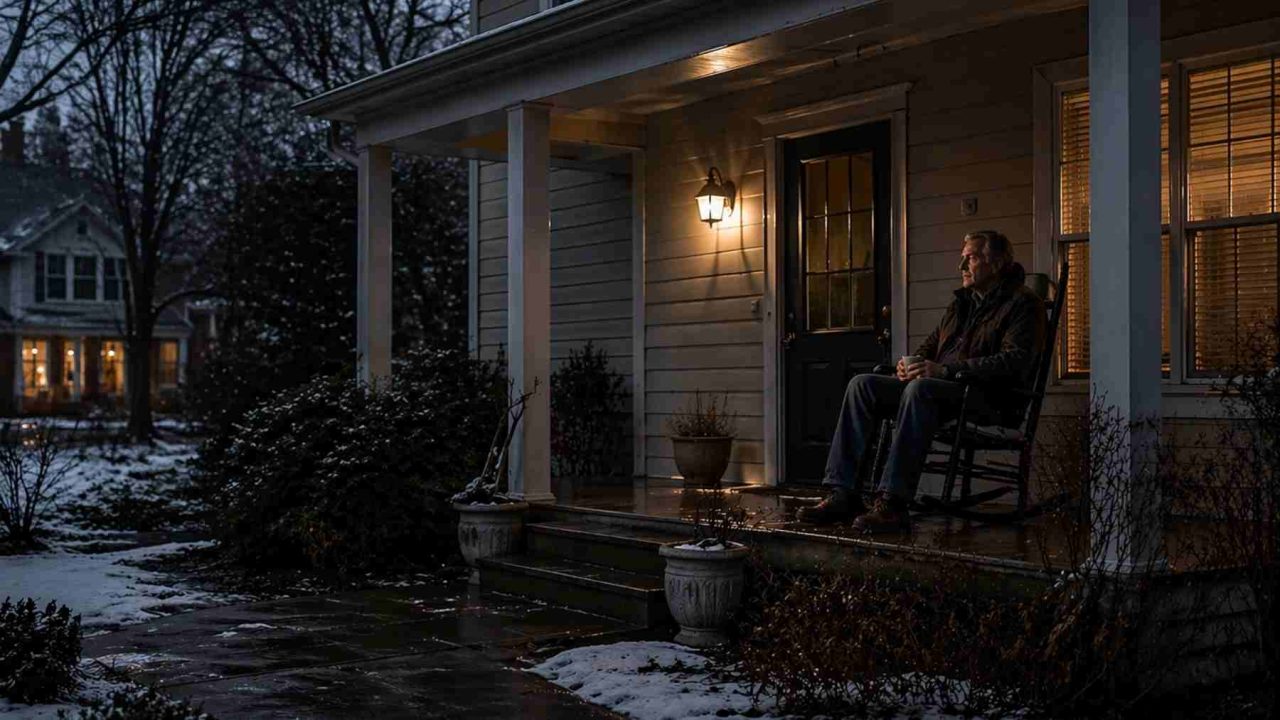
Last December, a woman named Carla in suburban Denver pulled into her driveway after a twelve-hour shift and noticed something. Every house on her block blazed with synchronized LED displays, inflatable snowmen, and rooftop projections. Her own porch sat dark, and for a moment she felt a familiar pang of guilt. Then she walked inside, sat on her couch in the quiet, and realized she felt something else entirely: relief.
Carla’s experience is more common than most people admit. And a growing body of psychological research suggests her instinct to opt out isn’t a sign of emotional detachment. It may be a sign of something far more interesting.
Holiday Decorations as Social Signals: What the Research Actually Says
For decades, holiday decorations have functioned as a quick social shorthand. A wreath on the door. Lights along the roofline. They broadcast warmth, approachability, and neighborhood belonging without a single word exchanged.
A study published in the Journal of Environmental Psychology confirmed this intuition with data. Researchers showed participants photos of homes with and without Christmas decorations. Strangers consistently rated decorated homes as belonging to friendlier, more socially connected residents.
The implication is powerful. Decorations serve as a social signal of warmth and neighborhood spirit. But signals and substance are two different things. And that distinction is where the psychology gets fascinating.
| Trait | Decorated Home (Perceived) | Undecorated Home (Perceived) |
|---|---|---|
| Friendliness | Higher | Lower |
| Social connection | Assumed strong | Assumed weak |
| Actual warmth | Not measured | Not measured |
| Psychological well-being | Not measured | Not measured |
Notice the gap. The study measured perception, not reality. And that gap is exactly where millions of undecorated households live, judged by a signal that tells us nothing about the person behind the darkened door.
Authenticity, Autonomy, and the Quiet Power of Saying No
The psychological case for skipping the lights begins with a concept researchers call self-authenticity. It means behaving in ways that match your actual values and beliefs, rather than performing for an audience.
A study published in Frontiers in Psychology linked self-authenticity directly to healthier psychological functioning and well-being. People who aligned their behavior with their inner values reported greater life satisfaction. They experienced less anxiety and fewer symptoms of depression.
“Self-authenticity, where behavior matches a person’s values and beliefs, is linked to healthier psychological functioning and well-being.”
— Frontiers in Psychology
Now apply that finding to the holiday season. If someone genuinely loves the ritual of stringing lights, climbing ladders, and watching the glow from the street, that behavior is authentic. It aligns with their values. But if someone does it because they feel watched, judged, or pressured by neighborhood norms, the same behavior becomes a performance. And performances exact a psychological toll.
A separate Frontiers in Psychology paper by Stefano Di Domenico, Richard Ryan, Emma Bradshaw, and Jasper Duineveld explored this through the lens of autonomous motivation. Across two studies of American adults, they found that people who acted from internal motivation, rather than external pressure, showed better financial knowledge and financial well-being. This held true even after accounting for income, wealth, age, gender, and education.
The connection to Christmas lights may seem indirect. But the underlying principle is direct. People who make choices based on their own values, rather than social expectations, tend to manage their resources more wisely. They protect their time, money, and energy with greater intentionality.
Clutter, Cortisol, and the Hidden Cost of Holiday Excess
The psychological cost of holiday decorations extends beyond the financial. Research tied to UCLA’s Center on Everyday Lives of Families offers a striking window into how domestic environments shape stress.
Darby Saxbe at the University of Southern California and UCLA psychologist Rena Repetti studied dual-income families and their relationship with their home environments. They found that mothers who described their homes using words like “mess,” “not fun,” or “very chaotic” showed higher cortisol stress markers tracked across the entire day.
Holiday decorations, by their nature, add complexity to a home. Boxes come down from attics. Extension cords snake across floors. Ornaments compete for shelf space with daily necessities. For some families, this layering of seasonal objects onto an already full environment tips the balance from festive to overwhelming.
The research on clutter and stress doesn’t single out Christmas decorations specifically. But the mechanism is clear. Physical environments shape emotional states. And adding temporary complexity to a home that already feels stretched can generate stress that outlasts the holiday season itself.
Broader psychological research also shows that people derive more lasting enjoyment from experiences than from possessions. A quiet evening with family, a shared meal, or a walk through a neighborhood to admire other people’s lights may deliver more genuine satisfaction than the act of decorating one’s own home.
Social Norms and the Pressure to Perform
Social norms exert enormous gravitational pull on behavior. Research published in The Conversation found that people save more energy when they believe others expect them to. The same mechanism works in reverse during the holidays. When an entire street lights up, the social expectation to participate intensifies.
This creates a specific kind of pressure. The decision to leave your home dark isn’t just a private choice. It becomes a visible deviation from the group. And visible deviations trigger judgment, exactly as the Journal of Environmental Psychology study demonstrated.
Yet the people who resist that pressure may be practicing what psychologists at Cottonwood Psychology call “quiet integrity.” This concept, studied in the context of people who use their turn signals on empty roads, describes consistent behavior that doesn’t depend on an audience. It suggests a stable internal compass rather than reactive social compliance.
Your neighbors have all decorated their homes for the holidays, and one has politely mentioned that your unlit house ‘brings down the vibe’ of the street. You genuinely prefer a simple, undecorated home. Do you:
Why Financial Self-Direction Matters More Than Festive Displays
The financial dimension of holiday decorating deserves its own examination. The Di Domenico and Ryan research on autonomous motivation and financial well-being points to a critical insight. People who make spending decisions based on internal values, rather than external expectations, build more sustainable financial lives.
Holiday decorations represent a recurring annual expense. Lights, timers, replacement bulbs, increased electricity consumption, storage containers, and the time spent installing and removing everything all carry costs. For a household operating on a tight budget, these costs aren’t trivial.
But the research suggests something deeper than simple frugality. People with autonomous motivation don’t just save money. They develop better financial knowledge and make more deliberate choices about where their resources go. Skipping decorations isn’t about deprivation. It’s about allocation, directing money, time, and energy toward things that generate authentic satisfaction.
Studies consistently suggest that people who skip holiday decorations may be protecting money, time, calm, and personal choice rather than rejecting celebration itself. The celebration simply takes a different form, one that doesn’t require a visible display for validation.
Rethinking the Dark House on Your Street
The Hawthorne effect, a well-documented phenomenon in behavioral science, shows that people modify their behavior when they know they’re being observed. Holiday decorations exist in a permanent Hawthorne zone. Your house faces the street. Your neighbors can see it. The social audience is always present.
People who decorate despite not wanting to are responding to that audience. People who don’t decorate, despite the social cost, are choosing not to. Neither choice is inherently superior. But the second choice requires more psychological independence.
This independence connects back to the authenticity research. When your behavior matches your values regardless of the audience, you experience less internal conflict. Less internal conflict means lower stress. Lower stress means better well-being. The chain is simple, even if the social dynamics surrounding it are not.
“People save more energy if they think others expect them to, showing that social norms are a powerful influence on behavior.”
— The Conversation / Oxford Environmental Change Institute
Where This Understanding Leads Next
As minimalism continues to grow as both a lifestyle movement and a research subject, the psychology of opting out will likely receive more attention. The current evidence already points in a clear direction. Simplicity, when chosen freely, tends to support well-being. Complexity, when imposed by social pressure, tends to erode it.
Future research may explore whether the specific act of resisting holiday decoration norms predicts other markers of psychological resilience. It may also examine whether communities that tolerate diverse levels of participation report higher collective satisfaction than those that enforce uniformity.
For now, the existing research offers a useful reframe. The dark house on your street isn’t necessarily occupied by a Scrooge. It might be occupied by someone who has figured out what many decorated households are still working toward: the ability to celebrate on their own terms, without needing the street to confirm that their joy is real.
The most quietly radical act during the holiday season might not be putting up the biggest display on the block. It might be sitting in a dark living room, content, while the rest of the street glows. Not because you’re against the light. But because you’ve already found yours.



Leave a Reply