
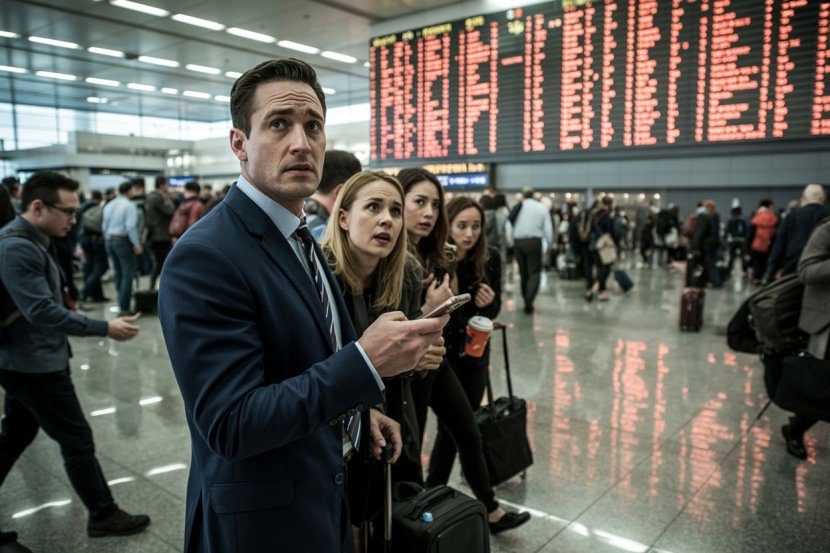
More than 200 flights were delayed and nearly 40 were cancelled at Toronto Pearson International Airport in a single day, leaving thousands of travellers stranded, scrambling for rebooking options, or stuck in terminals waiting for updates that were slow to come.
The disruption hit on March 26, 2026, and touched virtually every major carrier operating out of Canada’s busiest airport. From domestic routes connecting Toronto to Vancouver, Montreal, and Calgary, to international corridors stretching toward New York and beyond, the ripple effects were immediate and widespread.
With 210 delays and 39 cancellations recorded across the board, this was not a minor operational hiccup. It was a full-scale breakdown of the flight schedule at one of North America’s most trafficked hubs — and passengers are still feeling it.
(function(){var wrp=document.getElementById(“paap_stat_69c6fa386e2102.98464947”);if(!wrp)return;var ids=[“paap_stat_69c6fa386e2102.98464947_c0″,”paap_stat_69c6fa386e2102.98464947_c1”];var dur=1800;function ease(t){return 1-Math.pow(1-t,3);}function anim(){ids.forEach(function(id){var el=document.getElementById(id);if(!el)return;var tgt=parseFloat(el.getAttribute(“data-target”))||0;var pfx=el.getAttribute(“data-prefix”)||””;var sfx=el.getAttribute(“data-suffix”)||””;var dec=parseInt(el.getAttribute(“data-decimals”))||0;var st=null;function step(ts){if(!st)st=ts;var p=Math.min((ts-st)/dur,1);var v=ease(p)*tgt;el.textContent=pfx+v.toFixed(dec)+sfx;if(p<1)requestAnimationFrame(step);}requestAnimationFrame(step);});}if("IntersectionObserver" in window){var obs=new IntersectionObserver(function(e){e.forEach(function(en){if(en.isIntersecting){anim();obs.disconnect();}});},{threshold:0.2});obs.observe(wrp);}else{anim();}})();
What Happened at Toronto Pearson
Toronto Pearson International Airport serves as the primary gateway for both domestic Canadian travel and a significant volume of transatlantic and transborder routes. When operations break down there, the consequences don’t stay local — they cascade outward to airports across the continent and beyond.
On March 26, the airport recorded a combined total of 249 disrupted flights when you count both delays and cancellations together. That’s a staggering number for a single operating day, and it placed enormous pressure on airline staff, gate agents, and customer service teams across multiple terminals.
The causes behind the disruption have not been officially detailed in confirmed statements, but the scale of impact across so many different carriers simultaneously points to systemic pressure rather than any single airline’s operational failure. When Air Canada, WestJet, Porter, and several regional and international carriers are all affected at once, the airport’s infrastructure and air traffic management tend to be the common thread.
Which Airlines Were Hit the Hardest
Not every airline suffered equally. Jazz Aviation took the largest cancellation hit of any single carrier, with 14 flights cancelled and 13 delayed. Air Canada, despite having fewer cancellations, logged the most delays of any airline — 98 in total, alongside 9 cancelled flights.
WestJet, Canada’s second-largest carrier, saw 6 cancellations and 29 delays. Porter Airlines, which has been expanding its network aggressively in recent years, recorded 2 cancellations and 16 delays. Regional operators Republic Airways and Endeavor Air each faced 4 cancellations, with 6 and 4 delays respectively.
The disruption wasn’t limited to Canadian carriers. Air France, Emirates, United Airlines, American Airlines, Air India, and Cathay Pacific all reported delays — a sign that the problems at Pearson were broad enough to affect even long-haul international operations.
| Airline | Cancellations | Delays |
|---|---|---|
| Air Canada | 9 | 98 |
| Jazz Aviation | 14 | 13 |
| WestJet | 6 | 29 |
| Porter Airlines | 2 | 16 |
| Republic Airways | 4 | 6 |
| Endeavor Air | 4 | 4 |
| Air France, Emirates, United, American, Air India, Cathay Pacific | Not specified | Delays reported |
(function(){function loadChartJs(cb){if(window.Chart){cb();return;}var s=document.createElement(“script”);s.src=”https://cdn.jsdelivr.net/npm/chart.js@4.4.0/dist/chart.umd.min.js”;s.onload=cb;document.head.appendChild(s);}function initChart(){var cv=document.getElementById(“paap_chart_69c6fa386e2942.12869613”);if(!cv)return;var dv=[“98 delays”,”29 delays”,”16 delays”,”13 delays”,”6 delays”,”4 delays”];new Chart(cv,{type:”bar”,data:{labels:[“Air Canada”,”WestJet”,”Porter Airlines”,”Jazz Aviation”,”Republic Airways”,”Endeavor Air”],datasets:[{data:[98,29,16,13,6,4],backgroundColor:[“#3b82f6″,”#10b981″,”#f59e0b”,”#ef4444″,”#8b5cf6″,”#3b82f6″],borderRadius:6,borderSkipped:false}]},options:{indexAxis:”y”,responsive:true,maintainAspectRatio:false,animation:{duration:1200,easing:”easeOutQuart”},plugins:{legend:{display:false},tooltip:{callbacks:{label:function(ctx){return dv[ctx.dataIndex]||ctx.formattedValue;}}}},scales:{x:{grid:{color:”#e5e7eb”},ticks:{color:”#6b7280″}},y:{grid:{display:false},ticks:{color:”#1a1a1a”,font:{weight:600}}}}}});}var cv=document.getElementById(“paap_chart_69c6fa386e2942.12869613”);if(!cv)return;if(“IntersectionObserver” in window){var obs=new IntersectionObserver(function(e){e.forEach(function(en){if(en.isIntersecting){loadChartJs(initChart);obs.disconnect();}});},{threshold:0.1});obs.observe(cv);}else{loadChartJs(initChart);}})();
Routes and Airports Caught in the Crossfire
The disruption didn’t stay contained within Toronto’s terminals. Key airports connected to Pearson were also impacted, including LaGuardia Airport in New York — a critical business corridor between Canada and the United States.
Domestically, routes to and from Vancouver, Montreal, and Calgary were among those disrupted. These are three of Canada’s most important cities and represent some of the highest-volume air travel corridors in the country. Passengers travelling between Toronto and any of these destinations on March 26 faced significant uncertainty about whether their flights would depart on time, or at all.
For travellers with connecting flights — particularly those routing through Pearson to international destinations — the cascading effect would have been especially painful. A delay on a domestic leg into Toronto can easily translate into a missed long-haul departure, sometimes with no same-day alternative available.
What This Means for Travellers Still in the System
If you were booked on any of these carriers through Toronto Pearson on March 26, the immediate priority is confirming your rebooking status directly with your airline. Cancellations of this volume typically trigger passenger protection obligations under Canada’s Air Passenger Protection Regulations, which require airlines to offer rebooking or refunds depending on the cause of the disruption.
Travellers affected by the Jazz cancellations in particular — given that carrier recorded the highest number of outright cancellations — should check whether their flights have been rescheduled and what compensation options are available. The same applies to passengers on Republic Airways and Endeavor Air, both of which cancelled four flights each.
For anyone whose international connection through Pearson was missed as a result of a domestic delay, the picture can be more complicated. Passengers are encouraged to document their original itinerary, the delay or cancellation notice they received, and any costs incurred as a result — all of which may be relevant to a future compensation claim.
What Comes Next for Pearson Operations
Disruptions of this scale at major hub airports rarely resolve in a single day. When dozens of aircraft are out of position — sitting at wrong airports or grounded due to cascading delays — it can take 24 to 48 hours for an airline’s network to fully recover and return to normal scheduling.
Passengers with upcoming travel through Toronto Pearson in the days following March 26 should monitor their flight status closely. Airlines typically prioritize getting stranded passengers to their destinations before returning to normal operations, which can mean further schedule compression in the short term.
Travellers connecting through Pearson to international destinations served by Air France, Emirates, Air India, United, American, or Cathay Pacific should pay particular attention, as those long-haul routes have less scheduling flexibility and fewer daily departure options if a connection is missed.
Frequently Asked Questions
How many flights were cancelled at Toronto Pearson on March 26, 2026?
A total of 39 flights were cancelled across all carriers operating at Toronto Pearson International Airport that day.
Which airline had the most delays during this disruption?
Air Canada recorded the highest number of delays, with 98 flights delayed alongside 9 cancellations.
Which airline had the most cancellations?
Jazz Aviation led all carriers with 14 cancellations, in addition to 13 delays on the same day.
Which routes and destinations were affected?
Confirmed impacted routes included connections to Vancouver, Montreal, Calgary, and New York’s LaGuardia Airport, among others.
Were international carriers affected as well?
Yes — Air France, Emirates, United Airlines, American Airlines, Air India, and Cathay Pacific all reported delays at Toronto Pearson during this disruption.
What should affected passengers do now?
Passengers should contact their airline directly to confirm rebooking status and ask about compensation options under Canada’s Air Passenger Protection Regulations.

Leave a Reply