
▶ Read transcript
Here’s what you need to know about a surprisingly promising development in sustainable materials. Researchers have figured out how to turn banana plant waste into viable paper products, and the science just hit some major milestones in 2026.
First, the scale of the opportunity is enormous. Banana plants only fruit once, and every harvest leaves behind a massive waterlogged stem that farmers typically burn. In Pakistan’s Sindh province alone, 170,000 tons of bananas produced in a single year meant mountains of wasted pseudostems releasing carbon into the atmosphere.
Second, trials at Sindh Agriculture University found that pulping these stems at 230 degrees Fahrenheit yields 44 percent usable pulp, with brightness levels between 70 and 77, which meets consumer standards for tissue and packaging products. Third, by adjusting the cooking process, manufacturers can achieve a five-fold range in paper strength, meaning one raw material can serve everything from facial tissue to corrugated packaging.
If you’re in manufacturing, agriculture, or sustainable packaging, banana fiber is worth watching closely as a near-zero-cost feedstock with real commercial potential.
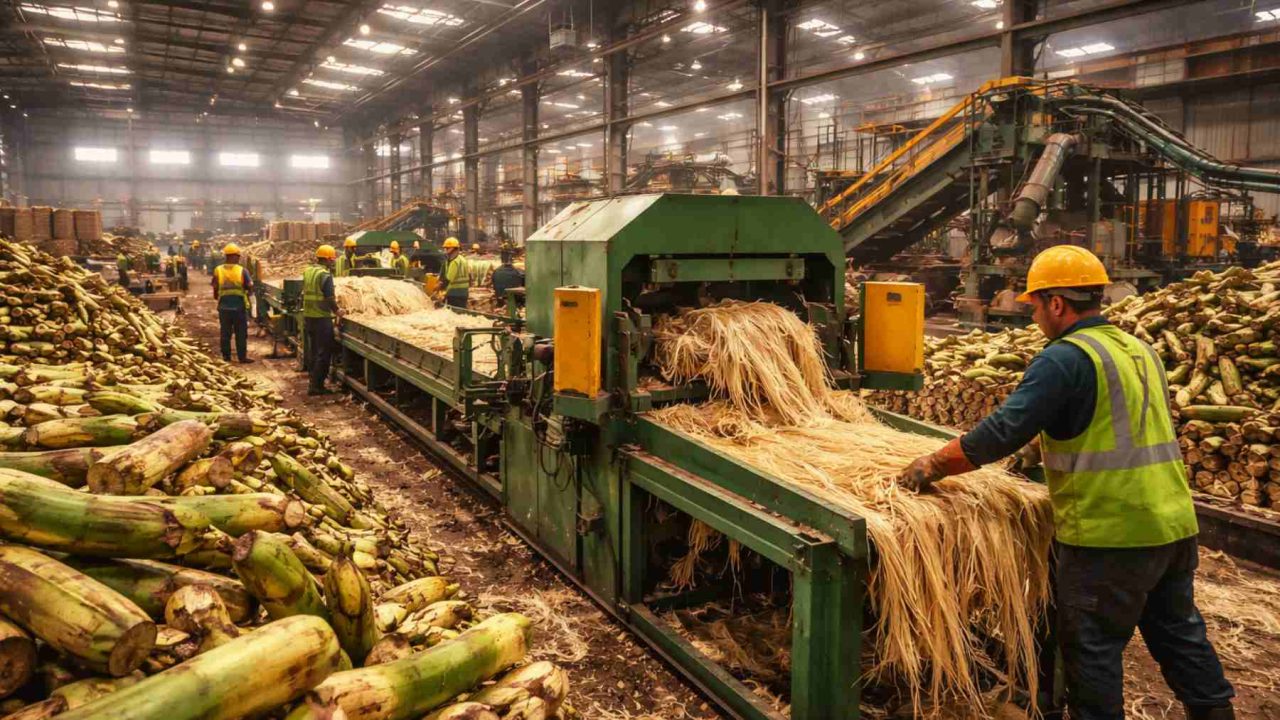
In the Sindh province of Pakistan, a farmer named Ghulam watches a mechanical extractor strip wet fibers from a banana pseudostem the size of his forearm. Three months ago, he would have burned that stem in a smoky heap at the edge of his field. Today, those fibers are headed to a pulping facility less than ten miles away.
This scene is becoming common across banana-growing regions worldwide. And the science behind it just took a major leap forward.
Why Banana Pseudostem Pulping Demands Attention in 2026
Banana plants are one-shot organisms. Each plant produces a single bunch of fruit, then the entire above-ground structure becomes waste. The pseudostem, that thick trunk-like column of tightly wrapped leaf sheaths, accounts for the bulk of that waste.
Sindh alone covers about 93 percent of Pakistan’s banana acreage, which totals roughly 86,000 acres nationwide. The province produced around 170,000 US tons of bananas in 2020 to 2021, representing about 83 percent of Pakistan’s national harvest. Every one of those tons of fruit left behind a pseudostem with nowhere to go.
Globally, the numbers are staggering. Farmers burn or abandon millions of tons of banana trunks every harvest cycle. That waste releases carbon, chokes waterways, and represents a massive missed opportunity. Because inside those waterlogged stems hides a fiber stronger than jute.
Here are the five breakthroughs, counted down from fifth to first, that are converting agricultural refuse into viable paper products.
| Breakthrough | Key Metric | Impact Area |
|---|---|---|
| Proximity Processing | Reduced transport costs | Logistics & scalability |
| Fiber Length Characterization | ~0.07 inches per fiber | Product suitability |
| Strength Optimization | 5× range in pull test values | Product durability |
| Brightness & Moisture Control | 70–77 brightness; 8–9% moisture | Consumer acceptance |
| Optimal NaOH Pulping at 230°F | 44% pulp yield | Commercial viability |
Five: Proximity Processing Solves the Water Weight Problem
Fresh banana pseudostems are waterlogged. They can be up to 95 percent moisture by weight. Hauling them over long distances would destroy any economic case for using them.
The solution is deceptively simple: process them near the farms. Mechanical extraction units, some small enough to fit on a flatbed truck, now strip fibers within hours of harvest. This eliminates the rot problem entirely and keeps transport costs low enough for small-scale farmers to participate.
In Sindh, where banana fields stretch across the Indus River delta, this proximity model means fiber extraction can happen at the village level. No cold chain. No expensive infrastructure. Just a machine, a water source, and stems that would otherwise become smoke.
Four: Fiber Length Characterization Reveals a Tissue-Grade Material
Not all plant fibers are created equal. Cotton fibers are long and fine. Wood pulp fibers are short and stiff. Banana pseudostem fibers occupy a sweet spot that researchers at Sindh Agriculture University in Tandojam have now precisely measured.
Shaukat Ibrahim Abro and colleagues at the Department of Soil Science reported fiber lengths of around seven hundredths of an inch. That places banana fibers in the range suitable for tissue paper, napkins, and lightweight packaging.
Longer fibers would make the paper too coarse for tissue applications. Shorter fibers would lack the tensile strength for packaging. Banana pseudostems land right in the zone where versatility meets practicality.
Three: A Five-Fold Strength Range Opens Multiple Product Lines
One of the most striking findings from the April 2026 trials is the sheer range of strength outcomes. Pull test values across different pulping recipes spanned from about 32 to 160. That is a roughly five-fold spread.
This matters enormously for commercialization. A pull test value of 32 might suit a soft facial tissue. A value of 160 could work for corrugated packaging inserts. The same raw material, banana pseudostem, can serve radically different markets depending on how you cook it.
The researchers tested sodium hydroxide at temperatures ranging from 212 to 248 degrees Fahrenheit, with heating times from 45 minutes to one hour and 15 minutes. Each combination produced a distinct strength profile. This tunability is what separates a laboratory curiosity from a viable industrial feedstock.
Two: Brightness and Moisture Readings Meet Consumer Standards
Paper brightness is measured on a scale where higher numbers mean whiter sheets. Commercial tissue paper typically needs brightness above 70 to look acceptable on store shelves. Banana pseudostem pulp delivered brightness readings between 70 and 77.
That range sits comfortably within consumer expectations for unbleached or lightly processed paper products. It also aligns with the growing market for “natural look” packaging, where a slightly warm tone signals eco-friendliness rather than poor quality.
Moisture retention landed at 8 to 9 percent. This is critical for shelf stability. Too much moisture and the paper molds. Too little and it becomes brittle and uncomfortable against skin. The banana fiber products threaded the needle.
You manage a small packaging company in a tropical region where banana farming is widespread. A local cooperative offers you banana pseudostem fiber at one-third the cost of your current wood pulp supply, but you’d need to invest in minor equipment modifications and accept a slightly warmer paper tone.
Together, these two metrics suggest that banana pseudostem paper could enter retail markets without extensive additional processing. No exotic bleaching agents. No costly dehumidification steps. The material arrives at usable quality almost by default.
The 44 Percent Pulp Yield at 230°F Changes the Economics
Here is where the countdown reaches its peak. The single most important finding from the April 2026 trials is the optimal pulping recipe itself.
About half an ounce of sodium hydroxide dissolved in a little over a quart of water. Heated for approximately one hour at around 230 degrees Fahrenheit. The result: a 44 percent pulp yield from raw banana pseudostem material.
“Traditionally left to decompose or burned, banana pseudostems are now being transformed into fibers for clothing, paper, and other eco-friendly products.”
— DES Action Australia
To understand why 44 percent matters, consider the economics. Wood-based pulping typically yields 40 to 55 percent depending on the species and process. Banana pseudostem pulp at 44 percent sits squarely in that competitive range, but the feedstock costs essentially nothing. It is waste.
Sodium hydroxide, commonly known as lye or caustic soda, costs a fraction of what sulfate chemicals used in kraft wood pulping require. The temperature of 230°F is achievable with basic steam equipment. No pressure vessels rated for extreme conditions. No exotic catalysts.
The research team, led by Abro at Sindh Agriculture University with support from Princess Nourah bint Abdulrahman University in Riyadh, deliberately kept the process accessible. Every parameter was chosen with small-scale operators in mind.
Consider the scale of the opportunity. Sindh’s 86,000 acres of banana farms generate pseudostem waste proportional to the 170,000 tons of fruit harvested. Even conservative estimates suggest tens of thousands of tons of usable fiber are rotting in fields each year in Pakistan alone.



Leave a Reply