
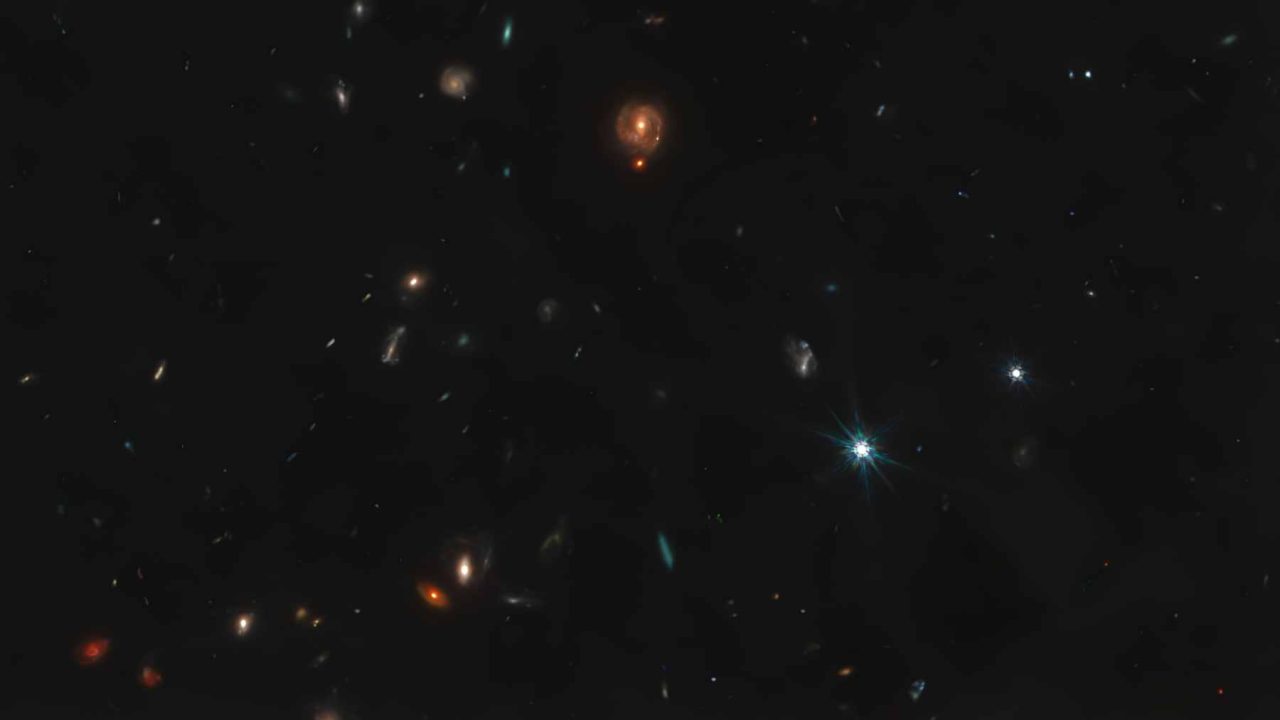
The window for understanding the universe’s first billion years is narrow, and it keeps getting more complicated. Since James Webb began full science operations, it has delivered one puzzle after another. But few have rattled cosmologists quite like the little red dots: hundreds of compact, crimson objects scattered across nearly every deep-field image the telescope has captured.
Now, a new study published in Nature is reshuffling everything astronomers thought they knew about these objects. They were not the ancient galaxies most researchers assumed. They appear to be something rarer and more dramatic: infant black holes gorging themselves on matter at nearly the maximum physically possible rate.
Why the Early Universe Seemed Full of Oversized Galaxies
When Webb’s first deep-field images arrived in 2022, astronomers celebrated. Then they started counting. The early universe appeared stuffed with massive, mature structures that had no business existing so soon after the Big Bang. Among the most puzzling were the little red dots, compact objects found at redshifts between 3.4 and 6.7, placing them in a window spanning roughly the universe’s first 1.5 billion years.
They appeared in nearly every pointing of the telescope. Their red color and compact shape made them stand out. Within months, the leading interpretation solidified: these were a form of early active galactic nucleus (AGN), galaxies harboring supermassive black holes at their centers, shrouded in dust that gave them their reddish hue.
The masses calculated from their spectral signatures were staggering. Some estimates placed individual black holes at hundreds of millions, even billions, of solar masses. That would make them among the most massive objects in the known early universe, and would demand explanations for how they grew so fast from nothing.
| Feature | Old Interpretation | New Study Finding |
|---|---|---|
| Object type | Early AGN / primordial galaxy | Young, low-mass black hole |
| Black hole mass estimate | Hundreds of millions to billions of solar masses | ~100,000 to 10 million solar masses |
| Cause of broad spectral lines | Fast-moving gas around massive black hole | Electron scattering in dense ionized gas |
| Growth rate | Uncertain | Near Eddington limit (maximum physical rate) |
| X-ray and radio signal | Expected to be strong | Surprisingly weak |
The Spectral Clue That Changed Everything
The cracks in the galaxy hypothesis appeared early. Typical AGNs produce strong X-ray and radio emissions. The little red dots were almost silent in both. That alone should have prompted more caution. But without a better explanation for the broad hydrogen emission lines in their spectra, the AGN interpretation held.
Those broad lines were the smoking gun. In standard astronomy, wide spectral lines mean fast-moving gas. Fast-moving gas around a compact object means a massive black hole exerting tremendous gravitational force. Larger mass, stronger gravity, faster gas, wider lines. The logic seemed airtight.
The new study, analyzing 12 objects with high-quality spectra from the James Webb Space Telescope’s NIRSpec instrument plus 18 more in a stacked analysis, found a different culprit entirely. The broad lines were not caused by rapid gas motion at all. They were shaped by electron scattering inside extraordinarily dense, ionized gas clouds surrounding the black holes.
“The black holes are far less massive than people previously believed.”
— Darach Watson, University of Copenhagen
That distinction matters enormously. When electron scattering accounts for the line broadening, the inferred black hole mass drops by roughly two orders of magnitude. Objects previously estimated at a billion solar masses may actually weigh in between 100,000 and 10 million solar masses — placing them among the lowest-mass black holes ever identified at high redshift.
What ‘Near the Eddington Limit’ Actually Means
Here is where the story gets stranger. A smaller black hole mass does not make these objects less dramatic. It makes them more so.
The Eddington limit is the theoretical maximum rate at which a black hole can accrete matter without the radiation pressure blowing the infalling gas away. Most black holes in the modern universe feed well below this ceiling. The little red dots appear to be feeding right at it, or close to it.
A black hole growing at the Eddington limit doubles its mass on a characteristic timescale of roughly 45 million years. For context, that is a geological eyeblink in cosmic time. If the little red dots represent black holes caught in this rapid-growth phase, astronomers may be witnessing the engines that eventually became the supermassive black holes powering quasars later in cosmic history.
This reframes an old mystery rather than solving it. The question was never just what the little red dots are. The deeper question is how black holes of any size reached high masses so early. The new study suggests the answer involves extreme, sustained accretion at the physical limit of what is possible.
Dense Gas Clouds and the Physics of Misleading Signals
The electron scattering explanation requires a specific environment: gas that is not just dense, but extraordinarily so. For photons emitted near the black hole to scatter off electrons and broaden the observed spectral lines, the surrounding gas must be orders of magnitude denser than what typical AGN models predict.
This creates a picture of black holes cocooned in thick, ionized shrouds. Those cocoons would absorb and scatter X-rays, explaining why the little red dots look so quiet in high-energy wavelengths. They were not weak X-ray sources. They were heavily obscured ones, with their high-energy light trapped before it could escape to a telescope 13 billion light-years away.
The dense gas also explains the red color. Dust mixed into these clouds would absorb shorter wavelengths and re-emit energy in redder light. The very feature that gave these objects their nickname turns out to be a signature of their extreme environment.
Rewriting the Early Universe’s Population of Black Holes
If the new mass estimates hold, the implications ripple outward. Astronomers have long struggled to explain how the universe produced supermassive black holes weighing billions of solar masses within the first billion years. The usual candidates, so-called black hole seeds, were thought to either grow slowly from stellar remnants or form rapidly from the direct collapse of massive gas clouds.
The little red dots may represent a third pathway: small seeds growing furiously at or near the Eddington limit, accumulating mass at the fastest rate physics allows. They would be the lowest-mass black holes yet identified at these redshifts, and their very existence in such numbers suggests that rapid early growth was not exceptional. It was normal.
The study draws on spectra covering redshifts from 3.4 to 6.7. That range corresponds to epochs between roughly 900 million and 2 billion years after the Big Bang. These were not isolated events at the cosmic dawn. They were a sustained population, present across hundreds of millions of years of early cosmic history.
What this means for anyone watching the field of cosmology is that our census of the early universe is still being written. The James Webb Space Telescope was supposed to confirm what we thought we knew about cosmic structure formation. Instead, it keeps handing astronomers objects that require the textbooks to be reopened.
The little red dots are now pointing toward a universe that built its largest black holes not from rare, exotic seeds but from small ones running at full throttle, wrapped in gas so thick that they hid their true nature for years. The universe was not assembling its giants slowly. It was sprinting, and we are only now learning how to read the signs of that sprint written in red light from across 13 billion years of space.
The most unsettling part is not what these objects are. It is what they imply about what else Webb is showing us that we have not yet learned to misread correctly.
Frequently Asked Questions

You Might Also Like

India’s Red Road Uses Psychology to Slow Drivers in Tiger Country
India's first red road on NH-45 uses a 5mm thermoplastic surface and 25 animal underpasses…

Mars ‘Spiderwebs’ Finally Explained — and Water Lasted Far Longer Than We Thought
NASA's Curiosity rover finally explains Mars' giant spiderweb formations spotted since 2006 — and the…

The 13,000-Pound Mystery: How Neolithic People Moved Scotland’s Stone to Stonehenge
How did Neolithic people move a 13,000-pound stone 500 miles from Scotland to Stonehenge? The…
Leave a Reply