A Dog Named Robot Led a Teen to 17,000-Year-Old Art
Audio Briefing~1:05
Click play to listen to key points
▶ Read transcript
Here’s what you need to know about one of the most remarkable archaeological discoveries of the twentieth century. In September 1940, an eighteen-year-old named Marcel Ravidat was walking through the woods in southwestern France when his dog, a mutt named Robot, fell into a hole near a fallen tree. Ravidat followed the dog underground and discovered the Lascaux cave, home to roughly 680 painted figures and 1,500 engravings spanning 771 feet of passages. Radiocarbon dating places the artwork between 15,500 and 18,900 years old, depicting horses, bulls, bison, and deer in vivid reds, blacks, and yellows. When the cave opened to the public in 1948, up to 1,800 visitors a day nearly destroyed the art through body heat, moisture, and carbon dioxide, forcing its closure in 1963. The takeaway: if you visit the Dordogne region today, seek out the Lascaux replica site, because the original remains closed to protect what seventeen millennia of nature preserved and just fifteen years of tourism almost ruined.
Approximately 1,800 visitors per day once filed through a narrow passage in southwestern France to stare at artwork older than civilization itself. That foot traffic, combined with body heat and carbon dioxide, nearly destroyed the very thing people came to see. But before the crowds, before the scientists, before the controversy over preservation, there was a teenager, a dog, and a hole in the ground.
September 12, 1940: A Dog Falls Into History
Marcel Ravidat was 18 years old. He lived near Montignac, a quiet town in the Dordogne region of France. On that Thursday in September, he was walking through the woods with his dog, a mutt named Robot.
Robot disappeared. The dog had found a hole near a fallen tree, and either fell or scrambled into it. Ravidat followed. He squeezed through the narrow opening, descending into darkness.
98 feet
Length of the initial passage Ravidat walked before spotting the first paintings
771 feet
Total length of the decorated passages inside Lascaux
He wasn’t alone for long. Ravidat returned with three friends: Jacques Marsal, Georges Agnel, and Simon Coencas. Together, the four teenagers walked along a passage stretching roughly 98 feet before the darkness gave way to something none of them expected.
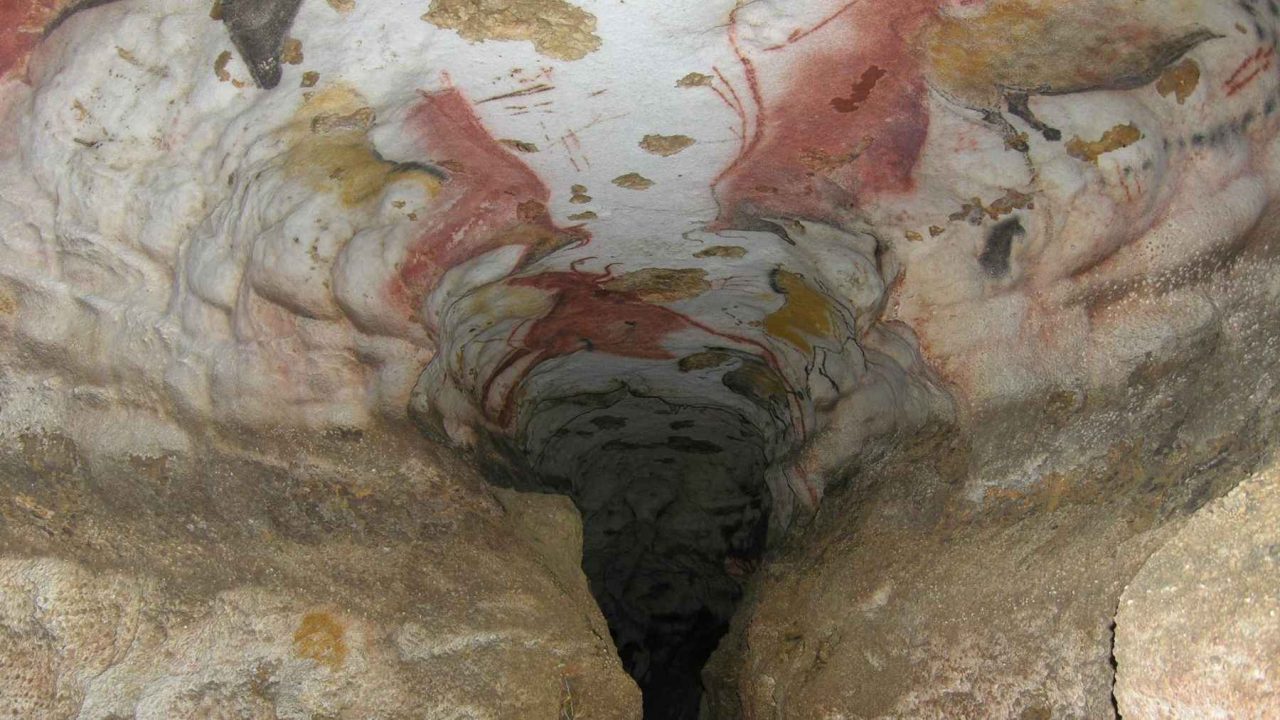
The walls were alive with animals. Bulls, horses, stags, and bison covered the limestone surfaces in vivid reds, blacks, and yellows. Some figures stretched beyond 6.5 feet in size. The boys had stumbled into what would become one of the most significant archaeological finds of the 20th century.
What the Walls of Lascaux Actually Contain
The scale of the discovery took years to fully catalog. According to the French Ministry of Culture, Lascaux contains approximately 680 painted figures and around 1,500 engravings. The decorated passages stretch about 771 feet in total. Radiocarbon dating places the artwork roughly between 15,500 and 18,900 years before present.
Gallery Name
Notable Features
Significance
Hall of the Bulls
Massive aurochs, horses, stags
Largest figures in the cave, some over 6.5 feet
Axial Gallery
Continuation of animal paintings
First paintings the teenagers spotted
The Shaft
Human figure facing a bison
One of the rarest human depictions in Paleolithic cave art
The Nave
Engravings and painted panels
Complex overlapping imagery
The Apse
Dense concentration of engravings
Highest density of art in the cave
Chamber of Felines
Rare depictions of big cats
Deepest gallery, hardest to access
The galleries were given names that now read like chapters in a story: the Hall of the Bulls, the Passageway, the Shaft, the Nave, the Apse, and the Chamber of Felines. Each section carries its own character. The Hall of the Bulls features the cave’s largest figures, massive aurochs that seem to stampede across the curved ceiling.
Deep inside, the teenagers descended a shaft roughly 26 feet deep. There, they encountered one of Lascaux’s most enigmatic scenes: a human figure, drawn in simple stick-like form, facing a wounded bison. A bird-topped staff lies nearby. Scholars have debated the meaning of this image for decades. No consensus exists.
Lascaux Cave: Art by the Numbers
Interactive data visualization
Painted Figures
680
771
Engraved Figures
1,500
771
Peak Daily Visitors (1960)
1,800
98
Documented Count
Passage Length (ft)
Source: French Ministry of Culture
KEY TAKEAWAY
Lascaux contains approximately 680 painted figures and 1,500 engravings spanning 771 feet of passages, with radiocarbon dates ranging from 15,500 to 18,900 years before present.
The Artists Who Painted in Darkness 17,000 Years Ago
Consider the logistics. These painters worked deep underground, far from any natural light source. They needed animal-fat lamps or torches. They needed scaffolding; some images are positioned on ceilings and high walls that no person could reach from the ground.
Lascaux Preservation Risk Index
8.2/10
Despite closure since 1963, Lascaux faces ongoing threats from fungal outbreaks, climate instability, and groundwater changes. The high score reflects the fragility of a 17,000-year-old microenvironment that was irreversibly altered by just 15 years of public access.
They ground minerals into pigments. Iron oxides produced reds and yellows. Manganese dioxide and charcoal created blacks. They applied paint with fingers, primitive brushes, and by blowing pigment through hollow bones to create a spray effect. The sophistication is startling.
The animals depicted are not random. Horses appear most frequently, followed by aurochs, deer, and ibex. Predators are rare. The Chamber of Felines, the deepest and most difficult gallery to access, is one of the few places big cats appear. This suggests intentional organization, not casual decoration.
“We have invented nothing.”
— Attributed to Pablo Picasso, upon seeing Paleolithic cave art
Whether Picasso actually said those words after visiting Lascaux or the similar cave at Altamira remains disputed. But the sentiment captures something real. The technical skill on display in these caves challenges any assumption that early humans were primitive in their creative capacities.
1,800 Visitors a Day Nearly Destroyed What 17 Millennia Could Not
Lascaux opened to the public in 1948. It became an instant sensation. By 1960, the cave was receiving up to 1,800 visitors per day. Each visitor brought body heat, moisture, and exhaled carbon dioxide into an environment that had remained sealed and stable for thousands of years.
1,800
Peak daily visitors to Lascaux before the cave was closed in 1963
The results were catastrophic. Green algae began colonizing the walls. A white calcite film, dubbed “the white disease,” started forming over the paintings. The delicate microclimate that had preserved the art since the Upper Paleolithic was collapsing.
⚡What Would You Do?
You’re an archaeologist who discovers a new sealed cave with ancient paintings. Opening it to study could damage the art, but leaving it sealed means the knowledge stays hidden. A tech company offers to fund non-invasive 3D scanning, but wants exclusive media rights for five years.
Pragmatic
The art is documented without physical entry, but public access to the findings is delayed by five years of corporate exclusivity.
Cautious
Full public ownership of the discovery is maintained, but bureaucratic delays could take years, and the cave’s condition may change.
Bold
Groundbreaking findings are made quickly, but the introduction of human presence risks the same environmental damage that nearly destroyed Lascaux.
In 1963, the French government made a painful decision. Lascaux was closed to the public. Only a handful of researchers would be allowed inside, and even their visits were strictly limited. The cave that a dog had accidentally opened was being sealed again, this time by human choice.
IMPORTANT
Lascaux has been closed to the general public since 1963. Visitors today can experience the art through Lascaux IV, a full-scale replica opened in 2016 at the International Centre for Cave Art near Montignac.
Lascaux IV and the Future of Paleolithic Preservation
The closure didn’t end public interest. It intensified it. France responded by building replicas. Lascaux II opened in 1983, reproducing the Hall of the Bulls and the Axial Gallery with painstaking accuracy. In 2016, a more ambitious project, Lascaux IV, opened as part of the International Centre for Cave Art.
Lascaux: Before and After Public Access
BEFORE (Pre-1948)
Sealed for approximately 17,000 years. Stable microclimate with constant temperature and humidity. No biological contamination. Paintings preserved in near-original condition with vivid pigments.
AFTER (1948–1963)
15 years of up to 1,800 daily visitors introduced body heat, CO2, and moisture. Green algae colonized walls. White calcite ‘disease’ formed over paintings. Forced permanent closure in 1963 with ongoing fungal threats.
Lascaux IV replicates the entire cave using 3D scanning and digital projection alongside traditional artistic reproduction. Visitors walk through a climate-controlled environment that mimics the cave’s darkness, temperature, and silence. The experience is immersive, though inevitably different from standing before the originals.
Meanwhile, the original cave continues to require monitoring and intervention. Fungal outbreaks have occurred periodically since the 2000s. A scientific committee oversees the cave’s environment, adjusting ventilation and humidity levels to keep the paintings stable. The battle between access and preservation remains unresolved.
Lascaux: Key Dates
September 12, 1940
Marcel Ravidat and three friends discover the cave near Montignac
1948
Lascaux opens to the public for the first time
1960
Visitor numbers peak at 1,800 per day; environmental damage becomes visible
1963
The French government closes Lascaux to the public permanently
1979
Lascaux is designated a UNESCO World Heritage Site
2016
Lascaux IV opens as a full-scale replica at the International Centre for Cave Art
What 680 Painted Figures Reveal About Early Human Minds
The deeper question Lascaux poses isn’t about pigments or preservation. It’s about cognition. These paintings were created by anatomically modern humans whose brains were identical to ours. They lived in a world of megafauna, glacial cold, and constant survival pressure. Yet they devoted enormous effort to art.
The organization of the cave suggests planning. Animals are grouped, not scattered. Certain species appear in specific galleries. The human figure in the Shaft scene is one of the rarest motifs in all of Paleolithic art, suggesting that depicting humans carried different significance than depicting animals.
Some researchers interpret the paintings as hunting magic, rituals meant to ensure success in the hunt. Others see astronomical records, with clusters of dots potentially representing star patterns or lunar cycles. Still others argue the cave functioned as a social gathering space, a cathedral of sorts for Upper Paleolithic communities.
No single interpretation has won. The paintings resist easy explanation, which is part of their power.
The Dog, the Boy, and the Weight of Accident
Marcel Ravidat lived until 1995. Jacques Marsal, who became one of the cave’s most devoted guardians, died in 1989. Simon Coencas, the last surviving discoverer, passed away in 2020 at the age of 97. Georges Agnel died in 1986.
The story of Robot the dog leading Ravidat to the cave has become legend, though some historians note the details are uncertain. What is certain is that four teenagers, armed with nothing but curiosity, entered a hole in the ground and found a gallery of art that had waited in perfect darkness for roughly 17,000 years.
They didn’t know what they were looking at. They couldn’t have. But they knew it mattered. Marsal and Ravidat camped outside the cave entrance for days afterward, guarding it until authorities arrived.
Seventeen millennia of silence, broken by a dog chasing something into the dark. The artists who painted those walls could never have imagined who would find them, or how fragile their masterwork would prove once the world finally walked in.
Frequently Asked Questions
What did the teenagers find inside Lascaux cave?▶
The four teenagers discovered cave walls covered with approximately 680 painted figures and around 1,500 engravings depicting animals including bulls, horses, stags, and bison. The art dates between 15,500 and 18,900 years before present. Named galleries include the Hall of the Bulls, the Axial Gallery, the Shaft, the Nave, the Apse, and the Chamber of Felines.
Why was Lascaux cave closed to the public?▶
Lascaux was closed in 1963 because the high volume of visitors, up to 1,800 per day by 1960, caused severe environmental damage. Body heat, water vapor, and carbon dioxide altered the cave’s microclimate, leading to green algae growth and white calcite deposits forming over the paintings.
Can you visit Lascaux cave today?▶
The original cave remains closed to the general public. However, visitors can experience Lascaux IV, a full-scale replica opened in 2016 at the International Centre for Cave Art near Montignac, France. It uses 3D scanning and digital projection to recreate the entire cave.
How old are the Lascaux cave paintings?▶
Radiocarbon dating places the Lascaux cave art roughly between 15,500 and 18,900 years before present, situating them in the Upper Paleolithic period.
The Editorial Team is the named, credentialed group responsible for every article on this site. Each piece is researched by a section editor, reviewed by a credentialed practitioner where the topic warrants it, and signed off by the Editor in Chief before publication. The corrections process is public; named editors are accountable.




Leave a Reply