
▶ Read transcript
Here’s what you need to know about the interstellar comet that broke the internet. Comet 3I/ATLAS is only the third interstellar object ever recorded passing through our solar system, making it a genuinely once-in-a-generation scientific event. It’s currently about 420 million miles from Earth, moving faster than anything born in our solar system could, and the window to study it is closing fast. But almost immediately after the discovery was announced, social media flooded with false claims about impossible trajectories and alien propulsion systems. When people turned to AI chatbots for answers, some of those systems actually repeated the misinformation back with total confidence, a phenomenon researchers call hallucination by contamination. The real science got buried under fabricated drama. So here’s your takeaway: when a major scientific story breaks, go directly to NASA or peer-reviewed sources first. Don’t let an AI chatbot be your first stop, because it may have already learned the wrong version.
The window is closing. Comet 3I/ATLAS is currently racing through our solar system at a speed no object born here could match, and the scientific community has only a narrow slice of time to study it before it vanishes back into interstellar space forever. But while astronomers scrambled to point their telescopes, something else was happening on the other side of a screen: the internet was generating its own version of reality, and artificial intelligence was helping it along.
This is not a story about a comet. It is a story about what happens when a genuinely extraordinary event collides with an information ecosystem that rewards sensation over accuracy. The result was a case study in how AI-generated misinformation can spread at the exact moment when the public most needs reliable science.
3I/ATLAS: The Third Interstellar Visitor in Recorded History
The comet was discovered by the NASA-funded ATLAS survey telescope, which stands for Asteroid Terrestrial-impact Last Alert System. Its official designation, 3I/ATLAS, follows a precise naming logic: the “3” marks it as the third interstellar object ever identified, the “I” stands for interstellar, and “ATLAS” credits the instrument that found it.
The first two interstellar visitors were 1I/ʻOumuamua, detected in 2017, and 2I/Borisov, spotted in 2019. Both generated enormous scientific interest. Both also triggered waves of speculation about extraterrestrial origins. 3I/ATLAS arrived into an internet that had learned nothing from either of those moments.
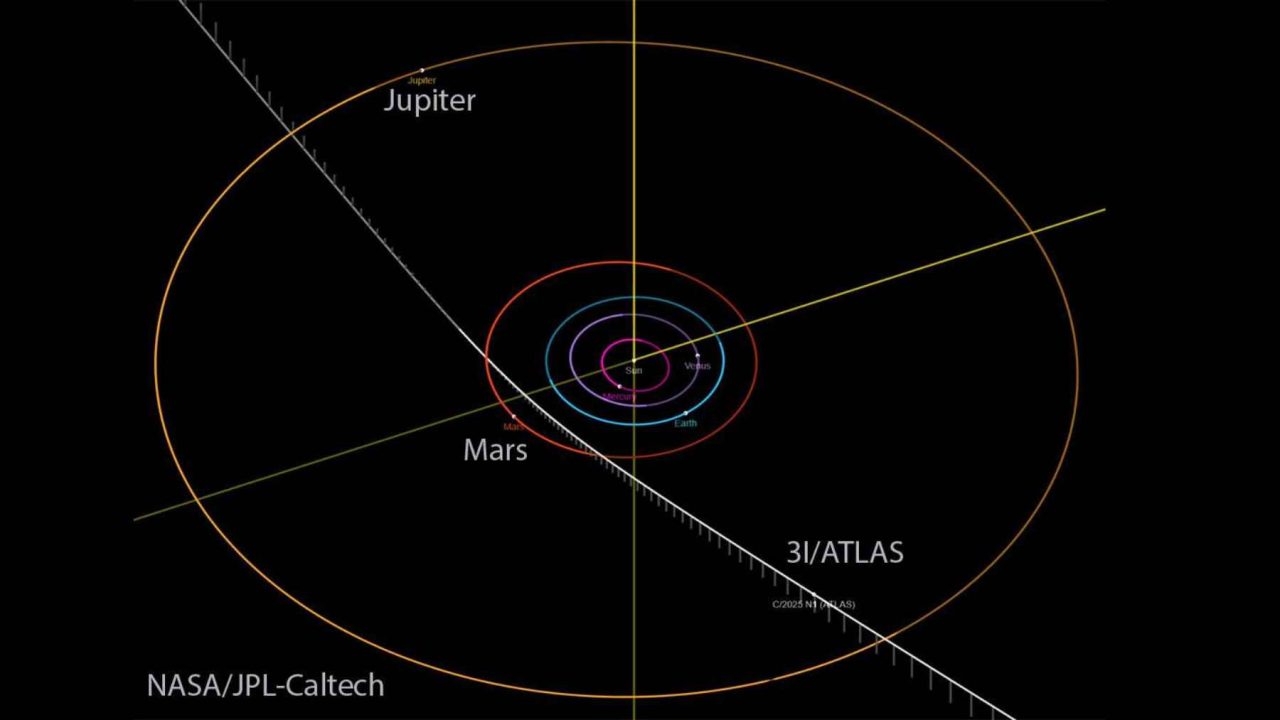
As of mid-2025, the comet sits approximately 420 million miles (670 million kilometers) from Earth. NASA’s Hubble Space Telescope has captured detailed imagery of the object, and researchers can track its path in real-time using NASA’s Eyes on the Solar System. The data is public, precise, and freely available. That availability, paradoxically, did not slow the misinformation. It may have accelerated it.
| Object | Year Discovered | Type | Notable Detail |
|---|---|---|---|
| 1I/ʻOumuamua | 2017 | Interstellar object | Unusual cigar shape; non-gravitational acceleration |
| 2I/Borisov | 2019 | Interstellar comet | First confirmed interstellar comet with visible coma |
| 3I/ATLAS | 2025 | Interstellar comet | Third known interstellar object; Hubble-imaged; ~420M miles from Earth |
How Social Media Turned a Scientific Discovery Into an AI Hallucination Factory
Within days of the announcement, social media platforms lit up with posts claiming 3I/ATLAS was following an “impossible trajectory” that no natural object could explain. The implication was clear, even when left unstated: something had steered it here. UAP (Unidentified Aerial Phenomena) communities amplified these claims aggressively, weaving the comet into existing narratives about government disclosure and non-human intelligence.
The problem accelerated when users began querying AI chatbots for information. Large language models, trained on internet data, began reflecting the noise back at users with the same confident tone they use to explain photosynthesis or the French Revolution. Some chatbots produced detailed descriptions of the comet’s “anomalous deceleration” — a feature that does not appear in any peer-reviewed data. Others generated speculative timelines connecting 3I/ATLAS to UAP sightings over the Pacific.
This is not a hypothetical risk. It is what happened. The feedback loop worked like this: a speculative post would go viral, get scraped into AI training pipelines or retrieval systems, and then get returned to users as a confident answer. The comet’s actual hyperbolic trajectory, which is genuinely remarkable on its own scientific merits, was buried under fabricated claims about alien propulsion systems.
Scientists studying 3I/ATLAS had to compete not just with public ignorance, but with authoritative-sounding AI outputs that contradicted their findings.
What the Real Science Says About 3I/ATLAS and Interstellar Trajectories
Here is what is actually known. 3I/ATLAS is traveling on a hyperbolic orbit, meaning its velocity exceeds the Sun’s gravitational escape speed. This is the scientific signature of an interstellar origin. It is not anomalous. It is exactly what you would expect from an object that formed around another star and was subsequently ejected into interstellar space, possibly by a gravitational interaction with a gas giant in its home system.
“Observing such a rare interstellar object gives us a unique window into the building blocks of planetary systems beyond our own.”
— NPR Science Desk, reporting on 3I/ATLAS research findings
The comet also contains nickel, a detail that researchers found scientifically significant. Nickel has been detected in other comets and interstellar objects, and its presence in 3I/ATLAS helps scientists compare the chemistry of our solar system’s formation with that of other stellar environments. This is the kind of data that takes decades of theoretical work to contextualize. It was almost entirely absent from popular coverage.
The trajectory claims circulating on social media were not just wrong. They were physically impossible under known mechanics. A comet decelerating without a visible propulsive force would violate conservation of momentum. No credible astronomer proposed this. The claim originated in speculative forums and was then laundered through AI outputs into apparent legitimacy.
Peer-Reviewed Science Coverage
Mainstream Media Coverage
Social Media & AI-Generated Posts
| Metric | Peer-Reviewed Science Coverage | Mainstream Media Coverage | Social Media & AI-Generated Posts |
|---|---|---|---|
| Factual Accuracy |
95 |
62 |
18 |
| Source Credibility |
92 |
58 |
14 |
| Sensationalism |
12 |
64 |
94 |
| AI-Generated Content |
8 |
22 |
87 |
| Public Engagement |
45 |
78 |
96 |
| Scientific Rigor |
97 |
48 |
11 |
| Spread Speed |
38 |
72 |
98 |
The Deeper Problem: AI Confidence Without Verification
The 3I/ATLAS episode exposed a structural vulnerability in how the public now accesses scientific information. When something extraordinary happens, people turn to AI assistants for quick context. Those systems are only as reliable as the data they draw from, and in the immediate aftermath of a viral science story, that data is often a chaotic mix of accurate reporting and viral fiction.
Astronomers and science communicators found themselves in an exhausting position. They had to simultaneously publish real findings, correct AI-generated errors, and debunk social media claims that were being reinforced by chatbot outputs. The science itself was extraordinary enough to warrant serious attention. Instead, the conversation was dominated by whether the comet was a spacecraft.
This dynamic is not unique to 3I/ATLAS. It followed a nearly identical pattern to the ʻOumuamua controversy, when Harvard astronomer Avi Loeb proposed the object might be artificial in origin. That hypothesis, published in a peer-reviewed paper, was widely misrepresented as proof of alien technology. The difference with 3I/ATLAS is that AI systems were now active participants in the distortion, not just passive conduits.
What Comes Next for 3I/ATLAS and Interstellar Science
The comet will not be here forever. Its hyperbolic trajectory guarantees it will exit our solar system and continue its journey through interstellar space, unreachable and unrecoverable. The scientific window to study it is genuinely limited, which makes the noise-to-signal ratio of the public conversation especially costly.
Several research teams are currently analyzing spectral data from 3I/ATLAS to determine its chemical composition in detail. The nickel findings are a starting point. Researchers hope to identify molecular signatures that could tell us something about the stellar environment where the comet formed. Every week of observation adds to a dataset that will be studied for decades.
There is also a policy conversation beginning to take shape. The 3I/ATLAS episode has prompted renewed calls for science communication protocols around high-profile astronomical discoveries. The question being asked in research institutions is not just “how do we study this object” but “how do we communicate about it in an environment where AI systems can amplify misinformation faster than corrections can travel.”
Some researchers have proposed that major astronomical announcements should be accompanied by pre-emptive AI guidance, essentially briefing the systems that millions of people will query within hours of a discovery going public. Whether that is technically feasible at scale remains an open question.
The broader implication is sobering. If a real, documented, officially named interstellar comet with publicly available tracking data and Hubble imagery can be transformed within days into an alien spacecraft narrative, reinforced by AI outputs, then the challenge of science communication in the current information environment is fundamentally different from anything that existed before. The comet is real. The trajectory is documented. The chemistry is being measured. And yet, for a significant portion of the population, the story they encountered was something else entirely.
3I/ATLAS will leave our solar system carrying no awareness of the chaos it caused here. The question it leaves behind is whether we can build information systems worthy of the science we are actually doing.
Frequently Asked Questions
Frequently Asked Questions

You Might Also Like

Beijing’s Air Hit 27 µg/m³ in 2025: The Decade That Erased the Smog
Beijing's PM2.5 dropped to 27 µg/m³ in 2025, a 70% fall from 2013. Here's how…
The Tupperware-Sized Box That Could Revolutionize Space Mining
A Tupperware-sized box and hungry microbes on the ISS extracted metals from a real meteorite.…

Your Tea Bag Is Releasing Billions of Plastic Particles Into Every Cup
New research finds a single tea bag can release up to 14.7 billion microplastics into…
Leave a Reply