
▶ Read transcript
Here’s what you need to know about a remarkable gold auction in France and what it reveals about the true cost of gold mining.
In early March, auctioneer Raphaël Courant sold nine gold bars and nearly a thousand gold coins in Angers, France, with the total collection exceeding two million euros. Each bar went for more than one hundred eighteen thousand euros to a room of about forty bidders competing in person, by phone, and online. But the real story is what those gleaming bars represent. At today’s average ore grades, producing a single troy ounce of gold requires processing roughly twenty-four metric tons of rock. Gold mining emits over one hundred million metric tons of CO2 equivalent annually, and emissions per ounce can range from one hundred twenty-nine to over twenty-seven hundred kilograms depending on where and how it’s mined. Artisanal mining alone accounts for thirty-seven percent of global mercury pollution.
Next time you consider a gold investment or purchase, look into its sourcing and environmental footprint, because not all gold carries the same hidden cost.
Gold is not precious because we decided it should be. That’s the story most people tell themselves, and it’s wrong. Gold is precious because the universe made almost none of it, the Earth buried what little arrived, and extracting a single ounce requires moving mountains. Literally.
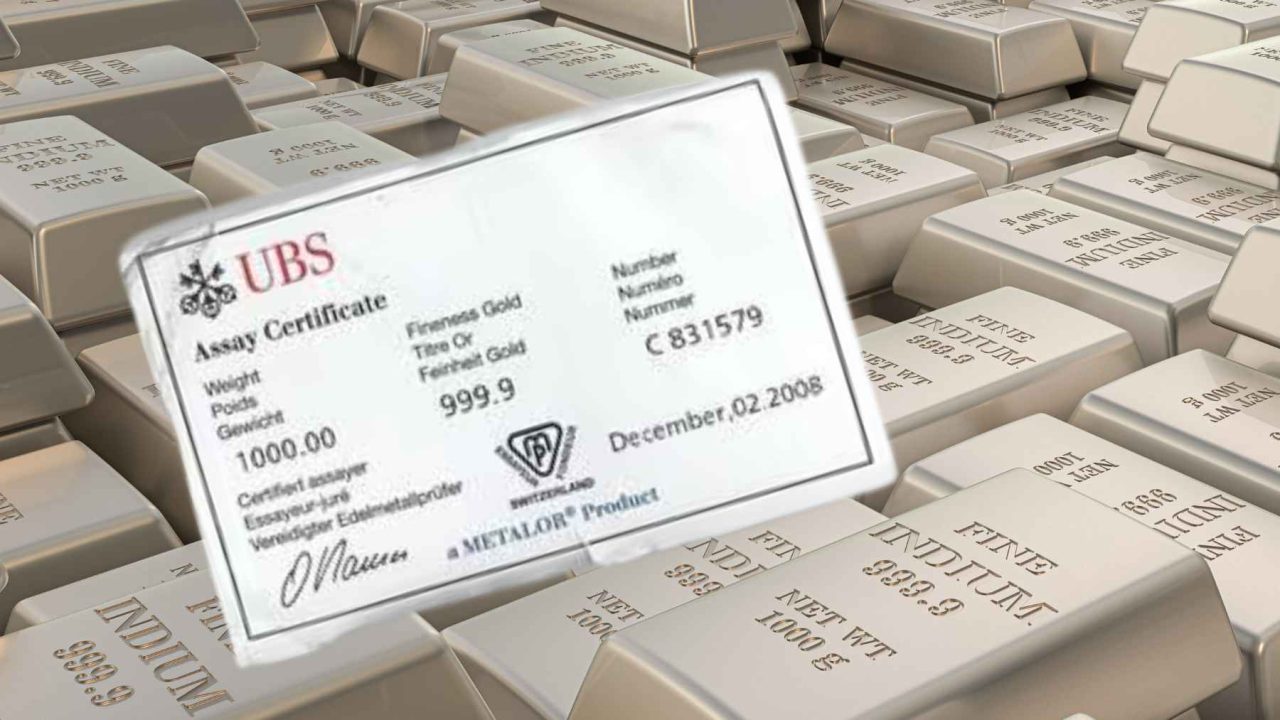
When auctioneer Raphaël Courant stood before a room of roughly 40 bidders in Angers, France, in early March, he wasn’t just selling metal. He was presiding over a collection so concentrated, so dense with geological history, that he called the sight of so many bars in one place genuinely unusual.
Nine gold bars. Nearly 1,000 gold coins. A total value exceeding €2 million, or roughly $2.3 million. Each bar cleared more than €118,000 at auction. Bidders competed in person, by phone, and online. The entire event lasted hours.
But Courant’s observation, that seeing this much gold together is rare, carries more scientific weight than most people realize. And the story behind each gleaming bar is far darker, far more violent, and far more ancient than the polished surface suggests.
Why 24 Metric Tons of Rock Yield a Single Ounce of Gold
Gold doesn’t grow. It doesn’t regenerate. Every atom of gold on Earth was forged in the collision of neutron stars or the explosions of supernovae billions of years ago. When our planet formed, most of that gold sank into the molten iron core, forever out of reach.
The gold we mine today exists only because of a period called the Late Heavy Bombardment, roughly 3.9 billion years ago. Asteroids pelted Earth’s surface, depositing thin veins of gold into the crust. Thin is an understatement.
That number means something staggering. At an average head grade of about 1.31 grams per metric ton, producing a single troy ounce of gold (31.1 grams) requires processing roughly 24 metric tons of ore. Picture a dump truck filled to the brim with rock. Now picture another. And another. You need several of them just to extract enough gold to sit on your fingernail.
The stripping ratio, the amount of waste rock removed to access ore, was a little over 4 to 1 in 2022. For every ton of ore mined, four tons of overburden had to be blasted, hauled, and dumped somewhere else. The math is relentless.
| Metric | Value | Context |
|---|---|---|
| Average head grade (2022) | ~1.31 grams per metric ton | S&P Global Market Intelligence |
| Ore needed per troy ounce | ~24 metric tons | Based on average head grade |
| Stripping ratio | ~4:1 | Tons of waste per ton of ore |
| Annual CO₂ from gold mining | >100 million metric tons CO₂e | Journal of Cleaner Production, 2022 |
| CO₂ per troy ounce (range) | 129–2,754 kg CO₂e | Varies by country and method |
So when Courant held up those nine gold bars in Angers, each one represented thousands of tons of displaced earth. The room full of bidders was looking at the concentrated output of industrial-scale geology, compressed into gleaming rectangles.
The Carbon Footprint Hiding Inside Each Gold Bar
The environmental cost of gold is not abstract. A 2022 study published in the Journal of Cleaner Production estimated that gold mining emits more than 100 million metric tons of CO₂ equivalent every year. That’s comparable to the annual emissions of entire nations.
What makes the number even more unsettling is the range. Emissions intensity varies wildly depending on where and how gold is mined. At the low end, certain operations produce about 129 kilograms of CO₂ equivalent per troy ounce. At the high end, that figure balloons to 2,754 kilograms per troy ounce.
The difference is enormous. A gold bar produced in a country with efficient, modern mining infrastructure carries a fraction of the carbon burden of one produced through artisanal methods in regions with limited technology. Yet both bars look identical on an auction table.
Mercury contamination adds another layer. The United Nations Environment Programme estimates that artisanal and small-scale gold mining accounts for about 37% of global mercury releases. Out of an estimated 2,200 metric tons of mercury emitted annually worldwide, small-scale gold miners contribute roughly 814 metric tons. Mercury poisons rivers, accumulates in fish, and damages the nervous systems of miners and their families.
None of this appeared on the auction catalog in Angers. The bidders saw weight, purity, provenance. They did not see the open pits, the cyanide leaching ponds, or the mercury-laced streams that are inseparable from gold’s journey from crust to coin.
What 40 Bidders in Angers Were Really Competing For
The auction itself was a study in controlled frenzy. Roughly 40 bidders, split between the physical room, phone lines, and online platforms, competed for the nine bars and nearly 1,000 coins. Each gold bar cleared over €118,000, which translates to roughly $138,000 at current exchange rates.
Courant, the auctioneer, seemed aware of the rarity. His comment about how unusual it was to see so many bars in one place wasn’t casual. All the gold ever mined in human history, every ring, every coin, every vault reserve, would fit into roughly three Olympic-size swimming pools. NASA has noted that gold is so scarce, its cosmic rarity is part of what makes it valuable.
You’ve inherited a small collection of gold coins from a relative. A local auction house says they could fetch €50,000 or more. But you’ve also learned about gold’s enormous environmental footprint and wonder about the ethics of participating in the gold market.
“It’s very rare to see so much gold in one place.”
— Raphaël Courant, Auctioneer, Angers, France
The coins told their own story. Nearly 1,000 of them, each stamped with a date, a nation, a ruler. Gold coins survive centuries because gold doesn’t corrode, doesn’t tarnish, doesn’t react with air or water under normal conditions. A Roman aureus pulled from the Mediterranean looks almost the same as the day it was struck. That chemical inertness is not a cultural choice. It’s atomic physics.
Gold’s electron configuration gives it extraordinary stability. Its outermost electron experiences relativistic effects, contracting closer to the nucleus than classical physics would predict. This makes gold resistant to oxidation and gives it that distinctive yellow color. No other metal in the periodic table shares this exact combination of properties.
The Cosmic Violence That Created Every Coin in That Room
For decades, scientists believed supernovae produced most of the universe’s gold. Recent research has shifted that understanding. In 2017, the LIGO and Virgo gravitational wave detectors observed a neutron star merger, designated GW170817. The resulting kilonova ejected material rich in heavy elements, including gold.
Current models suggest that neutron star collisions may be responsible for a significant portion of the gold in the universe. The pressures and temperatures involved are almost incomprehensible: trillions of degrees, densities where a teaspoon of material weighs billions of tons. In those conditions, rapid neutron capture (the r-process) builds heavy nuclei atom by atom.
Every coin in that Angers auction room carried atoms born in stellar cataclysms. The bidders were purchasing remnants of exploded stars, shaped by human hands into circles and rectangles, assigned a price in euros.
Show the math: From Rock to Gold Bar: The Numbers Behind One Auction Bar
What the €2 Million Auction Leaves Unanswered
The auction concluded. The bars sold. The coins found new owners. Courant’s gavel fell for the last time, and the room emptied. The total exceeded €2 million, a number that sounds enormous until you consider what it took to produce.
Somewhere, mines are still operating. Ore is still being crushed, 24 tons at a time, to yield a single ounce. Mercury is still flowing into rivers. Carbon is still rising into the atmosphere. The gold market doesn’t pause for reflection.
Some of the 40 bidders likely walked away satisfied, clutching receipts for bars worth over €118,000 each. Others probably lost out, outbid by phone callers or online competitors they never saw. A few may have wondered, briefly, where the gold came from before it became a bar. Most probably didn’t.
That’s the paradox of gold. Its beauty is inseparable from its violence. Its permanence is inseparable from its cost. The same atomic stability that lets a coin survive 2,000 years in seawater also means the mercury used to extract it will persist in ecosystems for generations.
Raphaël Courant was right. It is very rare to see so much gold in one place. But perhaps the rarer thing is to see it clearly, to understand what each gleaming surface actually represents: dead stars, displaced mountains, and a planet slowly paying the bill.
Frequently Asked Questions

You Might Also Like

Birdwatching May Literally Rewire Your Brain, Study Finds
A 2026 study reveals expert birdwatchers have measurably different brain structures than novices, sparking debate…
Fungus in Space: NASA’s Orbit Experiment Mines Metal from Rocks
NASA's BioAsteroid ISS experiment found that a fungus can extract palladium and platinum from meteorite…
Mars’ Young Volcanoes Stayed Active Far Longer Than We Thought
Scientists found lava flows on Mars as young as 2 million years old, proving the…
Leave a Reply