
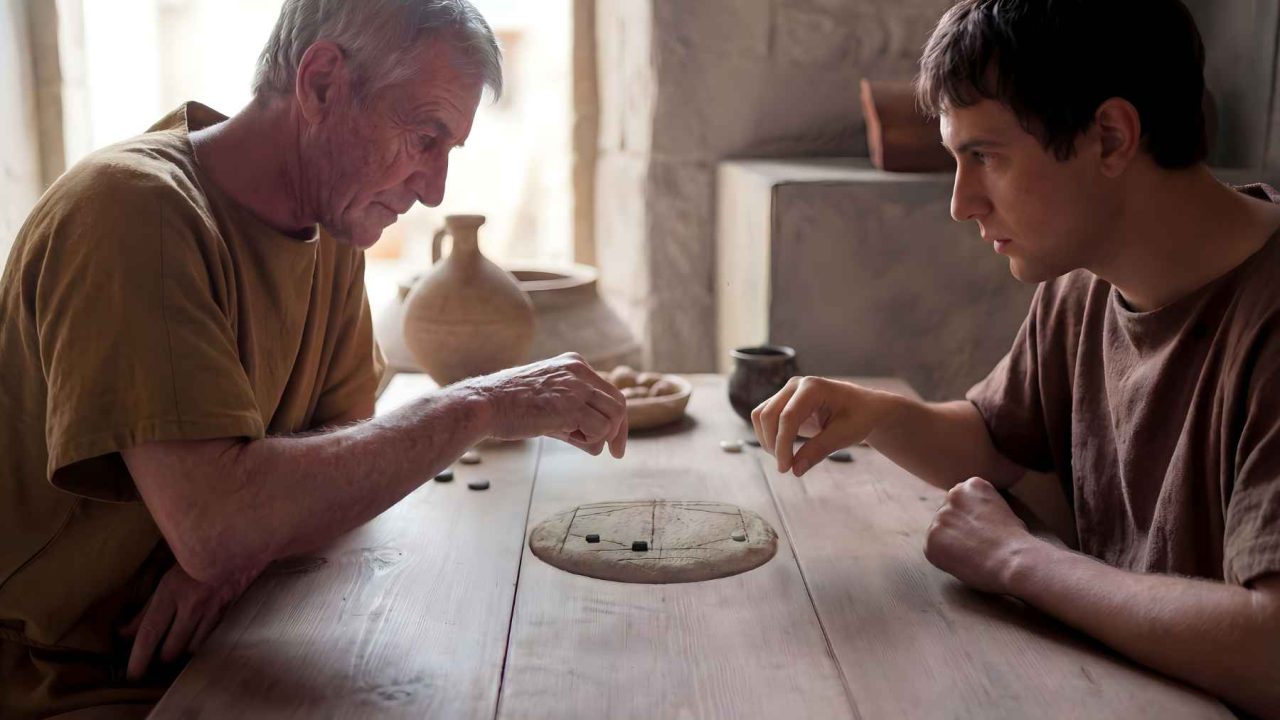
Here’s a claim that will make most classicists uncomfortable: we probably know far less about how Romans spent their leisure time than we think we do. The board games, the betting, the strategies scratched into stone courtyards and tavern floors — most of it has been guesswork dressed up as scholarship. And a small, unremarkable limestone slab sitting in a museum in Heerlen, the Netherlands, may be about to prove exactly that.
Known simply as Object 04433 at Het Romeins Museum, the stone measures roughly 8.35 by 5.71 inches and weighs just 7.45 pounds. It looks, at first glance, like a broken piece of architectural rubble. But the wear patterns carved into its surface, and the inscription etched along its edge, tell a story that archaeologists are only now beginning to read — with help from artificial intelligence.
Why a Worn Stone in Heerlen Is Suddenly the Most Interesting Object in Roman Archaeology
The story begins not with a dramatic excavation, but with a museum visit. Archaeologist Walter Crist was examining Object 04433 when he noticed something unexpected: a smoother band running parallel to the stone’s diagonal carved line, roughly 0.63 to 0.71 inches away from the carving itself. That kind of wear doesn’t happen by accident. It happens when hands, or game pieces, move repeatedly across the same path over years.
The limestone itself offers important clues. It’s white Jurassic limestone from the Norroy quarries in northeastern France, a material commonly used in Roman construction across the region. The stone’s dimensions are precise: 212 by 145 by 71 millimeters. Someone shaped this deliberately. Someone used it repeatedly. And someone inscribed it with text that has resisted easy translation for decades.
A new study published online on February 11, 2026, brought together archaeologists, historians, and computer scientists to tackle the problem systematically. The goal wasn’t just to read the inscription. It was to reconstruct an entire lost game from physical evidence alone.
How the Ludii AI System Tested 130 Game Configurations in Under a Day
This is where the science gets genuinely remarkable. The research team didn’t simply run the inscription through a translation algorithm. They built a computational framework to test what kind of game could have been played on this specific board, with these specific dimensions and wear patterns.
Researchers constructed 130 candidate game configurations, mixing and matching rule elements drawn from documented European games. Then they deployed Ludii, an AI game system developed by Maastricht University, to simulate each one. Two computer players ran 1,000 rounds for each board and ruleset combination, with approximately one second of processing time per move.
“We developed Ludii, a form of artificial intelligence that can deduce game rules.”
— Dennis Soemers, researcher and Ludii developer, Maastricht University
The AI wasn’t just playing games for fun. It was evaluating each configuration for something specific: balance. A well-designed game, ancient or modern, tends to produce competitive outcomes rather than one-sided walkovers. Configurations that generated consistently lopsided results were eliminated. Those that produced close, dynamic play were flagged as plausible candidates for what the Romans actually intended.
This approach borrows from modern game theory and computational archaeology, a field that has expanded rapidly as processing power has made large-scale simulation feasible. The same logic that helps modern designers balance video games is now being applied to stones carved two millennia ago.
| Method | Tool Used | What It Revealed |
|---|---|---|
| Physical analysis | Visual inspection, measurement | Wear patterns suggesting repeated game use |
| Material sourcing | Geological analysis | Norroy quarry origin in northeastern France |
| Inscription decipherment | AI-assisted language analysis | Possible game rules or player names encoded in Latin text |
| Rule reconstruction | Ludii AI (Maastricht University) | 130 configurations tested; balanced gameplay candidates identified |
The Broader AI Revolution in Ancient Text Decipherment
Object 04433 doesn’t exist in a vacuum. It arrives at a moment when AI is fundamentally transforming what archaeologists and classicists can recover from the ancient world. The most dramatic recent example is the Vesuvius Challenge, in which researchers used machine learning to read a carbonized scroll that survived the eruption of Mount Vesuvius. The scroll had been unreadable for nearly 2,000 years. AI changed that in a matter of months.
Oxford researchers have used similar techniques to decode ancient papyrus documents. Each breakthrough builds on the last, expanding the toolkit available to scholars who study the ancient world. What’s different about the Heerlen stone is the specific application: rather than recovering text that was always meant to be read, researchers are using AI to reconstruct behavior — how people actually played, competed, and interacted.
This matters because games are social documents. They encode values, social hierarchies, and cognitive priorities in ways that formal texts rarely do. A Roman soldier scratching a game board into a stone floor wasn’t writing for posterity. He was playing. That unself-conscious act preserves something that official inscriptions and literary texts almost never capture.
What the Inscription Itself May Actually Say
The inscription on Object 04433 remains the central puzzle. Roman game boards often carried text: player names, dedications, taunts, or abbreviated rule reminders. The wear pattern Crist identified, that smooth band running 16 to 18 millimeters from the diagonal carving, suggests the inscription wasn’t purely decorative. It was positioned where a player’s hand or piece would naturally travel.
Traditional Scholarship
Object 04433 Analysis
General Roman Archaeology
| Metric | Traditional Scholarship | Object 04433 Analysis | General Roman Archaeology |
|---|---|---|---|
| Written Records |
72 |
58 |
80 |
| Physical Artifacts |
45 |
82 |
65 |
| AI Analysis |
10 |
88 |
35 |
| Wear Pattern Data |
30 |
91 |
42 |
| Inscription Clarity |
55 |
74 |
68 |
| Contextual Dating |
60 |
79 |
75 |
| Strategic Rules Known |
25 |
67 |
38 |
If the inscription encodes game rules or move sequences, it would be extraordinarily rare. Most Roman game boards that survive are unmarked or carry only numerical sequences. A board with inscribed instructions would force scholars to reconsider how formally Romans understood and transmitted game knowledge. It would suggest a level of codification, of treating games as rule-governed systems worth preserving, that current scholarship largely attributes to much later periods.
The implications extend beyond gaming history. If Romans were encoding procedural knowledge in stone, the same techniques may have been used for other practical information that hasn’t yet been recognized as such. Object 04433 may be the first of many artifacts that need reexamination through this lens.
What Comes Next for Object 04433 and Computational Archaeology
The February 2026 study is explicitly a beginning, not a conclusion. The research team has identified plausible game configurations, but the inscription itself still needs deeper linguistic analysis. Future work will likely combine the Ludii simulations with more detailed imaging of the stone’s surface, potentially using multispectral scanning to reveal text that has faded below visual detection.
Maastricht University’s continued development of Ludii means the tool will only become more powerful. As more ancient game boards are digitized and added to comparative databases, the AI’s ability to identify meaningful patterns will improve. Object 04433 may ultimately serve as a calibration point, a known artifact against which future discoveries can be measured.
There’s also a broader institutional shift underway. Museums across Europe are beginning to treat their unclassified collections with new urgency, recognizing that objects dismissed as architectural debris may be waiting for the right analytical tool. The Heerlen stone spent decades as a catalogued curiosity. It took a combination of an attentive archaeologist and a sophisticated AI to reveal what it actually was.
That combination, human intuition paired with computational scale, is becoming the defining methodology of 21st-century archaeology. The field has always been about recovering lost voices. Now it has instruments powerful enough to hear whispers in stone.
The Romans who played on Object 04433 never imagined their game would survive two millennia. They certainly never imagined it would take an artificial intelligence to finally understand the rules they carved into limestone on a cold afternoon in what is now the Netherlands. But here we are, and the game, it turns out, is still being played.
Frequently Asked Questions

You Might Also Like

Denmark’s Red Streetlights Spark a Fight Over Bats vs Safety
Denmark replaced white streetlights with red LEDs on a 0.4-mile stretch to protect bat corridors.…

This 3-Gram Shrew Has a Flat Head, Hairy Tail, and a Heartbreaking Origin Story
Crocidura stanleyi weighs just 3 grams. Discovered in Ethiopian Highlands, this dwarf shrew has a…

JWST’s ‘Little Red Dots’ Aren’t Galaxies. They’re Infant Black Holes on a Feeding Frenzy
JWST's mysterious 'little red dots' aren't early galaxies. A new Nature study reveals they're rapidly…
Leave a Reply