
▶ Read transcript
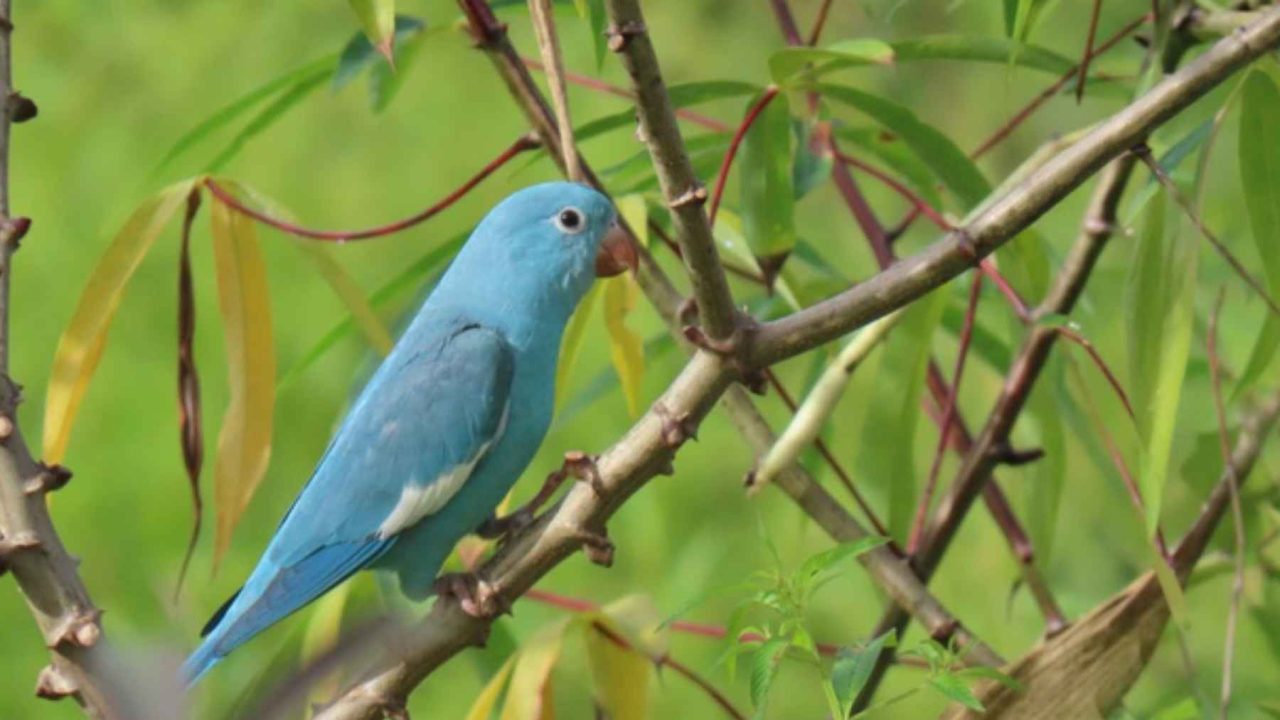
Here’s what you need to know about a remarkable wildlife discovery in Brazil. On April 2nd, 2026, environmental analyst Bianca Montanaro photographed a yellow-chevroned parakeet with striking blue plumage in Tocantins, Brazil. This is an extraordinarily rare condition called cyanism, occurring in fewer than one in several thousand parrots in the wild. The blue color appears because a genetic mutation shuts down the bird’s production of psittacofulvin pigments, the yellow and red molecules parrots uniquely synthesize internally. Without that yellow layer, only the underlying blue structural color of the feathers is visible. What concerns ornithologists is that this bird’s conspicuous blue plumage essentially eliminates its camouflage, making it highly vulnerable to predators. Yet it survived to adulthood, raising questions about whether this mutation might be more common in the local population than previously thought. If you’re in wildlife observation or conservation, report any unusually colored wild parrots to local researchers, because every sighting helps scientists assess genetic diversity and population health.
Fewer than one in every several thousand parrots displays cyanism in the wild. On April 2, 2026, environmental analyst Bianca Montanaro photographed one of those vanishingly rare individuals: a yellow-chevroned parakeet (Brotogeris chiriri) with vivid blue plumage, feeding calmly in a cornfield in São Félix do Tocantins, Tocantins, Brazil. The bird stood out like a sapphire dropped among emeralds, surrounded by a flock of its normally green-colored companions.
Montanaro described the sighting as “rare and valuable.” She was right. But the implications of this single blue bird stretch far beyond its beauty, touching on parrot biochemistry, genetic fragility, and the hidden pressures facing Brazil’s wild bird populations.
What Cyanism Actually Does to a Parrot’s Feathers
The blue parakeet didn’t acquire its color from diet or environment. Cyanism is a genetic condition that strips away psittacofulvin pigments, the molecules responsible for yellow, orange, and red tones in parrot feathers. Without those warm-spectrum pigments, only the underlying blue structural color remains visible.
This structural blue isn’t produced by pigment at all. It comes from the physical arrangement of nanoscale structures within the feather itself, which scatter light in a way that produces blue wavelengths. In a normal parrot, yellow psittacofulvin pigment layers over this blue structure, and the combination creates green.
A 2024 paper published in Science, led by researcher Roberto Arbore, mapped the chemistry behind yellow-to-red color variation in parrots. The team linked it to psittacofulvin pigment processing during feather growth. This research confirmed something remarkable: unlike carotenoid pigments that many animals obtain from food, parrots produce psittacofulvin pigments inside their own bodies.
That internal production system makes parrot coloration fundamentally different from, say, a flamingo turning pink from shrimp. When a mutation disrupts the psittacofulvin pathway in a parrot, the bird cannot compensate by changing its diet. The color loss is permanent and total.
| Trait | Normal Yellow-Chevroned Parakeet | Cyanistic Parakeet |
|---|---|---|
| Primary Feather Color | Green | Blue |
| Psittacofulvin Pigments | Present (yellow, orange, red) | Absent or severely reduced |
| Blue Structural Color | Present but masked by yellow | Fully visible |
| Pigment Source | Internally synthesized | Synthesis pathway disrupted |
| Camouflage Effectiveness | High (blends with foliage) | Low (highly conspicuous) |
Why a Single Blue Bird in Tocantins Alarms Ornithologists
A cyanistic parrot in captivity is a curiosity. A cyanistic parrot in the wild is a signal. The distinction matters enormously.
In captive breeding programs, color mutations are deliberately selected and amplified. Breeders prize blue budgerigars, lutino cockatiels, and other variants precisely because they’re unusual. But in wild populations, these mutations arise spontaneously and almost always carry survival costs.
“Rare and valuable” — that’s how environmental analyst Bianca Montanaro described the sighting of the cyanistic parakeet in São Félix do Tocantins.
— Bianca Montanaro, Environmental Analyst
The blue parakeet’s conspicuousness is its greatest vulnerability. Yellow-chevroned parakeets thrive around open areas and human activity, but their green plumage still provides crucial camouflage against predators like hawks and falcons. A blue bird feeding in a cornfield is, to a raptor’s eyes, essentially wearing a target.
Yet this bird survived long enough to be photographed as a seemingly healthy adult, feeding among its flock. That survival raises questions. Is the mutation more common in this population than anyone realized? Are there other cyanistic individuals hiding in plain sight across Brazil’s vast interior?
Brazil’s Complicated Relationship with Rare Genetic Discoveries
Brazil occupies a unique position in global genetics research. The country’s extraordinary biodiversity, combined with its complex human population genetics, has made it a recurring source of startling genetic findings.
Consider the human side. Brazil has hundreds of thousands of individuals carrying a rare mutation in the TP53 tumor suppressor gene, linked to Li-Fraumeni Syndrome. A 2026 study of Brazilian supercentenarians revealed more than 2,000 mobile element insertions and over 140 HLA alleles absent from global genomic databases. The country has even integrated Whole Exome Sequencing into its public health system to accelerate rare disease diagnosis.
On the wildlife side, Brazil’s avian diversity is staggering. The country hosts more than 1,900 bird species. With that diversity comes an enormous reservoir of genetic variation, including rare mutations that might never surface in smaller, less diverse populations.
The cyanistic parakeet sits at the intersection of these two realities. Brazil’s ecosystems harbor genetic secrets that science is only beginning to catalog. Every unusual phenotype spotted in the wild represents a data point that could illuminate broader patterns of mutation, selection, and population health.
The Survival Paradox of Conspicuous Mutations
Here’s what puzzles researchers most: cyanistic birds should not last long in the wild. Predation pressure alone should eliminate highly visible individuals before they reach reproductive age. Yet documented cases of wild cyanistic parrots, while exceedingly rare, do exist across South America.
Several hypotheses attempt to explain this paradox. One possibility is that the mutation is recessive, carried silently by many individuals in a population but only expressed when two carriers mate. Under this model, the visible blue bird is just the tip of a genetic iceberg.
Another hypothesis involves flock dynamics. Yellow-chevroned parakeets are highly social and move in groups. A conspicuous individual embedded in a large flock may benefit from the collective vigilance and confusion effect that flocking provides against predators. The blue bird doesn’t need to be camouflaged if the flock itself provides protection.
A third, more concerning possibility relates to population bottlenecks. When populations shrink due to habitat loss, disease, or other pressures, recessive alleles can become more common through genetic drift. A cyanistic individual appearing in the wild could, in theory, signal reduced genetic diversity in the local population.
You’re a wildlife biologist in Brazil and you spot a second cyanistic parakeet in the same region just weeks after the first was photographed. You have limited funding and must choose how to respond.
What Researchers Plan to Do Next
The São Félix do Tocantins sighting has already prompted calls for follow-up fieldwork. Ornithologists want to determine whether this is an isolated individual or part of a population carrying the cyanism allele at higher-than-expected frequency.
Genetic sampling of wild Brotogeris chiriri populations in the Tocantins region could reveal carrier rates for the mutation. If the allele is widespread, it would suggest either a founder effect (the local population descending from a small number of ancestors who happened to carry the gene) or recent inbreeding pressure.
The 2024 Science paper by Arbore and colleagues provides a molecular framework for this investigation. By identifying the specific genes involved in psittacofulvin processing, researchers now have targets to screen for in wild populations. The technology exists. The question is funding and access.
Brazil’s recent integration of advanced genetic sequencing into its public health system demonstrates the country’s growing capacity for genomic research. Extending similar tools to wildlife conservation could transform how scientists monitor genetic health in wild bird populations.
The Bigger Picture for Parrot Conservation Worldwide
Parrots are among the most threatened bird groups on the planet. Habitat destruction, the illegal pet trade, and climate change have pushed dozens of species toward extinction. In this context, understanding the genetic health of remaining wild populations is not academic. It is urgent.
Cyanism itself is not dangerous to a species. But its appearance in the wild serves as a biological indicator, much like a canary in a coal mine (or, more aptly, a blue parakeet in a cornfield). When rare recessive traits begin surfacing, it can mean that genetic diversity is narrowing.
The yellow-chevroned parakeet is not currently endangered. It adapts well to human-modified landscapes and maintains large populations across central Brazil. But “not currently endangered” is a status that can change with alarming speed when genetic diversity erodes beneath the surface.
Montanaro’s photograph from that Tocantins cornfield may end up being more than a beautiful image. It may be an early warning. The blue feathers of a single small parrot, glowing against a backdrop of green corn and green companions, could be telling us something about the invisible genetic currents flowing through Brazil’s wild bird populations.
Whether we listen depends on what happens next.




Leave a Reply