
▶ Read transcript
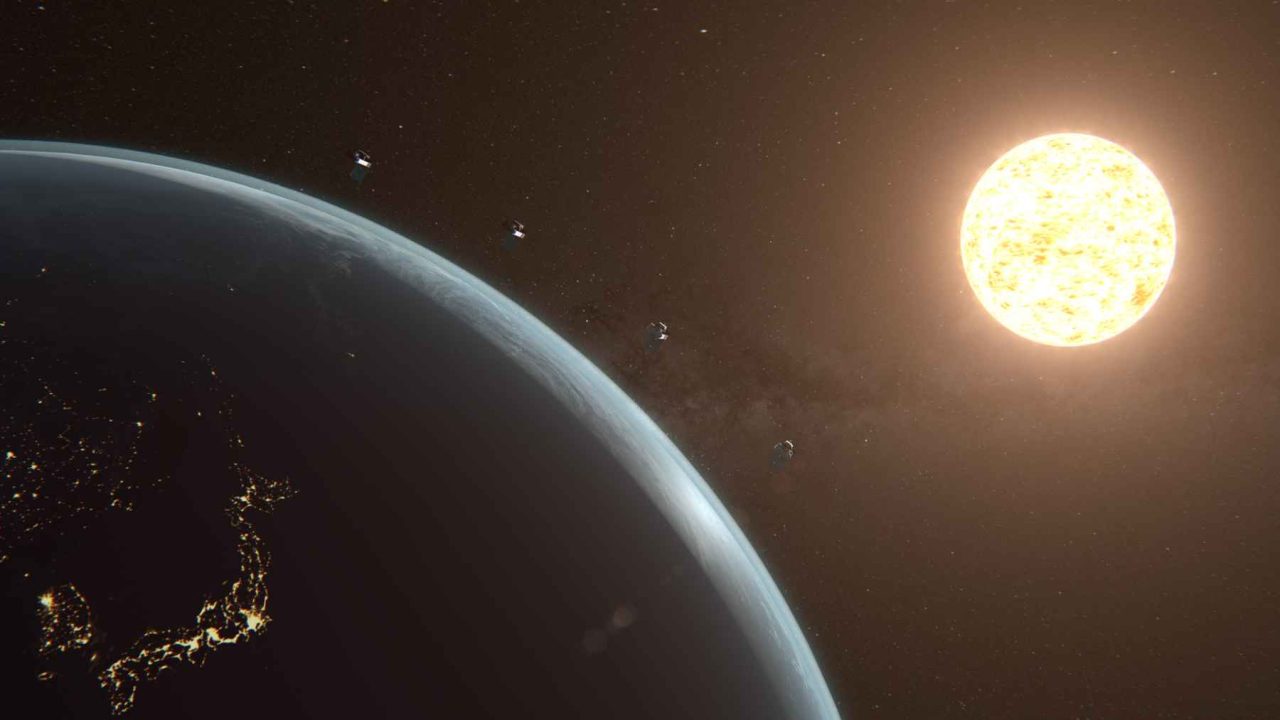
Here’s what you need to know about a growing crisis in space that could affect your daily life on the ground. The Sun has entered its solar maximum, the peak of its 11-year activity cycle, and it’s the most intense one in over two decades. The problem is that low Earth orbit is now packed with thousands more satellites than ever before. Researchers track something called the CRASH Clock, which estimates how quickly a collision would happen if satellites stopped dodging each other. In 2018, that number was 164 days. As of March 2026, it’s dropped to just 3 days, with objects passing within one kilometer of each other roughly every 36 seconds. Solar storms make this worse by heating the atmosphere, increasing drag, and pushing satellites off their predicted paths. During one storm in May 2024, nearly half of all active low Earth orbit satellites had to maneuver in just three days. SpaceX alone performed over 144,000 collision avoidance maneuvers in six months. The takeaway: pay attention to space weather alerts, because a major collision event could disrupt the GPS, communications, and weather forecasting systems we all depend on every single day.
What if the biggest threat to your morning commute, your phone’s GPS, and the weather forecast on your screen didn’t come from hackers, earthquakes, or war, but from a star 93 million miles away?
That star is our Sun. And right now, it is angrier than it has been in over two decades.
Solar Maximum Arrives at the Worst Possible Moment
In October 2024, NASA and NOAA jointly announced that the Sun had entered the maximum phase of its 11-year activity cycle. Solar maximum means more sunspots, more coronal mass ejections, and far more energetic storms blasting charged particles toward Earth.
This is a natural rhythm. The Sun has done this for billions of years. But this time, something is fundamentally different: there are thousands more satellites in the path of those storms than ever before.
Low Earth orbit has become a far more crowded, far more dangerous place. And the Sun is making it worse in ways that few outside the space-tracking community fully appreciate.
The CRASH Clock: A Countdown Nobody Wanted
Researchers at the Outer Space Institute maintain a metric called the CRASH Clock. CRASH stands for Collision Realization And Significant Harm. It answers one chilling question: if every satellite and rocket body in low Earth orbit stopped performing collision avoidance maneuvers right now, how long before two objects smash into each other?
On January 1, 2018, the answer was 164 days. By June 25, 2025, it had dropped to 5.5 days. As of March 20, 2026, it stands at just 3.0 days.
| Date | CRASH Clock Value | Close Approaches (within 1 km) |
|---|---|---|
| January 1, 2018 | 164 days | Every 3.9 minutes |
| June 25, 2025 | 5.5 days | Every 36 seconds |
| March 20, 2026 | 3.0 days | Data pending |
Let those numbers settle in. Objects in low Earth orbit now pass within one kilometer of each other roughly every 36 seconds. At around 550 kilometers altitude, the sweet spot for mega-constellations like Starlink, close approaches within one kilometer happen approximately every 22 minutes.
This is the orbital environment into which the Sun is now dumping enormous amounts of energy.
How Solar Storms Turn Satellites Into Sitting Ducks
When the Sun erupts, it doesn’t just send pretty auroras dancing across polar skies. Coronal mass ejections and solar wind carry energy that heats Earth’s upper atmosphere. That heating causes the atmosphere to expand, pushing thicker air into altitudes where satellites orbit.
Thicker air means more drag. More drag means satellites slow down, drop altitude, and drift off their predicted paths. Suddenly, the orbital calculations that keep thousands of spacecraft from colliding become unreliable.
That May 2024 event was a preview. With the Sun now at solar maximum, storms of that magnitude could recur multiple times per year. Each one forces mass-maneuvering events that strain tracking systems, burn precious satellite fuel, and create cascading uncertainty about where every object in orbit actually is.
144,404 Maneuvers and Counting: SpaceX’s Collision Avoidance Overload
SpaceX operates the largest satellite constellation in history. Between December 1, 2024, and May 31, 2025, the company reported performing 144,404 collision avoidance maneuvers for its Starlink fleet alone. That number has historically doubled about every six months.
Each maneuver is a small rocket burn that shifts a satellite’s orbit to avoid a predicted close encounter. In isolation, each one works. But every maneuver introduces a new problem: position uncertainty.
Right after a maneuver, a satellite’s actual position can be off from its predicted position by up to 40 kilometers. That is roughly 25 miles of uncertainty in an environment where objects close to within one kilometer every 36 seconds.
Now multiply that uncertainty across tens of thousands of active satellites, all maneuvering simultaneously during a solar storm. The tracking data that collision-avoidance systems depend on becomes temporarily unreliable. The safety net frays at the exact moment it is needed most.
Why GPS, Communications, and Weather Forecasts Are All at Stake
This isn’t an abstract problem for aerospace engineers. Modern civilization runs on satellite infrastructure. GPS navigation guides commercial aviation, shipping, ride-sharing apps, and precision agriculture. Weather satellites feed the forecast models that warn coastal cities about hurricanes. Communication satellites connect remote communities, enable financial transactions, and support military operations worldwide.
You lead a satellite constellation company with 2,000 spacecraft in low Earth orbit. A major solar storm is forecast to hit in 48 hours. Your collision avoidance system is already performing record numbers of maneuvers, and each maneuver creates up to 40 km of position uncertainty. You must decide how to respond.
A single catastrophic collision in low Earth orbit would generate thousands of debris fragments. Each fragment becomes a new projectile, capable of triggering more collisions. This cascading scenario, known as Kessler Syndrome, could render entire orbital bands unusable for decades.
“A great change in our stewardship of the earth and the life on it is required, if vast human misery is to be avoided and our global home on this planet is not to be irretrievably mutilated.”
— World Scientists’ Warning to Humanity
That warning was originally about environmental stewardship on Earth’s surface. But its logic extends upward. We have filled low Earth orbit with critical infrastructure while assuming the environment up there would remain stable and predictable. The Sun is now demonstrating otherwise.
The Collision Between Solar Physics and Orbital Crowding
The core problem is a collision of timelines. Mega-constellations have exploded in number over the past five years. Starlink alone operates thousands of spacecraft. Amazon’s Project Kuiper, OneWeb, and dozens of other operators are adding more every month.
Simultaneously, the Sun has entered its most active phase in over two decades. These two trends were always going to intersect. That intersection is now.
Scientists are not saying a catastrophe is inevitable. They are saying the safety margins that once protected orbital operations have eroded dramatically. The CRASH Clock dropping from 164 days to 3 days in eight years tells the story in a single metric.
What Can Be Done?
Several responses are under discussion. Better space weather forecasting would give satellite operators more lead time before storms hit. Improved tracking systems, possibly using ground-based radar and space-based sensors together, could reduce the 40-kilometer position uncertainty after maneuvers.
International coordination on orbital traffic management remains the biggest gap. There is no global air-traffic-control equivalent for space. Operators largely manage their own collision avoidance independently, with limited data sharing between nations and companies.
The Outer Space Institute continues to publish a live version of the CRASH Clock, offering the public a rare window into how quickly orbital conditions are deteriorating.
A Three-Day Warning We Cannot Afford to Ignore
The Sun will eventually quiet down. Solar maximum will give way to solar minimum over the next few years. But the satellites will still be there. More will launch. The orbits will grow more crowded. And the next solar maximum, expected around 2036, will arrive to find an even denser orbital environment.
Three days. That is the current buffer between controlled orbital traffic and uncontrolled collision. Three days assumes every operator keeps maneuvering perfectly, every tracking system stays accurate, and no solar storm overwhelms the system all at once.
The threat that worries scientists most right now does not crawl along Earth’s surface or lurk in a laboratory. It streams outward from the Sun at a million miles per hour, invisible until it slams into an atmosphere we forgot was there. And when it does, the machines we built to connect the world could become the shrapnel that disconnects it.

Leave a Reply