
▶ Read transcript
Here’s what you need to know about a surprising experiment happening just outside Copenhagen. In February 2026, the Danish municipality of Gladsaxe installed thirty low red LED bollards along a half-mile stretch of road called Frederiksborgvej. The reason is that seven species of bats use this corridor to travel between feeding grounds and roosts, and conventional white LED streetlights were effectively blocking their path. White LEDs emit blue-rich light that scatters widely, creating bright zones that bats avoid because the exposure makes them vulnerable to predators. The red bollards sit just over three feet tall and are spaced about a hundred feet apart with intentional dark gaps, allowing bats to pass through safely. Critics argue the red light reduces visibility for cyclists and pedestrians, creating real safety concerns. Supporters counter that warm white lighting remains on the busier sections of the same road, making this a targeted intervention, not a blanket change. If you’re involved in urban planning or conservation, watch this project closely. It could become a model for how cities balance human infrastructure with wildlife needs before species reach crisis status.
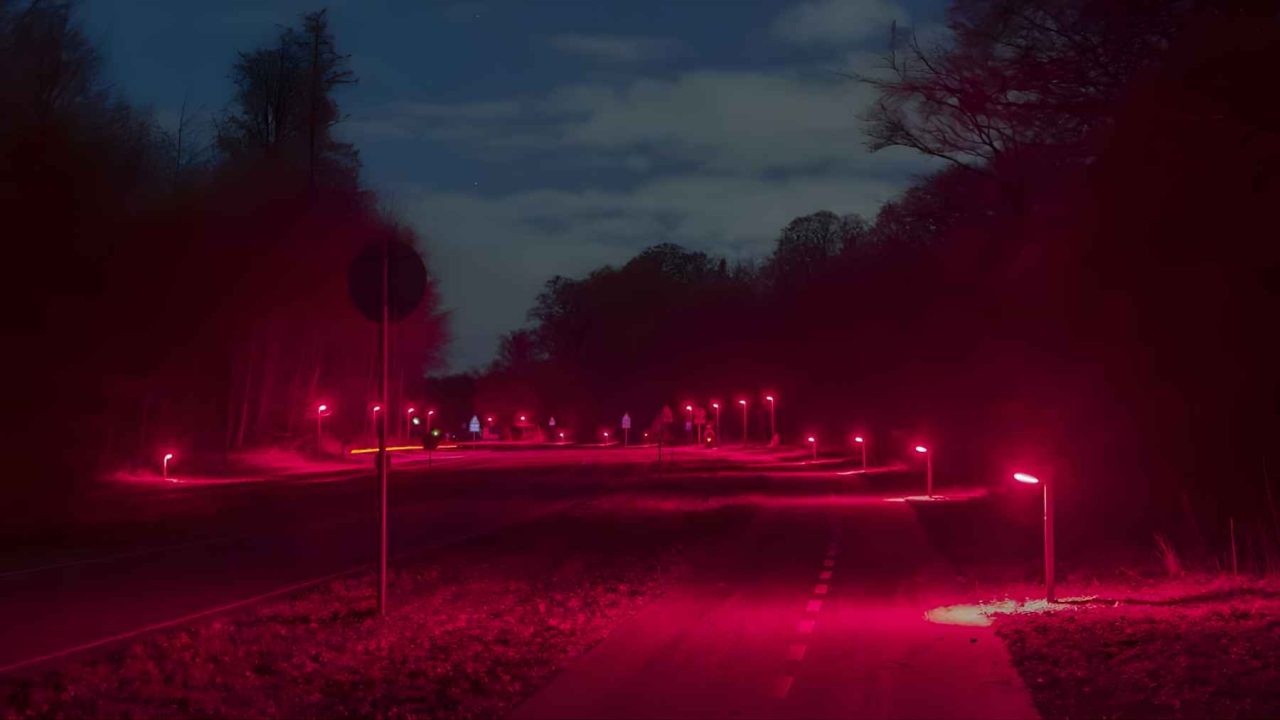
Darkness is infrastructure. That’s a strange sentence, and most city planners would reject it outright. For over a century, the goal of urban lighting has been simple: eliminate darkness. More light means safer streets, fewer accidents, less crime. But on February 8, 2026, drivers entering Gladsaxe, a municipality just outside Copenhagen, encountered something that flipped that logic on its head. Part of Frederiksborgvej was bathed in a deep, unmistakable red glow.
The red wasn’t a malfunction. It was deliberate. Thirty low bollards, each about 3.3 feet tall and spaced roughly 100 feet apart, now cast pools of red LED light along a 0.4-mile stretch of road. Between those pools: intentional gaps of near-darkness. The reason? Seven species of bats use this corridor to move through the suburban landscape, and white streetlights were blocking their path as effectively as a concrete wall.
Why White LEDs Act Like Walls for Bats in Gladsaxe
The debate here isn’t really about red versus white. It’s about what cities owe to species that operate on a completely different schedule than humans. To understand the controversy, you need to understand how modern streetlights changed the game for nocturnal wildlife.
White LEDs, which have rapidly replaced older sodium-vapor lamps across Europe, contain significantly more blue-rich light. That shorter-wavelength light scatters more aggressively through the atmosphere, amplifying light pollution far beyond the lamp’s immediate area. For humans, this means better color rendering and improved visibility. For bats, it means exposure.
| Factor | White LED Streetlights | Red LED Bollards (Gladsaxe) |
|---|---|---|
| Light Spectrum | Blue-rich, short wavelength | Long wavelength, minimal scatter |
| Height | Standard pole (15–30 ft) | Low bollard (~3.3 ft) |
| Spacing | Continuous illumination | ~100 ft apart with dark gaps |
| Bat Impact | Creates avoidance zones | Designed to allow passage |
| Human Visibility | Full-color, high clarity | Reduced color rendering |
Many bat species avoid bright, open areas because illumination makes them easier targets for predators. A brightly lit road doesn’t just inconvenience a bat. It fragments habitat, severing flight corridors that connect feeding grounds to roosts. For two local species identified as especially vulnerable to road impacts, including the most common bat in the Gladsaxe area, Frederiksborgvej was essentially impassable at night.
The Case for Red: Ecological Design as Urban Responsibility
Proponents of the Gladsaxe project argue that cities have spent decades engineering the night sky out of existence, and it’s time to push back. Philip Jelvard, a lighting designer from Light Bureau who worked on the project, put it plainly.
“The red light should make passersby aware ‘this is a special natural area which the municipality wishes to protect and preserve.'”
— Philip Jelvard, Light Bureau
The design isn’t reckless. Warm white light remains in place along sections of Frederiksborgvej with heavier pedestrian and vehicle traffic. Red is deployed only where ecological sensitivity is highest. The bollards are low to the ground specifically to minimize upward light spill, keeping illumination at ankle height rather than flooding the canopy where bats fly.
Supporters also point out that this isn’t just about bats. Light pollution disrupts insects, migratory birds, and even human circadian rhythms. The Gladsaxe project, they argue, is a proof of concept. If a suburb of Copenhagen can redesign a half-mile of road to coexist with wildlife, larger cities can follow.
The ecological argument is also preventive. None of the seven bat species recorded near Frederiksborgvej are currently listed as threatened. But two are considered more vulnerable to disruption from roads. Acting before a species reaches crisis status is far cheaper and more effective than emergency conservation measures later.
The Case Against: Safety Concerns and Scope Skepticism
Critics raise legitimate points. Red light dramatically reduces human color perception. Objects that would be clearly visible under white light become harder to distinguish. For cyclists using the nearby cycle route, or pedestrians walking after dark, the shift from white to red isn’t a minor aesthetic change. It’s a functional downgrade.
There’s also the question of scale and proportionality. As one Reddit commenter noted with some exasperation, “the nation of Denmark didn’t switch to red streetlights. One city in Denmark switched to red streetlights in one area.” The project covers 0.4 miles. Copenhagen’s greater metropolitan area spans hundreds of miles of illuminated roads. Framing this as a national transformation overstates what is, in practice, a localized experiment.
Safety advocates also question the precedent. If bats can trigger a lighting redesign on one road, what stops similar demands from scaling across entire municipalities? Urban infrastructure serves millions of people. Redesigning it around species that aren’t even endangered, critics say, risks prioritizing ecological symbolism over practical human needs.
There’s a cost dimension too, though specific budget figures for the Gladsaxe project haven’t been publicly detailed. Custom red LED bollards, ecological surveys, design consultations, and ongoing monitoring all add up. Municipalities with tighter budgets may view this as a luxury they can’t afford.
What Bat Research Actually Reveals About Light and Flight Corridors
The science on bats and artificial light is more settled than the public debate suggests. Multiple studies have documented that many bat species actively avoid artificially lit areas. The mechanism is straightforward: light exposes bats to predators and disrupts their echolocation-based hunting strategies.
White LEDs, which produce blue-rich light, are particularly problematic. Blue wavelengths scatter more in the atmosphere than red or amber wavelengths. This means a single white LED streetlight pollutes a much larger area of sky and habitat than its red equivalent. The physics isn’t controversial; it’s the same reason the sky is blue.
Red light, by contrast, sits at the long-wavelength end of the visible spectrum. It scatters less, penetrates less into surrounding habitat, and research suggests many bat species are less sensitive to it. The Gladsaxe design exploits this by combining red wavelength with low mounting height and intentional dark gaps between bollards.
Your city is retrofitting all streetlights with energy-efficient white LEDs. An ecological survey reveals that a major bat corridor crosses a 0.5-mile stretch of a residential road. You’re on the city planning committee.
The alternating light-dark pattern is crucial. A continuous line of even red light would still create a barrier. By spacing bollards 100 feet apart, the design creates windows of darkness wide enough for bats to cross the road corridor. It’s a nuanced approach that goes beyond simply swapping bulb colors.
Red Light Districts for Bats Deserve Serious Consideration
Here’s where I land: the Gladsaxe project is smart, proportionate, and worth replicating. Not because bats are more important than pedestrian safety, but because the project demonstrates they don’t have to be in conflict.
The design preserves warm white light where human traffic is heaviest. It deploys red only where ecological need is greatest. It uses low bollards instead of tall poles, keeping light at ground level for human wayfinding while minimizing sky glow. This isn’t an either/or trade-off. It’s a both/and solution.
The critics are right that 0.4 miles of red-lit road won’t save global bat populations. But that misses the point. Every urban wildlife corridor has to start somewhere specific. The question isn’t whether Gladsaxe alone will reverse light pollution’s ecological damage. The question is whether the design principles work well enough to scale.
Early indications suggest they do. The technology is off-the-shelf LED. The design logic, alternating pools of light and dark, is replicable on any road. And the ecological rationale applies to thousands of bat corridors across Europe, where white LED retrofits have accelerated over the past decade.
What Gladsaxe Means for Urban Lighting Across Europe
The implications extend well beyond Denmark. Cities across Europe are in the middle of massive LED retrofit programs, replacing old sodium-vapor lamps with white LEDs for energy savings and better visibility. Most of these programs include zero ecological assessment. Gladsaxe suggests that’s a mistake.
If white LEDs fragment bat corridors, then every retrofit is potentially an ecological intervention disguised as an energy upgrade. Cities that install thousands of new white LED fixtures without considering wildlife impacts may be creating problems they’ll need to spend far more to fix later.
The Gladsaxe model also raises a philosophical question that urban planners will increasingly face. As cities grow denser and wildlife habitat shrinks, who gets to use the night? For most of human history, that question answered itself. Darkness belonged to nocturnal animals. Artificial light claimed it for us.
Gladsaxe is one of the first places to formally negotiate a compromise. Thirty low bollards casting red light along a half-mile of suburban road, with dark gaps wide enough for bats to cross. It’s modest. It’s specific. And it might be the template for how every city eventually learns to share the dark.
The strangest part is that most residents of Gladsaxe will never see a bat on Frederiksborgvej. The animals they’re protecting are invisible to them, flying overhead in darkness, navigating by sound through corridors of air that no human eye can perceive. We’re redesigning cities for neighbors we’ll never meet.




Leave a Reply