
What if the ground beneath your feet has been moving your entire life, and you never once felt it?
Not metaphorically. Literally. The continent you live on is drifting, millimeter by millimeter, toward a collision that will reshape this planet beyond recognition. It has happened before. It will happen again. And the last time it did, nearly everything alive on Earth died.
That is not speculation. That is the geological record, written in rock and fossil and ancient ocean sediment, waiting for anyone patient enough to read it.
Pangea’s Violent Birth and the Mass Extinction It Triggered 252 Million Years Ago
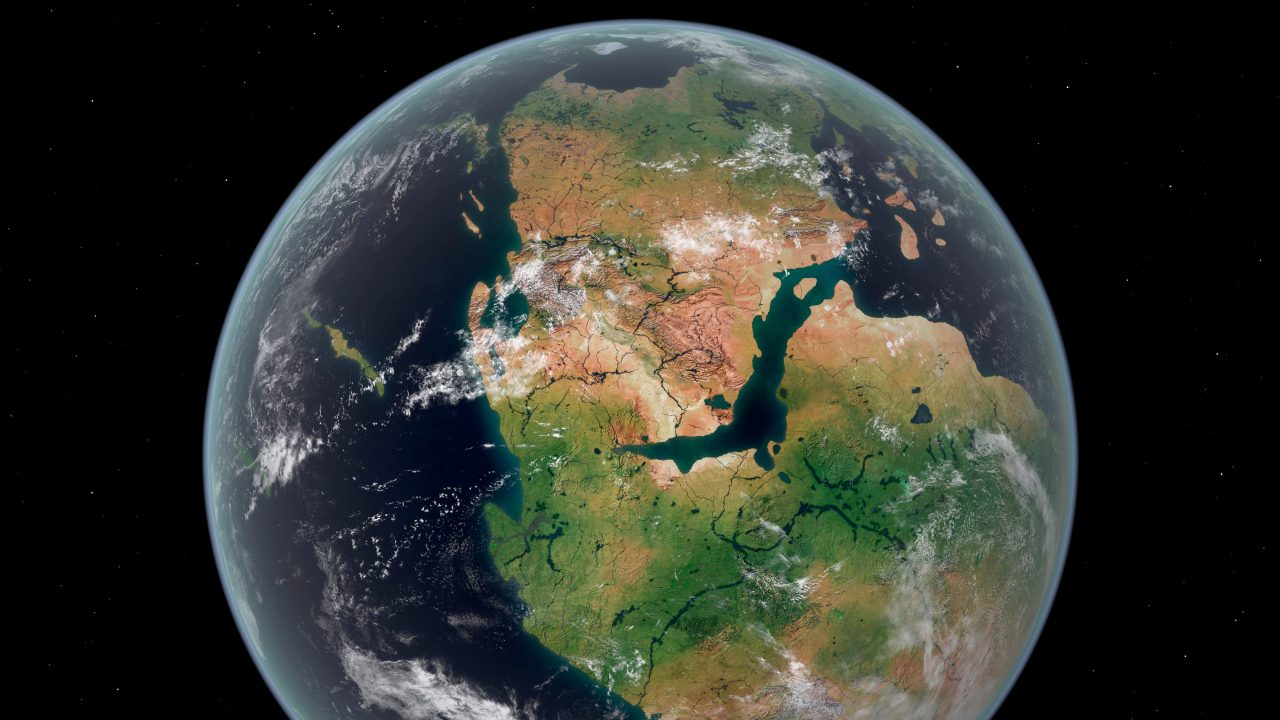
About 240 million years ago, all of Earth’s landmasses were fused into one enormous supercontinent called Pangea. It dominated the planet, a single vast body of rock surrounded by a global ocean called Panthalassa. Then, roughly 200 million years ago, Pangea began to crack apart. The Atlantic Ocean was born in fire and fracture, as volcanic activity tore the land open along what is now the eastern seaboard of North America and the western coast of Europe and Africa.
But the story of Pangea does not begin with its breakup. It begins with what happened just before it fully formed, during the transition from the Permian period to the Triassic. Around 252 million years ago, Earth experienced the most catastrophic extinction event in its history. Scientists at NASA have described it plainly: most of the life on Earth perished in a brief moment of geologic time. Researchers call it the Permian-Triassic extinction, or simply “the Great Dying.”
More than 90 percent of marine species vanished. Around 70 percent of terrestrial vertebrate species disappeared. The planet essentially had to start over.
The Triassic period that followed lasted about 50.5 million years, from 251.9 million years ago to roughly 201.3 million years ago. And then, almost as if on cue, another mass extinction struck at its end. The climate shifted, massive volcanic eruptions reshaped the atmosphere, and the world changed again. The causes of the end-Triassic extinction are still not entirely understood, but the pattern is hard to ignore: supercontinent formation and breakup correlate with some of the deadliest chapters in Earth’s biological history.
Four Possible Futures: How Scientists Model the Next Supercontinent
Here is where the story stops being ancient history and starts being something closer to prophecy.
Researchers, including Hannah Sophia Davies and her colleagues, have outlined four distinct scenarios for how Earth’s continents could merge over the next 200 to 250 million years. Each has a name. Each has a radically different geography. And each carries its own set of consequences for the climate, the oceans, and whatever life exists at the time.
| Supercontinent Name | Ocean Behavior | Location on Earth | Climate Risk |
|---|---|---|---|
| Novopangea | Atlantic stays open; Pacific closes | Mid-latitudes | Extreme interior heat |
| Pangea Proxima | Atlantic closes; Pacific closes | Near current position | Severe continental aridity |
| Aurica | Atlantic and Pacific both close; Indian Ocean opens | Straddling the equator | +3°C global average temperature |
| Amasia | Continents drift north; Antarctica isolated | Clustered near North Pole | Disrupted currents; possible ice age |
The Aurica model was developed by Portuguese geophysicist João C. Duarte and colleagues. In this scenario, both the Atlantic and Pacific oceans close while the Indian Ocean expands. The result is a single landmass sitting directly on the equator, baking under the most intense solar radiation on the planet.
Climate simulations led by Michael J. Way at NASA’s Goddard Institute for Space Studies found that in the Aurica scenario, global average temperatures would rise by approximately three degrees Celsius compared to today’s baseline. That may sound modest. But consider that a two-degree rise above pre-industrial levels is considered catastrophic by current climate science. Three degrees above today’s already-warmer baseline would push vast interior regions of the supercontinent into permanent, lethal heat zones.
Amasia presents a different kind of horror. With ocean currents disrupted by the radical rearrangement of landmasses, Earth could lock into a long-lived ice age. The kind that doesn’t end in a few thousand years. The kind that reshapes evolutionary possibility for millions of years.
Why Mammals — and Humans — Are Particularly Vulnerable to Supercontinent Climate Shifts
There is a reason scientists specifically flag mammals when modeling supercontinent futures. Mammals are warm-blooded. We regulate our internal temperature within narrow ranges. We are exquisitely sensitive to sustained heat. A world where the interior of a continent 200 million years in the future sits at temperatures that regularly exceed 50 degrees Celsius is not a world where mammalian biology functions.
Reptiles survived the Great Dying and the end-Triassic extinction because their metabolisms are more flexible. Insects, fungi, and microbial life are almost impossible to fully extinguish. But large, warm-blooded creatures with complex social structures and high caloric needs? The geological record does not treat them kindly during planetary reorganizations.
“Most of the life on Earth perished in a brief moment of geologic time roughly 250 million years ago.”
— NASA Science, on the Permian-Triassic Extinction Event
The honest answer to whether humans specifically would survive a supercontinent formation is: almost certainly not. Not because the event is violent in any sudden sense. Plate tectonics moves at roughly the same pace as a growing fingernail, a few centimeters per year. The danger is not the movement itself. It is the cascading climate consequences that accumulate over millions of years as landmasses converge.
| Supercontinent | Time Formed (Ma) | Time Broke Apart (Ma) | Size Relative to Earth | Associated Extinction Event | Global Ocean |
|---|---|---|---|---|---|
| Pangea | 335 million years ago | 175 million years ago | ~30% of Earth's surface | End-Permian (96% species lost) | Panthalassa |
| Rodinia | 1.1 billion years ago | 750 million years ago | ~25% of Earth's surface | Cryogenian glaciation | Mirovia |
| Columbia (Nuna) | 1.8 billion years ago | 1.5 billion years ago | ~18% of Earth's surface | Unknown — limited fossil record | Proto-Tethys |
| Gondwana | 600 million years ago | 180 million years ago | ~22% of Earth's surface | End-Ordovician (85% species lost) | Paleo-Tethys |
| Pangea Ultima (Predicted) | 250 million years from now | Unknown | ~35% of Earth's surface | Mass extinction predicted | Unknown |
Ocean circulation patterns that currently moderate global temperatures would be destroyed. Monsoon systems that billions of people depend on would collapse or relocate entirely. The interior of a supercontinent, far from any ocean moisture, would become a desert of almost incomprehensible scale. And if the supercontinent forms near the equator, as in the Aurica scenario, the heat load on that interior would be extreme.
The 200-Million-Year Warning Nobody Will Ever Hear
There is something philosophically vertiginous about all of this. The timescales involved are so vast that no human institution, no civilization, no species as we currently understand ourselves will exist to witness the outcome. Homo sapiens has been around for roughly 300,000 years. The next supercontinent is 200 million years away. That is nearly 700 times longer than our entire species history.
And yet the science matters. Not because we can stop it or prepare for it in any practical sense. It matters because it reveals something about the nature of Earth itself: this planet is not a stable backdrop for life. It is an active, churning system that has repeatedly reorganized itself in ways that made most existing life impossible.
We are alive right now during a relatively calm window between catastrophes. The continents are spread out. The oceans circulate. The climate, even with human-driven disruption, remains within ranges that support complex life. That is not the permanent state of this planet. It is a temporary condition.
The Geological Survey of Ireland notes that Pangea began breaking apart about 200 million years ago, and over millions of years those pieces drifted into the continents we recognize today. What took 200 million years to scatter will take another 200 million years to reassemble. And when it does, the planet that results will be as alien to mammalian life as the surface of Venus.
The question is not whether it will happen. The rock record makes that clear. The question is what it means to be alive on a planet that has already decided, in its slow tectonic way, what comes next, and simply hasn’t told anyone yet.


Leave a Reply