
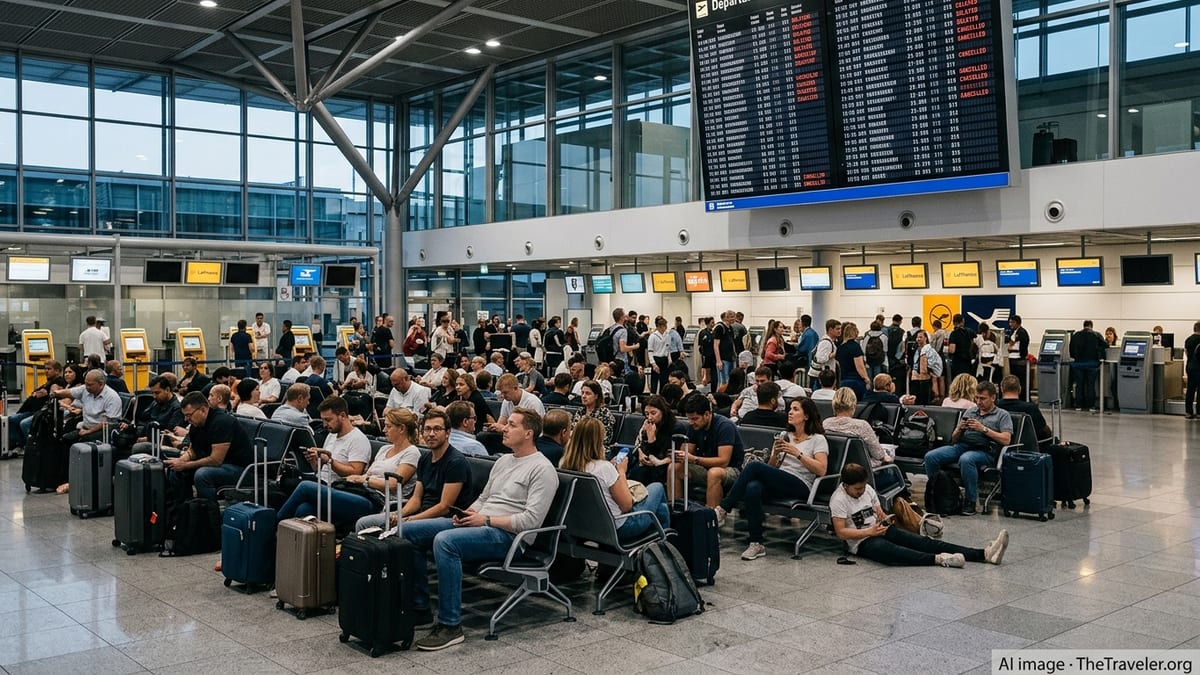
More than 200 flights have been disrupted across two of Germany’s busiest airports, leaving hundreds of passengers stranded, rerouting plans in chaos, and raising urgent questions for anyone with travel booked through Frankfurt or Munich right now.
Frankfurt International Airport and Munich International Airport are reporting a combined total of 214 flight delays and 3 cancellations, with the disruptions hitting major carriers including Lufthansa and EasyJet. Routes affected span domestic German destinations, European connections, and long-haul flights to North America — meaning the fallout is being felt far beyond Germany’s borders.
If you’re flying through either airport today, or have a connection routed through one of them, here’s what the disruption looks like and what you need to know.
What’s Happening at Frankfurt and Munich Airports
Germany’s aviation sector is dealing with widespread disruption across its two flagship international hubs simultaneously. Frankfurt International Airport, one of the busiest airports in all of Europe, and Munich International Airport, a major gateway for both European and transatlantic travel, are both reporting significant operational problems.
The combined figure of 214 delays is not a minor blip. For context, Frankfurt alone handles hundreds of flights daily, serving as a critical connecting hub for passengers traveling between North America and destinations across Europe, the Middle East, and Asia. When delays cascade at a hub this size, the knock-on effects spread quickly — missed connections, rebooking queues, and overnight stranding become the reality for large numbers of travelers.
The 3 cancellations, while smaller in number, represent complete disruptions for those passengers, who face the most difficult path to rebooking, particularly on high-demand international routes.
Airlines and Routes Caught in the Disruption
The disruptions are not limited to a single carrier. Multiple airlines operating out of both airports are affected, with confirmed disruptions reported for:
- Lufthansa — Germany’s flagship carrier and one of the largest operators at both Frankfurt and Munich, making it the airline most heavily exposed to delays at these hubs
- EasyJet — the low-cost carrier operating European routes from both airports
- Additional airlines operating across the affected route network
The routes caught up in the disruption cover a wide geographic spread, including:
- Domestic German destinations
- European short and medium-haul routes
- Long-haul routes to North America
That combination — domestic, European, and transatlantic — means the passenger impact is broad. A traveler connecting through Frankfurt on their way from New York to a smaller European city, for example, faces compounding risk if their inbound or outbound leg is delayed.
A Snapshot of the Disruption by the Numbers
| Airport | Location | Delays Reported | Cancellations Reported | Affected Airlines (Confirmed) |
|---|---|---|---|---|
| Frankfurt International Airport | Frankfurt, Germany | Part of 214 combined | Part of 3 combined | Lufthansa, EasyJet, others |
| Munich International Airport | Munich, Germany | Part of 214 combined | Part of 3 combined | Lufthansa, EasyJet, others |
| Combined Total | — | 214 | 3 | — |
Who Gets Hit Hardest — and Why It Matters Beyond Germany
Frankfurt and Munich are not ordinary regional airports. Frankfurt is consistently ranked among the top five busiest airports in Europe by passenger volume, and Munich regularly handles tens of millions of passengers per year. When disruptions hit hubs of this scale, the consequences ripple outward in ways that affect travelers who may not even be in Germany.
A passenger flying from Chicago to Rome with a Frankfurt connection, for instance, is just as vulnerable to this disruption as someone flying domestically within Germany. That’s the nature of hub-and-spoke aviation — delays at the center of the network spread outward along every spoke.
For passengers already at the airports, the experience is one of frustration and uncertainty: long queues at rebooking desks, limited real-time information, and the practical challenge of finding accommodation if an overnight delay becomes unavoidable. Travelers with onward connections face the most acute pressure, particularly on routes to North America where flight frequency is lower and rebooking options are fewer.
Budget travelers flying EasyJet face a different set of challenges. Low-cost carriers typically offer fewer rebooking protections and less flexibility than full-service carriers, meaning passengers on those tickets may need to navigate their options more carefully and potentially at greater personal cost.
What Affected Passengers Should Do Right Now
If you have a flight through Frankfurt or Munich today, the most practical steps are straightforward but time-sensitive:
- Check your flight status directly with your airline’s app or website before heading to the airport — real-time information is more reliable than airport departure boards during high-disruption periods
- Know your passenger rights — under EU regulation EC 261/2004, passengers on flights departing from EU airports are entitled to care and compensation depending on delay length and flight distance
- Contact your airline proactively rather than waiting in rebooking queues at the airport — phone lines and apps often move faster during disruption events
- Keep all receipts for meals, accommodation, and transport if you incur costs due to the delay — these may be reimbursable under EU passenger rights rules
- Travel insurance holders should review their policy for delay and cancellation coverage
The cause of the disruptions has not been confirmed in the available source material. Whether the delays stem from weather, staffing, technical issues, or air traffic control constraints, the practical advice for affected passengers remains the same: act quickly, document everything, and know your rights.
Frequently Asked Questions
How many flights have been delayed and cancelled across Frankfurt and Munich airports?
A combined total of 214 flights have been delayed and 3 flights have been cancelled across both Frankfurt International Airport and Munich International Airport.
Which airlines are affected by the Frankfurt and Munich flight disruptions?
Confirmed affected airlines include Lufthansa and EasyJet, along with other carriers operating at both airports.
Which routes are disrupted?
Disrupted routes include domestic German destinations, European connections, and long-haul routes to North America.
What caused the flight delays at Frankfurt and Munich?
The specific cause of the disruptions has not been confirmed in the available reporting at this time.
Are passengers entitled to compensation for these delays?
Passengers on flights departing EU airports are generally protected under EU Regulation EC 261/2004, which provides entitlements to care and potential compensation based on delay length and distance — though individual circumstances vary.
Should I still go to the airport if my flight is through Frankfurt or Munich today?
Check your flight status directly with your airline before departing for the airport, as conditions are actively changing and real-time airline updates will be the most accurate source of information.




Leave a Reply