
▶ Read transcript
Here’s what you need to know about NASA’s experiment using fungus to mine metal in space.
Scientists sent living microorganisms to the International Space Station, 400 kilometers above Earth, and had them extract metals from a meteorite. The experiment, called BioAsteroid, proved that biological mining in microgravity actually works. That’s a bigger deal than it sounds. The US currently imports 89% of its platinum and 57% of its palladium, both critical for catalytic converters, fuel cells, and cancer treatments. Any geopolitical disruption could trigger serious shortages overnight.
What makes the results compelling is the scale. Researchers tracked 44 elements in the meteorite samples, and microorganisms successfully extracted 18 of them. They also used a common meteorite type, meaning the technique could potentially apply to a wide range of asteroids.
If you want to follow this story, search for the BioAsteroid experiment and keep an eye on ESA and NASA updates on space biomining research.
The window for cheap, Earth-based metal mining is closing faster than most people realize. As of April 2026, the United States imports 57% of its palladium and 89% of its platinum, two metals that sit inside every catalytic converter, every fuel cell, and a growing share of cancer-treatment drugs. That dependence is a supply chain crisis waiting to happen.
So NASA did something extraordinary. Scientists sent a fungus to space, 400 kilometers above Earth, and asked it to eat a meteorite. The results rewrote what we thought was possible in space biology and resource extraction.
Here are the five most important findings from this experiment, ranked by their long-term implications for science, industry, and humanity’s future beyond Earth.
Why Earth’s Platinum Supply Crisis Makes This Experiment Urgent
Before ranking the findings, you need to understand what’s at stake. Palladium and platinum are not obscure laboratory curiosities. They are industrial essentials. The USGS reported that roughly 50,000 kilograms of palladium and 8,600 kilograms of platinum were recovered from automobile catalytic converters in the United States alone in 2025.
That recovery effort exists because primary mining cannot keep up with demand. Both metals come overwhelmingly from South Africa and Russia. With US net import reliance at 57% for palladium and 89% for platinum, any geopolitical disruption could trigger shortages across automotive, pharmaceutical, and hydrogen energy sectors simultaneously.
Space mining has long been proposed as a solution. Asteroids contain concentrations of platinum-group metals that dwarf anything on Earth’s surface. The problem has always been extraction. You can’t send a smelter to an asteroid. But you might be able to send a fungus.
The 5 Most Significant Findings, Ranked
Finding 5: The Experiment Actually Worked in Orbit
This sounds obvious, but it wasn’t guaranteed. Biology behaves unpredictably in microgravity. Fluid dynamics change. Cell membranes respond differently. Metabolic rates shift. The fact that microorganisms survived, remained active, and performed biomining functions 400 kilometers above Earth was the first critical hurdle, and they cleared it.
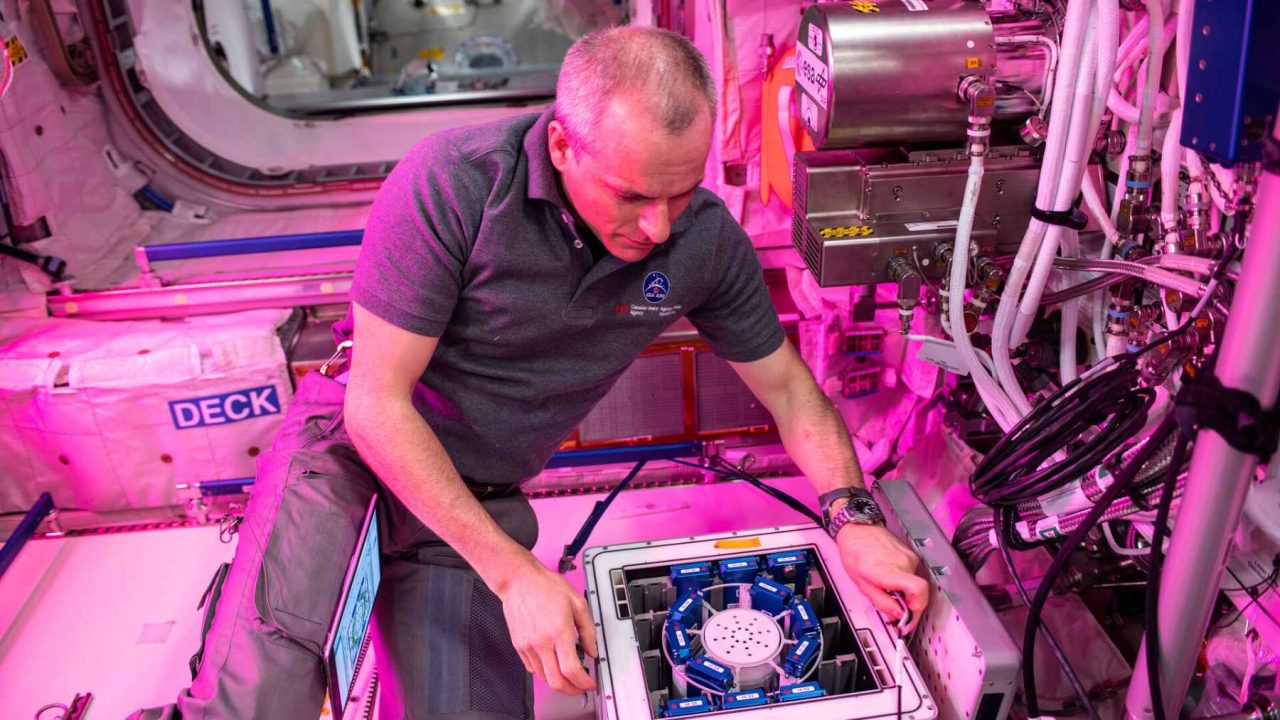
NASA astronaut Michael Scott Hopkins handled crew tasks for the BioAsteroid flight experiment. Small reactors were installed inside ESA’s KUBIK incubators aboard the International Space Station, allowing scientists to compare microgravity conditions directly against matched control tests on Earth. That experimental design made the results scientifically defensible, not just anecdotally interesting.
Finding 4: An L-Chondrite Was the Rock of Choice
Scientists didn’t use a rare or exotic meteorite. They chose an L-chondrite, one of the most common meteorite types found on Earth and, by inference, throughout the solar system. This matters enormously for scalability.
If biomining only worked on rare asteroid compositions, the commercial case would be weak. But L-chondrites represent a large fraction of near-Earth asteroids. Demonstrating biological extraction on this rock type means the technique could theoretically apply across a wide range of accessible space bodies.
Finding 3: Scientists Tracked 44 Elements and Found 18 Were Biologically Extracted
The research team didn’t just look for one or two target metals. They tracked 44 elements across the meteorite samples. Of those, 18 were biologically extracted by the microorganisms, a result that suggests biomining could be a broad-spectrum extraction tool, not a single-element solution.
That breadth changes the economic calculus. A mining operation that can extract nearly half the elements it targets, across a common rock type, in the vacuum environment of space, starts to look less like a curiosity and more like a viable industrial process.
Finding 2: Sphingomonas desiccabilis Proved Bacteria Can Mine in Space
The bacterium Sphingomonas desiccabilis was one of the two microorganisms tested in the BioAsteroid experiment. It was already known on Earth for surviving extreme desiccation, meaning it can endure environments with almost no liquid water. That resilience made it a logical candidate for space conditions.
Its performance in orbit confirmed that bacteria engineered or selected for stress tolerance can function as biological mining agents beyond Earth’s atmosphere. This opens a pathway toward designing microbial consortia specifically for asteroid mining missions, organisms bred or selected for maximum metal extraction efficiency in specific space environments.
| Organism | Type | Key Trait | Role in Experiment |
|---|---|---|---|
| Sphingomonas desiccabilis | Bacterium | Extreme desiccation resistance | General metal extraction from L-chondrite |
| Penicillium simplicissimum | Fungus | Organic acid secretion | Enhanced release of palladium, platinum, and other elements in microgravity |
The Most Important Discovery: A Fungus Unlocked Platinum and Palladium in Microgravity
This is the finding that changes everything. The fungus Penicillium simplicissimum enhanced the release of palladium, platinum, and other elements from the meteorite rock in microgravity conditions. Not just any elements. The two metals that the United States imports at rates of 57% and 89% respectively.
You are a mission planner at a space agency. A new study confirms that fungal biomining works in orbit. You have budget for one next-step project. Which do you prioritize?
Penicillium simplicissimum is not an exotic laboratory creation. It is a common environmental fungus, best known as a relative of the mold that gave us penicillin. It survives in soil, on decaying plant matter, and apparently, in the controlled reactors of the International Space Station 400 kilometers above the planet.
“The idea that a fungus related to the organism behind the first antibiotic could also pioneer space mining is one of the more poetic coincidences in modern science.”
— Undiscovered America analysis, April 2026
The mechanism involves organic acids. Penicillium simplicissimum secretes acids that chemically attack mineral matrices, breaking chemical bonds that lock metals inside rock. On Earth, this process is already used in low-grade ore processing. In microgravity, the fluid dynamics are different. Convection currents that normally carry acids through rock pores don’t work the same way. Scientists expected this to reduce efficiency.
Instead, the fungus adapted. The results showed enhanced metal release compared to abiotic controls, meaning the fungus extracted more metal than pure chemistry alone would have managed under the same conditions. That result was not predicted by existing models.
The deeper implication is architectural. Future asteroid mining missions would not need to carry smelters, chemical processing plants, or heavy extraction machinery. They could carry culture vials. Microorganisms could process ore in situ, concentrate metals into solution, and leave behind depleted rock. The mass savings alone would transform mission economics.
There are still enormous engineering challenges. Scaling from a laboratory reactor to an asteroid-surface operation involves problems that haven’t been solved. Contamination control, organism containment, extraction and return of metal-rich fluids, all of these require technology that doesn’t exist yet at commercial scale.


Leave a Reply