
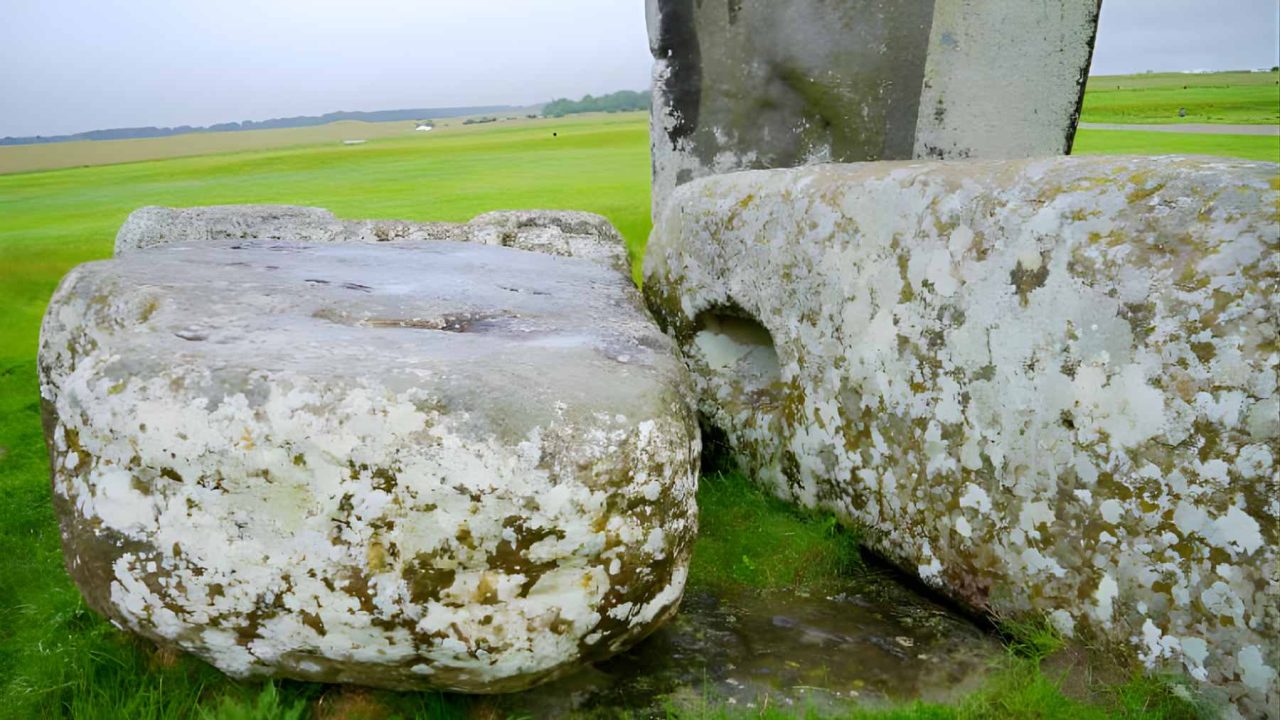
What would it take to convince you to move a 13,000-pound rock across 500 miles of open ocean and rugged terrain — without wheels, without engines, and without any written instructions to guide you?
That is precisely what a group of Neolithic people appear to have done roughly 4,500 to 5,000 years ago. The object in question is the Altar Stone at Stonehenge, a massive slab of Orcadian sandstone that now lies flat near the center of one of the world’s most studied monuments. For decades, researchers assumed it came from Wales, like many of Stonehenge’s other stones. New geological analysis has shattered that assumption entirely.
The Altar Stone did not come from Wales. It came from northeast Scotland — a staggering distance of at least 750 kilometers from its current resting place on Salisbury Plain in southern England.
Why the Altar Stone’s Scottish Origin Changes Everything
For most of the 20th century, archaeologists focused their attention on Stonehenge’s more famous components. The towering sarsen stones came from West Woods, about 16 miles away — impressive, but logistically comprehensible. The iconic bluestones were traced to the Preseli Hills of southwestern Wales, roughly 140 miles from the monument. That journey already seemed extraordinary.
But 140 miles is a short stroll compared to what the Altar Stone’s origin implies. A geological analysis published in 2024 confirmed that the stone’s unique mineral composition matches outcrops found only in the Orcadian Basin of northeast Scotland. No matching geology exists in Wales or anywhere closer to Wiltshire.
This discovery did not just extend a mileage estimate. It fundamentally reframed what Neolithic Britons were capable of organizing, communicating, and executing across enormous geographic distances.
| Stone Type | Origin | Distance to Stonehenge | Approximate Weight |
|---|---|---|---|
| Sarsen Stones | West Woods, Wiltshire | ~16 miles (26 km) | Up to 25 tonnes each |
| Bluestones | Preseli Hills, Wales | ~140 miles (230 km) | 2–5 tonnes each |
| Altar Stone | Northeast Scotland | ~500 miles (750+ km) | ~6 tonnes (13,000 lbs) |
The Sea Route Hypothesis and the Science Behind It
Moving a 6-tonne block overland from northeast Scotland to Wiltshire would require navigating the Scottish Highlands, crossing numerous rivers, and hauling the stone over terrain that would challenge modern construction equipment. Researchers find this scenario nearly impossible for Neolithic technology.
The more plausible explanation, supported by several geologists and archaeologists, is that the Altar Stone traveled primarily by sea. As researchers noted in their findings, the difficulty of long-distance overland transport of such massive cargo from Scotland, navigating topographic barriers, strongly suggests sea transport was involved.
The proposed sea route would have taken the stone from northeastern Scotland along the rugged eastern coastline, possibly around the tip of Britain, then through the Bristol Channel and up a river system toward Salisbury Plain. Neolithic peoples of Britain were experienced coastal seafarers. They built and maintained trade networks along Britain’s shorelines for centuries before Stonehenge reached its final form.
Dugout canoes and log rafts capable of carrying heavy loads are well-documented in the Neolithic archaeological record. Lashing multiple watercraft together to distribute the weight of a multi-tonne stone is not just speculative, it follows principles that appear in ancient seafaring traditions across the world.
Ruling Out Glaciers: Why This Had to Be a Human Effort
One alternative explanation scientists considered was glacial transport. During the last Ice Age, massive glaciers did move rocks considerable distances across Britain. Could a glacier have dragged the Altar Stone from Scotland to southern England, leaving Neolithic builders to simply find it lying on the plain?
Geologists have examined this possibility and rejected it. According to geological assessment, the ice sheets of the last glaciation did not extend far enough south to deposit material in the Stonehenge area. The stone’s presence at Salisbury Plain requires a human explanation. Neolithic people chose this stone, extracted it, and moved it intentionally.
That deliberate choice carries weight far beyond the physical. It suggests that communities across Britain were connected by shared cosmology, long-distance communication, and the organizational capacity to execute multi-generational projects. The construction of Stonehenge was not a local effort. It was something closer to a continental collaboration.
“The work prompts two important questions: why and exactly how was the Altar Stone transported from the very north of Scotland, a distance of over 750 kilometers from its current location?”
— Researchers commenting on the 2024 Altar Stone origin study, via Sci.News
What Neolithic Engineering Actually Looked Like
Hollywood tends to imagine ancient monument builders as barely organized, grunting laborers who somehow stumbled into greatness. The archaeological evidence tells a very different story.
Experimental archaeology has demonstrated that a team of around 200 people using wooden sledges and rope can move a multi-tonne stone across flat ground at a rate of roughly one mile per day under good conditions. On water, a well-constructed raft can carry extraordinary loads with comparatively little effort. The physics were always in humanity’s favor. The challenge was social, not mechanical: organizing hundreds or thousands of people across hundreds of miles for a single shared purpose.
The Neolithic peoples who built Stonehenge lived in communities that already engaged in long-distance trade. Polished stone axes made in the Lake District of England have been found as far away as Scotland and Ireland. Pottery styles spread across enormous distances. Cattle and grain moved between communities that had never met face to face. The Altar Stone’s journey, extraordinary as it seems, fits within a pattern of behavior that Neolithic Britons had been practicing for generations.
The Deeper Question: Why Scotland Specifically?
Confirming the how of the Altar Stone’s journey still leaves the most unsettling question unanswered. Why did Neolithic builders travel to the very north of Scotland to source a specific stone when materials closer to Stonehenge were available?
Some researchers suggest the stone carried symbolic or spiritual significance tied to its place of origin. Sacred sites in Neolithic Britain were often associated with specific landscapes and geological features. The bluestones from Wales, for instance, were quarried from locations that appear to have already been sacred sites. The Altar Stone may have been chosen not despite its remote origin, but because of it.
Others propose that the stone’s distinct reddish-green color and texture made it visually unlike any other stone at Stonehenge, positioning it as a deliberate focal point within the monument’s design. Placed flat near the center, it would have served as a literal and symbolic foundation for whatever rituals unfolded in that space.
We may never know the complete answer. But the question itself reveals something important: the people who built Stonehenge were making choices that required abstract thinking, long-term planning, and a view of the world that stretched far beyond their immediate horizon.
That a 13,000-pound rock crossed half the length of Britain five millennia ago is impressive. That someone decided it was worth doing in the first place is the part that should keep you up at night.
Frequently Asked Questions

You Might Also Like

A ‘Dead’ Tectonic Plate Just Reawakened Under Western America
A fragment of the ancient Farallon plate has reappeared beneath western North America, quietly reshaping…

Cannibalism Kills 97% of Baby Blue Crabs. Shallow Water Saves Them
A 37-year Chesapeake Bay study found cannibalism by adult crabs causes over 97% of juvenile…

We Carry Neanderthal DNA… Except Where It Matters Most
A 2026 Science study reveals humans carry Neanderthal DNA everywhere — except the X chromosome.…
Leave a Reply