
What if the sound of rain on your roof stopped being noise and started being something closer to revenue? It sounds fanciful, the kind of promise that has followed every emerging energy technology right up until it quietly disappears. But researchers in China are not talking about a vague future. They have already built the device.
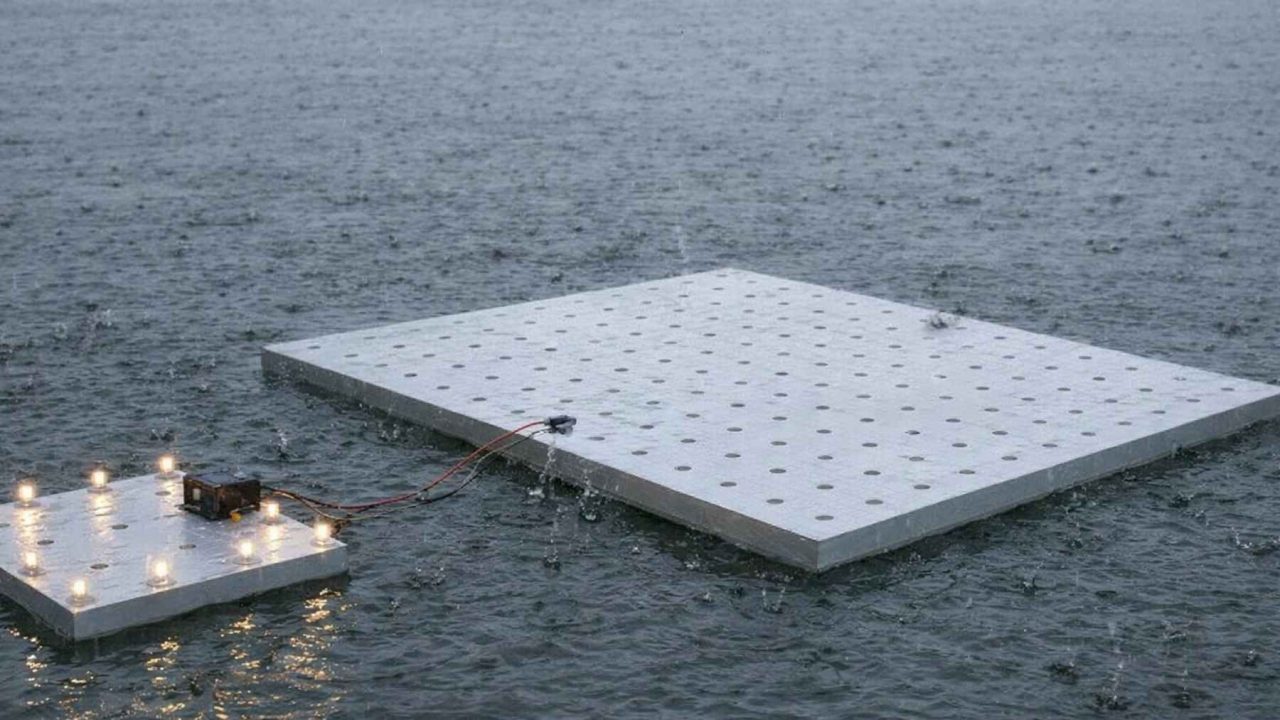
In April 2026, a team led by Wei Deng and corresponding author Wanlin Guo at Nanjing University of Aeronautics and Astronautics published findings describing a lightweight, floating generator that converts raindrop impacts into short electrical pulses. The device floats on water surfaces like reservoirs and coastal zones. It uses the water itself as both mechanical support and lower electrode. The science is real. The debate, however, is very much alive.
The Split Between Promise and Practicality in Hydrovoltaic Research
The field is called hydrovoltaics, a growing branch of clean energy research focused on pulling usable electricity from the way water moves and interacts with materials. It sits alongside solar and wind as a potential piece of the renewable puzzle. But unlike those two, it has vocal critics who question whether it can ever leave the laboratory.
The central controversy is this: raindrops carry energy, but they carry it in tiny, irregular bursts spread across enormous areas. Capturing that energy efficiently enough to compete with even modest solar panels is a challenge that splits researchers into two distinct camps. One group sees a complementary power source that works precisely when solar fails. The other sees an expensive solution looking for a problem that larger technologies already solve better.
| Energy Source | Works in Rain | Requires Infrastructure | Scalability |
|---|---|---|---|
| Solar PV | Reduced output | Moderate (panels, inverters) | Very high |
| Wind Turbine | Yes (wind-dependent) | High (towers, grid tie) | High |
| Raindrop Generator | Yes — rain is the fuel | Low (floats on water) | Experimental |
| Hydropower (dam) | Yes (indirectly) | Very high | Limited by geography |
Why Rain-to-Electricity Believers Have a Surprisingly Strong Case
The most compelling argument for raindrop energy is one of timing. Solar panels lose significant output on overcast and rainy days, exactly the conditions when a rain-powered generator would be most productive. The two technologies are almost perfectly anti-correlated in their peak output windows. That makes them natural partners, not competitors.
Scientists in Spain have already explored this pairing directly, developing a hybrid solar panel that generates electricity from both sunlight and falling raindrops. The logic is intuitive: the same roof that soaks up photons on a July afternoon could harvest kinetic impact energy during a February storm. A new coating has also been developed that helps solar cells generate power from rainfall while actually improving durability in harsh weather conditions.
“Researchers looked at rain hitting rooftops and saw wasted energy. Now a roof system could turn every raindrop into electricity.”
— Energies Media, April 2026
The floating design from Nanjing University adds another layer to this argument. Most previous raindrop generators required rigid ground or rooftop supports. By using the water surface of a reservoir or coastal area as both a platform and the lower electrode of the electrical circuit, this device sidesteps the infrastructure problem entirely. It requires no new construction on land. Reservoirs already exist by the millions worldwide, most of them doing nothing during rainfall events beyond collecting water.
The physics also work more elegantly than critics often acknowledge. A falling raindrop strikes an insulating dielectric film on top of the device, causing charge displacement. This shift generates a measurable voltage between the top electrode and the water below. Natural water, carrying dissolved salts and minerals, acts as a surprisingly effective conductor, far better than laboratory-pure water. The circuit closes through the water itself.
The Skeptics’ Argument: Scaling Rain Energy Beyond the Lab Bench
Critics are not dismissing the physics. They are questioning the economics and the engineering at scale. A single raindrop carries a tiny amount of kinetic energy. To produce meaningful power, you need an enormous surface area covered with these devices, all working simultaneously, all converting energy efficiently, all connected to collection systems that don’t consume more energy than they produce.
The skeptical position points to a fundamental constraint: rain is intermittent, geographically uneven, and seasonally unreliable. Regions that need clean energy most urgently, including arid zones facing desertification, receive the least rainfall. Meanwhile, tropical regions with heavy rainfall often already have access to significant hydropower infrastructure built around rivers and reservoirs.
There is also the maintenance question. A device floating on a reservoir in open water faces UV degradation, biological fouling from algae and microorganisms, mechanical stress from waves, and the cumulative wear of millions of raindrop impacts. The research published in April 2026 demonstrates the electrical concept convincingly. It does not yet demonstrate 10-year durability in real outdoor conditions.
Opponents also raise a resource allocation argument. The engineering talent, materials, and funding spent refining raindrop generators could, some argue, go toward better battery storage or more efficient solar cells, technologies already proven at grid scale. Incremental improvement of mature technologies may deliver more kilowatt-hours per research dollar than building an entirely new energy category from scratch.
What the Nanjing Research Data Actually Shows in Detail
The Nanjing team’s design is structured as a simple sandwich: a top electrode, an insulating dielectric film, and water below. When a raindrop strikes the film, it pushes charges through the circuit, creating a voltage pulse. The elegance is in what is absent. There are no turbines, no chemical reactions, no moving parts beyond the droplet itself.
The floating setup achieves electrical output comparable to conventional raindrop generators that require rigid, grounded supports. That is not a trivial result. Previous floating designs suffered from energy losses caused by the instability of the platform. By using the water’s ionic content as a functional part of the circuit rather than fighting against it, the Nanjing team converted a liability into an asset.
Separate research published prior to this study showed that newer plug-flow raindrop systems can generate up to 100,000 times more electricity than the earliest methods attempted. That number sounds dramatic, and it is, but context matters. The baseline was extremely low. Even with that improvement factor, raindrop generators produce power measured in microwatts to milliwatts per device at current scales. Grid-relevant numbers require massive arrays.
| Technology | Energy Source | Output Consistency | Maturity Level | Deployment Environment | Cost per kWh (est.) |
|---|---|---|---|---|---|
| Solar PV | Sunlight photons | High (predictable cycles) | Commercial scale | Rooftops, deserts, fields | $0.03–0.06 |
| Wind Turbines | Kinetic wind energy | Moderate (variable) | Commercial scale | Open land, offshore | $0.02–0.05 |
| Hydrovoltaic (Raindrop) | Raindrop impact kinetic energy | Low (weather-dependent, irregular bursts) | Early laboratory | Reservoirs, coastal water surfaces | Unknown (pre-commercial) |
| Wave Energy | Ocean wave motion | Moderate (tidal patterns) | Pilot/prototype stage | Coastal and offshore zones | $0.15–0.30 |
| Piezoelectric Harvesting | Vibration and mechanical stress | Low (highly irregular) | Research stage | Structures, wearables, roads | Unknown (pre-commercial) |
What the data does confirm is a clear upward trajectory. Each successive generation of raindrop and hydrovoltaic technology has leapt ahead of the previous one, not through incremental refinement but through conceptual redesigns. The floating electrode concept is one such leap. There is no scientific evidence suggesting the trajectory has reached its ceiling.
The Editorial Verdict: A Real Technology That Needs Honest Framing
The debate between believers and skeptics is largely a disagreement about time horizon and application scope, not about the underlying science. Both sides are correct, just talking about different things.
Raindrop generators will not replace solar farms or wind installations in any decade visible from here. The physics of scale make that clear. But the framing that treats this as a failure misses the actual opportunity. This technology does not need to power cities to be genuinely useful. It needs to power sensors, remote monitoring stations, environmental data buoys, small off-grid devices in wet climates, and hybrid roof systems that harvest energy whether or not the sun is shining.
The floating design from the Nanjing team is particularly well-suited to exactly this niche: bodies of water in rainy regions, far from grid infrastructure, where any self-powered device has high value. A floating sensor network on a reservoir that powers itself from rainfall is not a fantasy. It is an achievable near-term application.
The honest framing is that this is a complementary technology entering a serious phase of development. The lab work is credible. The engineering challenges ahead are also credible. Dismissing one or the other distorts the picture.
What Hydrovoltaic Rain Energy Means for the Future of Distributed Power
The broader implication of this research line is a shift in how we think about energy collection. The dominant paradigm has been concentration: gather sunlight over large panels, gather wind across large turbines, gather water behind large dams. Raindrop energy points toward dispersion. Spread tiny collectors across the surfaces where rain falls, and aggregate the result.
That is a different engineering philosophy, and it has different strengths. Distributed systems are harder to knock out with a single point of failure. They do not require transmission lines across hundreds of miles. They can be deployed incrementally, one floating panel at a time, rather than requiring billion-dollar infrastructure commitments before a single watt flows.
The integration possibilities are expanding fast. Hybrid panels that harvest both solar photons and raindrop kinetic energy are already in prototype. Roof coatings that generate power from rainfall while protecting the underlying surface are in early development. Each raindrop hitting a future smart roof could become a tiny pulse in a vast, city-wide distributed energy web.
The question is not whether rain can generate electricity. The Nanjing team has answered that. The question is whether the people funding energy infrastructure will look at a rainy afternoon and see not an obstacle to solar, but a second system quietly humming alongside it, harvesting what would otherwise just make puddles.



Leave a Reply