
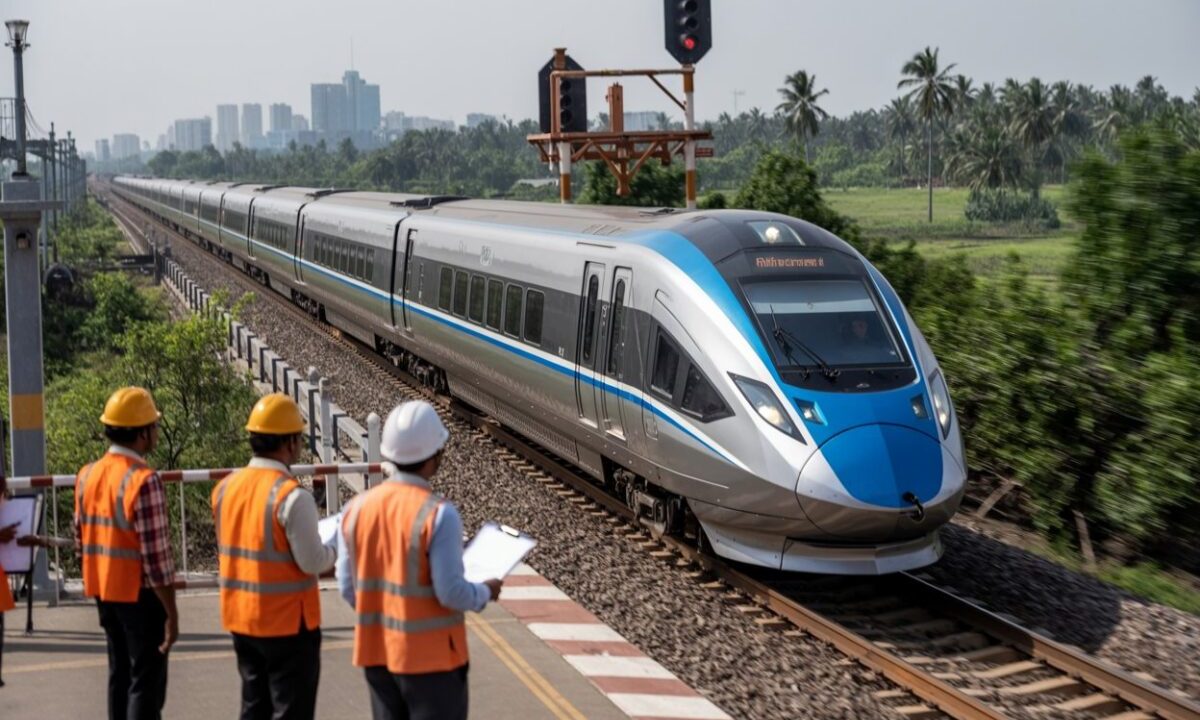
India’s Railway Board has approved the production of two next-generation trainsets capable of reaching 220 kmph — a speed that would make them the fastest passenger trains ever operated on Indian soil, surpassing even the celebrated Vande Bharat Express.
The approval comes as part of the Coach Production Programme for fiscal year 2027–28, marking a deliberate push by Indian Railways to shift long-distance travel into a higher gear. For millions of passengers who rely on rail to cross the subcontinent, this signals something genuinely new: not just faster journeys, but a different standard of what rail travel in India can look like.
The current benchmark for fast rail in India is the Vande Bharat Express, which carries a design speed of 180 kmph. The new 220 kmph trainsets would clear that bar by a meaningful margin — and the implications stretch well beyond raw speed.
(function(){var wrp=document.getElementById(“paap_stat_69ddfde77e7042.54325418”);if(!wrp)return;var ids=[“paap_stat_69ddfde77e7042.54325418_c0″,”paap_stat_69ddfde77e7042.54325418_c1”];var dur=1800;function ease(t){return 1-Math.pow(1-t,3);}function anim(){ids.forEach(function(id){var el=document.getElementById(id);if(!el)return;var tgt=parseFloat(el.getAttribute(“data-target”))||0;var pfx=el.getAttribute(“data-prefix”)||””;var sfx=el.getAttribute(“data-suffix”)||””;var dec=parseInt(el.getAttribute(“data-decimals”))||0;var st=null;function step(ts){if(!st)st=ts;var p=Math.min((ts-st)/dur,1);var v=ease(p)*tgt;el.textContent=pfx+v.toFixed(dec)+sfx;if(p<1)requestAnimationFrame(step);}requestAnimationFrame(step);});}if("IntersectionObserver" in window){var obs=new IntersectionObserver(function(e){e.forEach(function(en){if(en.isIntersecting){anim();obs.disconnect();}});},{threshold:0.2});obs.observe(wrp);}else{anim();}})();
What Indian Railways Has Actually Approved
The Railway Board’s decision to include these advanced trainsets in the 2027–28 Coach Production Programme is a formal planning commitment, not just an aspiration. Two trainsets have been approved for production, positioning them as a pilot deployment ahead of any broader rollout.
These trains are described as next-generation semi-high-speed services — built to outpace existing options by delivering faster, smoother, and more efficient long-distance travel. The focus appears to be on both performance and passenger experience, with the goal of reshaping how people move between major cities and tourism destinations across India.
Officials have noted that enhanced rail connectivity at this speed tier has direct implications for tourism, potentially making previously time-consuming journeys between heritage sites, pilgrimage destinations, and urban centres far more accessible within a single day.
How the 220 kmph Trains Compare to What Exists Today
To understand what this upgrade means, it helps to look at where Indian Railways currently stands — and where these new trains would sit within that landscape.
| Train Type | Design Speed | Status |
|---|---|---|
| Vande Bharat Express | 180 kmph | Currently operational across key routes |
| New 220 kmph Trainsets | 220 kmph | Approved for production in FY 2027–28 |
(function(){function loadChartJs(cb){if(window.Chart){cb();return;}var s=document.createElement(“script”);s.src=”https://cdn.jsdelivr.net/npm/chart.js@4.4.0/dist/chart.umd.min.js”;s.onload=cb;document.head.appendChild(s);}function initChart(){var cv=document.getElementById(“paap_chart_69ddfde77e7f12.06487362”);if(!cv)return;var dv=[“180 kmph”,”220 kmph”];new Chart(cv,{type:”bar”,data:{labels:[“Vande Bharat Express”,”New 220 kmph Trainsets”],datasets:[{data:[180,220],backgroundColor:[“#3b82f6″,”#10b981″],borderRadius:6,borderSkipped:false}]},options:{indexAxis:”y”,responsive:true,maintainAspectRatio:false,animation:{duration:1200,easing:”easeOutQuart”},plugins:{legend:{display:false},tooltip:{callbacks:{label:function(ctx){return dv[ctx.dataIndex]||ctx.formattedValue;}}}},scales:{x:{grid:{color:”#e5e7eb”},ticks:{color:”#6b7280″}},y:{grid:{display:false},ticks:{color:”#1a1a1a”,font:{weight:600}}}}}});}var cv=document.getElementById(“paap_chart_69ddfde77e7f12.06487362”);if(!cv)return;if(“IntersectionObserver” in window){var obs=new IntersectionObserver(function(e){e.forEach(function(en){if(en.isIntersecting){loadChartJs(initChart);obs.disconnect();}});},{threshold:0.1});obs.observe(cv);}else{loadChartJs(initChart);}})();
The gap between 180 and 220 kmph may sound incremental on paper, but at rail scale it translates into meaningfully shorter journey times across hundreds of kilometres. A route that currently takes five hours could potentially be completed in considerably less — which changes the calculus entirely for both business and leisure travellers.
India’s existing semi-high-speed network has already demonstrated strong passenger demand. The Vande Bharat Express consistently runs at high occupancy, and the appetite for faster, more comfortable rail journeys clearly exists. The 220 kmph trainsets are designed to meet — and expand — that demand.
What This Means for Travellers and Tourism
The real-world impact of faster rail extends far beyond the trains themselves. When journey times shrink, destinations that once required an overnight trip or a domestic flight become reachable in an afternoon. That shift fundamentally changes travel behaviour.
For domestic tourism, this matters enormously. India’s rail network connects an extraordinary range of cultural, historical, and natural destinations — many of which are not well served by airports. High-speed connectivity on key corridors could draw more visitors to regions that currently sit just beyond comfortable day-trip range from major cities.
Business travellers stand to benefit as well. Faster intercity connections reduce the time cost of in-person meetings, making rail a more competitive option against short-haul aviation on certain routes.
Supporters of the expansion argue that improved rail infrastructure also eases pressure on road networks and contributes to lower per-passenger carbon emissions compared to car or air travel over equivalent distances — a consideration that carries increasing weight in national transport planning.
- Design speed of 180 kmph, currently the fastest passenger rail service operating in India.
- Established semi-high-speed service connecting key cities with premium journey experience.
- Sets the current benchmark that the next generation of trains is specifically designed to surpass.
- Design speed of 220 kmph, making these the fastest passenger trainsets ever approved for India.
- Two trainsets approved under the Coach Production Programme for fiscal year 2027–28.
- Designed to deliver faster, smoother, and more efficient long-distance travel across India.
What Happens Next on the Road to 220 kmph
The approval of two trainsets for the 2027–28 production cycle represents the formal starting point of a longer process. Production planning, infrastructure assessment, and route selection will all need to follow before passengers can board these trains.
High-speed rail also demands track upgrades and signalling improvements to operate safely at top speeds — meaning the rollout will depend on parallel investments in rail infrastructure, not just the trains themselves. These are standard requirements for any step-change in operating speed, and Indian Railways has been progressively upgrading key corridors in recent years.
The 2027–28 fiscal year production timeline suggests that operational deployment is most likely a target for the late 2020s, though specific route announcements have not yet been confirmed. The two approved trainsets are expected to serve as a demonstrable proof of concept, with broader fleet expansion decisions likely to follow based on their performance.
What is clear is that the approval itself marks a policy commitment — a signal that India’s rail ambitions are moving beyond the Vande Bharat era and into a new phase of speed and connectivity.
Frequently Asked Questions
What is the top speed of India’s newly approved trainsets?
The newly approved trainsets have a design speed of 220 kmph, making them faster than any passenger train currently operating in India.
How does this compare to the Vande Bharat Express?
The Vande Bharat Express has a design speed of 180 kmph. The new 220 kmph trainsets would surpass that by 40 kmph, representing a significant step up in performance.
How many new trainsets have been approved?
The Railway Board has approved the production of two advanced 220 kmph trainsets as part of the Coach Production Programme for fiscal year 2027–28.
When will these trains be available for passengers to use?
Specific operational dates have not yet been confirmed. The production is planned for fiscal year 2027–28, with passenger deployment expected to follow after infrastructure and route preparation.
Which routes will the 220 kmph trains operate on?
Specific route assignments have not yet been announced. This has not yet been confirmed by official sources.
Will these trains benefit tourism in India?
Officials have highlighted improved tourism connectivity as a key goal, with faster rail travel expected to make more destinations accessible within shorter journey times.


Leave a Reply