
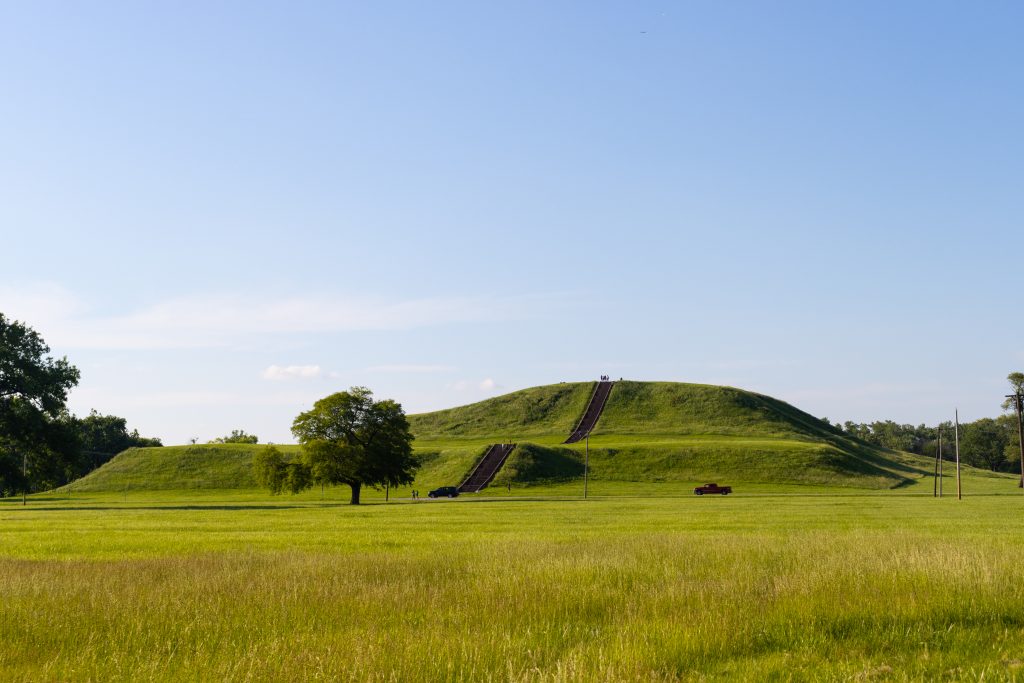
Most Americans can name the Roman Colosseum, Machu Picchu, and Stonehenge without hesitation — yet the largest pre-Columbian city north of Mexico sits roughly eight miles east of St. Louis, charges no admission to enter its grounds, and receives fewer annual visitors than a mid-tier regional theme park. That city is Cahokia, and the gap between its historical significance and its public profile is one of the more quietly damning oversights in American cultural memory.
What Cahokia Actually Was — and Where It Stands Today
Cahokia Mounds State Historic Site encompasses roughly 4,000 acres in Collinsville, Illinois, administered jointly by the Illinois Department of Natural Resources and the Cahokia Mounds Museum Society. The site preserves approximately 80 earthen mounds — remnants of what archaeologists believe was once a complex of more than 120 — constructed by the Mississippian culture between roughly 700 AD and 1400 AD.
The civilization at its center is referred to by scholars as “Cahokia,” though the actual name used by its inhabitants is unknown. The “Cahokia” name comes from a sub-tribe of the Illiniwek Confederacy that lived in the region centuries after the original city’s abandonment — a naming accident that further distances modern visitors from understanding who actually built it.
The site’s defining landmark, Monks Mound, remains the largest earthen structure in North America. It stands approximately 100 feet tall, stretches 951 feet in length and 836 feet in width at its base, and contains an estimated 22 million cubic feet of earth — all moved without draft animals, metal tools, or the wheel, according to the UNESCO World Heritage designation record.
The Population Question — and Why the Numbers Matter
Estimating the population of a pre-literate, pre-contact civilization is inherently imprecise, and archaeologists have debated Cahokia’s peak numbers for decades. The figure most commonly cited in peer-reviewed literature — 10,000 to 20,000 residents at peak occupation around 1050–1100 AD — comes from analysis of residential mound density, refuse deposits, and comparison with other Mississippian sites.
For context, London’s population in 1100 AD is estimated by historians at roughly 10,000 to 15,000 people. Paris held approximately 20,000. Cahokia, located on the floodplain of the Mississippi River near its confluence with the Missouri and Illinois rivers, sat at what was arguably the most logistically advantageous location on the continent for trade and agriculture.
What is not contested is the city’s scale of civic organization. Cahokia featured a planned urban grid, a large central plaza roughly the size of 35 football fields, a wooden stockade enclosing the central precinct, and a “Woodhenge” — a series of large timber circles used, researchers believe, for astronomical observation and ceremonial purposes.
Why Cahokia Was Abandoned — and What Archaeology Has Found
The Mississippian city at Cahokia was effectively abandoned by approximately 1350 AD, roughly 150 years before European contact. The reasons remain one of North American archaeology’s most actively studied questions. Current leading theories, as summarized in research published through institutions including the Archaeological Institute of America, include a combination of environmental stress, resource depletion, and political fragmentation.
- Flooding: Sediment cores from the American Bottom floodplain suggest major flood events in the 1100s and 1200s disrupted agriculture and may have triggered population dispersal.
- Deforestation: Constructing and maintaining thousands of wooden structures, including Woodhenge posts, depleted timber resources within practical hauling distance.
- Political instability: Evidence of a wooden palisade constructed around the city’s core circa 1175 AD suggests internal conflict or external threat, indicating the social cohesion of the early city had deteriorated.
- Climate shift: The Medieval Warm Period, which had enabled agricultural surpluses supporting Cahokia’s growth, gave way to cooler, more erratic conditions after approximately 1200 AD.
Excavations since the mid-20th century have also revealed evidence of large-scale feasting deposits, mass burials with clear status differentiation, and what researchers describe as sacrificial interments near Mound 72 — including the burial of a high-status male on a platform of approximately 20,000 shell beads alongside the remains of more than 250 other individuals.
Visiting Cahokia in 2026 — What to Expect on the Ground
The grounds of Cahokia Mounds State Historic Site are open year-round and free to access. The Cahokia Mounds Interpretive Center, which houses artifacts, scale models, and educational exhibits, requests a suggested donation of $7 for adults and $2 for children, though no admission is charged at the door. The center is located at 30 Ramey Street, Collinsville, Illinois 62234, approximately 15 minutes by car from downtown St. Louis via Interstate 55/70.
Annual visitation figures for Cahokia hover around 200,000 to 300,000 per year, according to state historic site records — a number that has remained roughly flat for the past decade despite increased national media coverage. For comparison, Yellowstone National Park received more than 4.5 million visits in 2023, according to National Park Service data. The disparity is not explained by access: Cahokia sits within a metropolitan area of approximately 2.8 million people and is within a day’s drive of Chicago, Kansas City, and Nashville.
The Collinsville area, with a city population of roughly 26,000, sees modest but measurable economic benefit from site visitors. Local historians and tourism officials in Madison County have advocated for increased federal designation and marketing support for years, citing the economic potential of a site that draws a fraction of visitors proportional to its historical significance.
What happens next for Cahokia depends in part on ongoing excavation permits, state preservation funding, and whether institutions treating the site as a footnote — rather than a headline — begin to reassess that framing. The mounds are not going anywhere. The question, as archaeologists and local advocates have pointed out for decades, is whether the culture that surrounds them is paying attention.
Related: Landour Costs Less Than Mussoorie — Stays Under ₹2000 Prove It
Frequently Asked Questions

You Might Also Like

Over 50 Flights Cancelled Across UAE Airports as Major Airlines Disrupt Routes
More than 50 flights have been cancelled across the United Arab Emirates in a single…
3,800+ Ghost Towns Worth Your Next American Road Trip
America has 3,800+ ghost towns — open-air museums with no admission line. Here's which forgotten…
Florida’s Steam-Powered US Sugar Express Is Running Again and People Are Booking Fast
A steam locomotive hasn’t turned heads in Florida quite like this in decades. The return…
Leave a Reply