
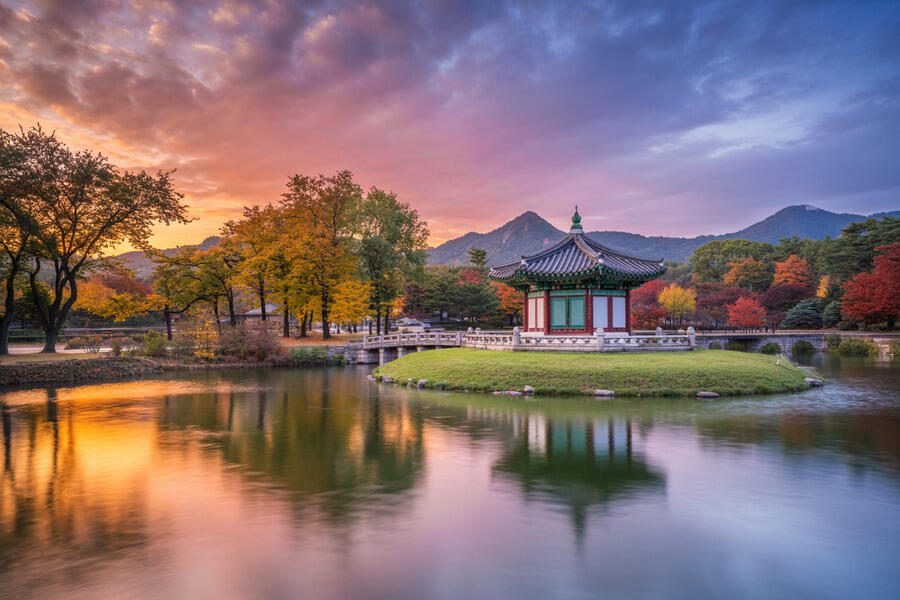
More than 2 million international visitors entered South Korea in March 2026 alone — a figure that would have seemed extraordinary just a few years ago but now marks what officials are calling a new baseline for the country’s tourism era.
The numbers are staggering, and they’re not a fluke. South Korea’s surge in foreign arrivals is being driven by a powerful combination of cultural momentum, high-profile events, and an airline industry that has rapidly expanded to meet demand. If 2026 wasn’t already on your travel radar, it probably should be.
The country hasn’t simply gotten more popular — it has become the destination of the moment, pulling visitors from across Asia-Pacific and Europe in numbers that are reshaping its hospitality sector from the ground up.
(function(){var wrp=document.getElementById(“paap_stat_69c4bb2e6cd8f0.93570797”);if(!wrp)return;var ids=[“paap_stat_69c4bb2e6cd8f0.93570797_c0″,”paap_stat_69c4bb2e6cd8f0.93570797_c1”];var dur=1800;function ease(t){return 1-Math.pow(1-t,3);}function anim(){ids.forEach(function(id){var el=document.getElementById(id);if(!el)return;var tgt=parseFloat(el.getAttribute(“data-target”))||0;var pfx=el.getAttribute(“data-prefix”)||””;var sfx=el.getAttribute(“data-suffix”)||””;var dec=parseInt(el.getAttribute(“data-decimals”))||0;var st=null;function step(ts){if(!st)st=ts;var p=Math.min((ts-st)/dur,1);var v=ease(p)*tgt;el.textContent=pfx+v.toFixed(dec)+sfx;if(p<1)requestAnimationFrame(step);}requestAnimationFrame(step);});}if("IntersectionObserver" in window){var obs=new IntersectionObserver(function(e){e.forEach(function(en){if(en.isIntersecting){anim();obs.disconnect();}});},{threshold:0.2});obs.observe(wrp);}else{anim();}})();
Why South Korea’s Tourism Boom Is Unlike Anything Before It
The driving force behind this surge isn’t a single campaign or a lucky news cycle. It’s the K-Wave — the global cultural phenomenon that has spent years building an audience for South Korean music, food, film, and fashion — finally converting millions of fans into actual travelers.
The BTS comeback concert in Seoul has been identified as a particularly significant catalyst. Events of that scale don’t just fill stadiums — they fill hotels, restaurants, transit systems, and tourist sites across an entire city. Fans who might have streamed a performance from their living rooms are now booking flights to be there in person, and they’re staying long enough to explore well beyond the concert venue.
This is what separates the current boom from previous upticks in Korean tourism. The cultural pull is deep and global, spanning demographics and continents in a way that traditional tourism marketing rarely achieves on its own.
The Airlines, the Routes, and the Numbers Behind the Surge
To handle the extraordinary volume of travelers, major carriers have moved quickly. Korean Air, Asiana Airlines, and Jeju Air have all increased flight frequencies across Asia-Pacific and European corridors — a coordinated expansion that reflects just how confident the aviation industry is in the sustained demand for travel to South Korea.
Here’s what the current situation looks like across key dimensions of the boom:
| Factor | Detail |
|---|---|
| International arrivals (March 2026) | Over 2 million visitors confirmed |
| Primary cultural driver | K-Wave global phenomenon |
| High-profile event catalyst | BTS comeback concert in Seoul |
| Airlines expanding routes | Korean Air, Asiana Airlines, Jeju Air |
| Expanded corridors | Asia-Pacific and European routes |
| Affected sectors | Hospitality, national parks, regional destinations |
The flight expansion is significant because it signals something beyond a short-term spike. Airlines don’t increase capacity on international routes for a single month — they respond to forward booking trends and sustained demand signals. The fact that three major carriers have all moved in the same direction suggests the industry expects this level of traffic to continue well into the year.
What This Means If You’re Planning a Trip — or Already Booked One
For travelers, the boom cuts both ways. More flights and routes mean more options and — in theory — more competitive pricing on airfare. But the surge in arrivals is also pushing hotel occupancy rates higher, and prices in the hospitality sector are rising accordingly.
The impact isn’t contained to Seoul, either. Tourists are increasingly venturing toward South Korea’s national parks and regional destinations, spreading the economic and logistical effects of the boom well beyond the capital. That’s good news for travelers looking to avoid the most crowded urban areas — but it also means that previously quieter destinations are now seeing their own pressure on accommodation and infrastructure.
Anyone traveling to South Korea in 2026 should expect a more competitive booking environment than in previous years. Hotels that once had availability a few weeks out may now require advance reservations, and popular sites tied to K-culture — filming locations, music venues, fan experience destinations — are likely to see sustained crowds throughout the year.
What Comes Next for South Korea Tourism
The momentum shows no sign of slowing. The K-Wave has been building for over a decade, and 2026 appears to be a year where years of cultural investment are translating into record-breaking physical arrivals. With airline infrastructure now expanded and the hospitality sector actively adapting — even as it strains — South Korea is positioning itself as one of the dominant global tourism destinations of the mid-2020s.
Regional destinations across the peninsula are likely to see continued development pressure and investment as the government and private sector respond to demand that now extends well beyond Seoul’s traditional tourist corridors. Travelers who have been considering South Korea but haven’t yet committed may find that 2026 is the year the decision becomes urgent — not because the destination will be less accessible, but because the experience of visiting during a genuine cultural peak rarely comes twice.
Frequently Asked Questions
How many tourists visited South Korea in March 2026?
Official data confirmed over 2 million international visitors entered South Korea in March 2026 alone, marking a record-breaking milestone for the country’s tourism sector.
What is driving the South Korea tourism boom?
The surge is largely attributed to the global K-Wave cultural phenomenon, with the BTS comeback concert in Seoul identified as a particularly significant high-profile catalyst.
Which airlines have expanded flights to South Korea?
Korean Air, Asiana Airlines, and Jeju Air have all increased flight frequencies across Asia-Pacific and European corridors to accommodate the rise in demand.
Are hotel prices going up in South Korea?
Yes — the hospitality sector is experiencing rising hotel occupancy and higher prices as a direct result of the record influx of international visitors.
Is the tourism boom limited to Seoul?
No. Tourists are increasingly traveling beyond the capital, with national parks and regional destinations across the peninsula also seeing a significant rise in visitor numbers.
Is 2026 a good time to visit South Korea?
More flights and routes are available than before, improving access — but travelers should book accommodation well in advance, as rising occupancy and prices reflect a highly competitive market throughout 2026.



Leave a Reply