
Sri Lanka receives roughly 1.5 million international tourists annually, yet the island remains one of the most underestimated destinations on Earth. That statistic meant nothing to me when I booked my flight from Chicago to Colombo in January 2025. I just needed to leave.
My divorce had been finalized three weeks earlier. The apartment felt like a museum of another life. I had $4,800 saved, fourteen days of unused leave, and a vague idea that moving through a place with centuries of history might make my own small grief feel appropriately small.
I did not expect Sri Lanka to restructure something inside me. But it did.
Anuradhapura and Polonnaruwa: Walking Through 2,300 Years of Collapse and Renewal
I landed in Colombo on a Tuesday and took a four-hour bus north to Anuradhapura. The city is considered one of the oldest continuously inhabited cities in the world, and its ruins are among the most ancient and fascinating in all of Southern Asia. That phrase sat in my head on the bus ride as the landscape flattened into scrub and palm.
Anuradhapura was the capital of ancient Sri Lanka for over a thousand years. What remains are massive stupas, sacred fig trees, and stone pools that once served royal bathing gardens. The UNESCO World Heritage Site covers a vast archaeological zone, and I spent two full days walking it with a rented bicycle that cost me 300 rupees, roughly one US dollar.
The eight sacred sites within Anuradhapura, including Jaya Sri Maha Bodhiya, Ruwanwelisaya, and Abhayagiri Dagaba, are not museum pieces. Monks chant at them before dawn. Pilgrims arrive barefoot with lotus flowers. The place breathes.
From Anuradhapura, I hired a tuk-tuk driver named Saman for the two-hour ride southeast to Polonnaruwa. The entry fee there was $25. It was the best $25 I spent on the entire trip.
Polonnaruwa served as Sri Lanka’s capital between the 11th and 13th centuries, after Anuradhapura fell to South Indian invaders. It is a UNESCO World Heritage Site, and wandering its ruins means moving through the remnants of palaces, monastic gardens, and sculptures carved with precision that still defies easy explanation. The Gal Vihara alone, four colossal Buddha figures cut directly from a granite cliff face, stopped me completely. I stood there for twenty minutes saying nothing.
| Destination | Era | Entry Fee (USD) | Best Explored By |
|---|---|---|---|
| Anuradhapura | 3rd century BC onward | ~$25 | Bicycle |
| Polonnaruwa | 11th–13th century AD | $25 | Bike or tuk-tuk |
| Sigiriya Lion Rock | 5th century AD | $30 | On foot (steep climb) |
| Kandy (Tooth Relic Temple) | Active sacred site | ~$10 | Walking |
Sigiriya, Kandy, and the Slow Climb Toward Nuwara Eliya’s Tea Country
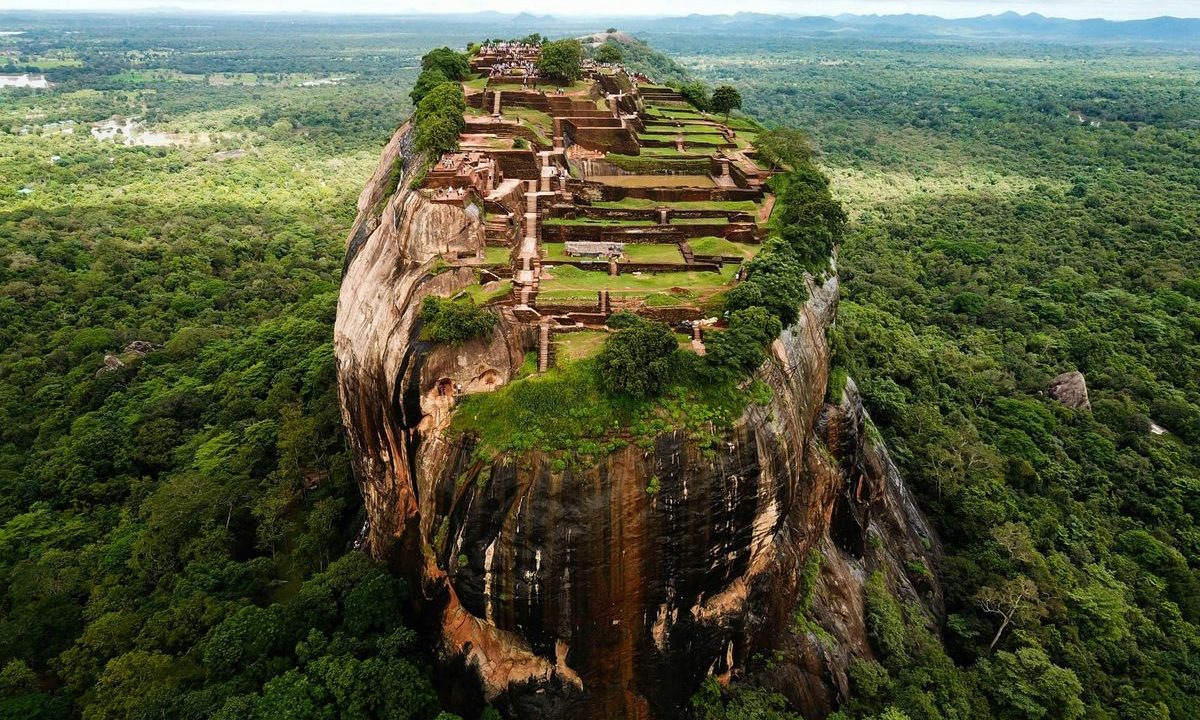
Sigiriya Lion Rock had 12,007 reviews on major travel platforms when I checked before going. The number felt abstract until I joined the pre-dawn queue at the base in the dark with two hundred other people. The climb is steep and occasionally alarming on the exposed iron staircases bolted into the cliff. At the top, a ruined royal palace sits 200 meters above the surrounding jungle, surrounded by views that extend to a flat green horizon in every direction.
King Kassapa built his fortress palace atop Sigiriya in the 5th century AD. He ruled there for eighteen years. When he died, the site was abandoned to monks and then to the forest. Standing in the ruins of his throne room, I thought about the specific loneliness of building something extraordinary and impermanent.
From Sigiriya I traveled south to Kandy, Sri Lanka’s cultural capital, to visit the Temple of the Sacred Tooth Relic. The temple houses what devotees believe is a tooth of the Buddha, brought to the island in the 4th century AD. The evening ceremony, called the Puja, drew hundreds of worshippers. The drumming was so loud and rhythmic it bypassed thought entirely and went somewhere else in the body.
I took the famous hill country train from Kandy toward Nuwara Eliya the following morning. The six-hour ride through tea plantations at elevation is consistently ranked among the world’s most scenic rail journeys. I sat in an open doorway for two hours watching the mist move through terraced green hills.
“Step back in time where kings once walked, and ancient stories live in stone.”
— Araliya Resorts, describing Nuwara Eliya’s historic district
Nuwara Eliya sits at 1,868 meters above sea level. The British colonial administration called it “Little England” and built Victorian guesthouses and manicured gardens that still exist in faded splendor. The air was cold in a way that surprised me after weeks of lowland heat. I paid $42 per night for a room in a heritage guesthouse and spent a full day just walking in the cold with no agenda.
Udawalawe’s 6,000 Wild Elephants and What Slowing Down Actually Costs
The turning point of the journey was not a ruin or a viewpoint. It happened in Udawalawe National Park, three days before I was scheduled to fly home.
Udawalawe is one of Sri Lanka’s best national parks for wildlife. It holds a resident population of roughly 600 elephants and is considered one of the most reliable places in Asia to see wild elephants in their natural habitat. The park entrance fee for foreigners runs around $15, plus the mandatory jeep safari cost of approximately $40 to $60 depending on the operator.
| Destination | Type | UNESCO Status | Estimated Visit Duration | Avg Daily Cost (USD) | Best For |
|---|---|---|---|---|---|
| Anuradhapura | Ancient Ruins & Sacred Sites | World Heritage Site | 2–3 Days | $15–$30 | History & Spiritual Exploration |
| Polonnaruwa | Medieval Ruins & Archaeology | World Heritage Site | 1–2 Days | $10–$25 | Cycling & Ancient Architecture |
| Colombo | Capital City & Gateway | Not Listed | 1–2 Days | $30–$60 | Transit & Urban Culture |
| Sigiriya | Rock Fortress & Gardens | World Heritage Site | 1 Day | $20–$40 | Iconic Landmark & Panoramic Views |
| Southern Coastline | Beaches & Wildlife | Not Listed | 3–5 Days | $20–$45 | Relaxation & Nature |
My jeep entered the park at 6:15 AM on a Thursday. Within eleven minutes, we stopped beside a family group of fourteen elephants crossing the dirt track ahead of us. A calf, maybe two weeks old, stumbled beneath its mother’s belly. The adults fanned their ears. Nobody in the jeep spoke.
Something released in my chest in that moment. Not a solution. Not a resolution. Just the specific relief of being made briefly irrelevant by something larger and indifferent and alive.
I had been carrying my divorce like cargo for months. In Udawalawe at 6:26 AM with fourteen elephants twenty meters away, I simply forgot to carry it for a while. That is the most honest thing I can say about what travel does and does not do.
Mirissa Beach and the Cost of Three More Days I Almost Didn’t Take
I had planned to fly home on a Friday. On Wednesday night in a guesthouse near Mirissa Beach, I changed my flight for $180 and bought three more days.
Mirissa is a small beach village on Sri Lanka’s southern coast rated 4.3 stars from over 3,173 traveler reviews. It is quieter than Bentota and less developed than Unawatuna. The shoreline curves in a gentle arc. Fishing boats go out before 5 AM. By 7 AM, the beach belongs to a handful of early risers and some dogs.
I spent those three days reading, eating kottu roti for $2 a plate from a roadside stall, and swimming in warm water. The whale-watching boats depart from Mirissa harbor between November and April, and blue whales are spotted with some regularity. I did not book a whale watch. I did not move fast.
My total expenditure across fourteen days in Sri Lanka, including flights, was $3,940. That left $860 of my original budget intact. I had expected to spend every dollar and return exhausted. I returned quieter instead, which is not the same thing as healed, but is something.
The Nine Arches Bridge near Ella, rated 4.4 stars from nearly 3,000 reviews, was my last stop before Colombo. A colonial-era railway viaduct built entirely from brick and stone, it carries the hill country train above a forested gorge twice a day. I watched it from below as the blue train passed slowly overhead, steam evaporating into jungle green.
Sri Lanka is a destination that has survived invasions, colonial occupation, a 26-year civil war that ended in 2009, a catastrophic 2004 tsunami, and an economic crisis in 2022 that saw fuel shortages and mass protests. The ruins at Anuradhapura are not just ancient. They are evidence that things collapse and people rebuild and the stones remain.
I am not sure that thought would have meant anything to me before I went. I am certain it means something to me now. Whether that counts as travel doing its job is a question I keep returning to, without an answer that fully satisfies.


Leave a Reply