
▶ Read transcript
Here’s what you need to know about the robot that might change how America harvests its food. Researchers at Washington State University have built a soft, inflatable robotic arm that can pick apples for around $5,500 — a fraction of what earlier agricultural robots have cost. It picks about 140 apples per hour, which is slower than a skilled human worker, but it never needs breaks, never suffers heat exhaustion, and doesn’t require housing or insurance. The university is also testing precision irrigation systems that cut water use by more than 50 percent without reducing crop yields, which is a huge deal for drought-stressed regions like the Columbia River Basin. And here’s the key thing the researchers themselves are saying: these machines are designed to work alongside farm workers, not replace them. So if you follow agricultural technology, keep your eye on the hybrid human-robot model — that’s where the real-world future of farming is actually headed.
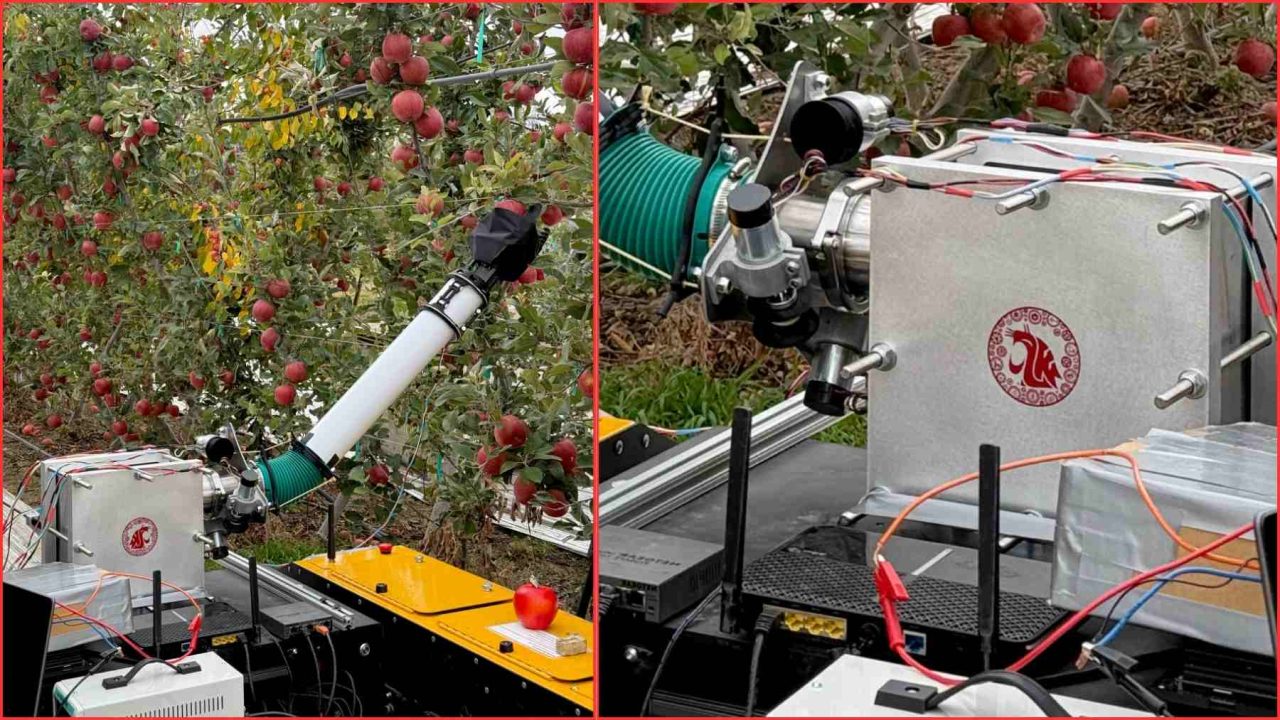
Every year, American farms need roughly 2.4 million hired workers to bring in crops before they rot in the field. And every year, that number gets harder to fill. Now, a team at Washington State University has built something that could quietly reshape that equation: a soft, inflatable robotic arm that weighs under 50 pounds, costs about $5,500, and can identify and pick an apple in roughly 25 seconds.
That works out to approximately 140 apples per hour. Not bad for a machine that runs on air pressure and computer vision.
But before anyone declares the end of the farm worker, it is worth slowing down. The real story of agricultural robotics is messier, more interesting, and more human than the headlines suggest.
What Most People Assume About Farm Automation
The popular assumption goes something like this: robots are coming for farm jobs, immigrant labor will be made obsolete, and the American food system will hum along efficiently without human hands in the soil. It is a tidy narrative. It is also incomplete.
The fear version of this story casts automation as a direct displacement engine, one machine in, dozens of workers out. The optimistic version imagines fields of tireless robots solving every labor shortage overnight. Both versions skip the complicated middle ground where most of the actual science lives.
The WSU Apple Robot: What It Actually Does
The Washington State University robotic arm is deliberately soft. That design choice is not accidental. Rigid metal arms bruise fruit and damage tree branches, making them impractical for delicate harvesting. The WSU team built their arm to be inflatable, using air pressure to create a gentle grip that adjusts to the shape of each apple.
The machine uses computer vision to locate fruit on the tree, calculate the best approach angle, and execute the pick. At 25 seconds per apple, it is slower than a skilled human picker. An experienced worker can grab far more than 140 apples per hour by hand. But the robot does not need breaks, does not suffer heat exhaustion, and does not require housing, transportation, or workers’ compensation insurance.
The strawberry harvesting robot from the same WSU program adds another layer of sophistication. It uses AI vision that combines multiple camera images, then deploys a small blower to move leaves out of the way before soft silicone fingers pluck the berry. Strawberries are notoriously difficult to harvest mechanically because they bruise easily and hide under foliage. This machine addresses both problems directly.
The Water Revolution Happening Quietly Alongside the Robots
Harvesting gets most of the attention, but some of the most significant automation work at WSU is happening underground, in the irrigation systems feeding the orchards.
At the WSU Smart Apple Orchard, automated irrigation cut water use by up to 50% without reducing yields. A separate precision irrigation setup saved 52.4% of water compared to conventional soil moisture scheduling. That same setup reported higher estimated effective yield and dramatically improved water use efficiency.
Robotic System ($5,500 WSU Arm)
Experienced Human Crew
Hybrid Human-Robot Team
| Metric | Robotic System ($5,500 WSU Arm) | Experienced Human Crew | Hybrid Human-Robot Team |
|---|---|---|---|
| Speed & Throughput |
55 |
78 |
85 |
| Cost Efficiency |
72 |
45 |
80 |
| Adaptability |
38 |
95 |
78 |
| Consistency |
90 |
70 |
85 |
| Labor Availability |
99 |
32 |
75 |
| Delicate Handling |
65 |
88 |
82 |
| Scalability |
80 |
55 |
88 |
| Method | Water Saved | Yield Impact | Water Use Efficiency |
|---|---|---|---|
| Standard soil moisture scheduling | Baseline | Baseline | Baseline |
| WSU Smart Orchard automated irrigation | Up to 50% | No reduction | Significantly higher |
| WSU precision irrigation system | 52.4% | Higher estimated effective yield | Much higher |
Washington State agriculture is a multibillion dollar industry. Even modest efficiency gains in water use translate to enormous cost savings and environmental benefits across the region. The Columbia River Basin, which supplies much of the state’s agricultural water, faces increasing pressure from drought cycles and competing demands. Cutting water use by half without sacrificing crops is not a minor engineering footnote. It is a potential lifeline.
Do you regularly struggle to fill your harvest crew before crops begin to spoil in the field?
Robotic harvesting investment is likely premature for your scale. Focus on optimizing your current labor practices and monitor agricultural robotics developments over the next 3 to 5 years as costs are expected to decline significantly.
Is your primary crop one that requires careful, selective picking such as apples, strawberries, or similar delicate produce?
Are your current labor costs consuming more than 40% of your total operating budget?
Can your operation absorb an upfront equipment cost of approximately $5,500 per robotic unit plus maintenance and training expenses?
Current robotic harvesters are optimized for selective crops like apples. For bulk or mechanically harvested crops, traditional automation such as combine harvesters may offer better ROI than soft robotic arm systems at this stage.
Can your operation absorb an upfront equipment cost of approximately $5,500 per robotic unit plus maintenance and training expenses?
Your labor situation appears stable. Consider piloting a single robotic unit to gather performance data on your specific crop and terrain before committing to broader investment.
Are you open to a hybrid model where robots and human workers collaborate on the same harvest, with robots handling repetitive tasks and humans handling quality control and exceptions?
Financing and grant options may bridge the gap. USDA farm modernization grants and state agricultural innovation funds have supported similar purchases. Consult your local agricultural extension office before ruling out adoption.
Strong candidate for robotic harvesting investment. A hybrid human-robot crew model aligns with WSU researcher recommendations, can process roughly 140 apples per hour per unit, and allows your experienced workers to shift toward higher-skill supervisory and quality roles.
Reconsider the hybrid approach before investing. WSU researchers emphasize that current robotic harvesters are designed to work alongside humans, not replace them entirely. Full replacement is not yet technically or economically viable for most operations.
Why the “Robots Replace Workers” Narrative Misses the Point
Here is where the story gets genuinely complicated. WSU researchers are careful to frame their work as collaboration, not replacement. Their automation is described as working alongside people rather than substituting for them entirely.
That framing matters because harvesting is not a single task. It involves scouting for ripeness, managing equipment, making judgment calls about damaged fruit, coordinating logistics across hundreds of acres, and dozens of other functions that current robots handle poorly or not at all. A machine that picks apples at 140 per hour still needs humans to maintain it, position it, empty its collection bins, and decide which rows to prioritize.
“Washington State University researchers are building a new kind of farm helper, one that does not get tired, does not call in sick.”
— WSU research description, 2026
WSU has been explicit: harvesting robots are not yet ready to become routine farm equipment. The machines can perform tasks under controlled or semi-controlled conditions. Open fields with variable lighting, wind, irregular tree shapes, and unpredictable fruit placement remain genuinely hard problems. The gap between laboratory performance and commercial deployment is still significant.
The Labor Shortage That Actually Drives This Research
The honest reason agricultural robotics research is accelerating has less to do with cost-cutting ambition and more to do with a genuine crisis in farm labor availability. Farms across the American West routinely report being unable to find enough workers during peak harvest windows. Fruit left unpicked because of labor shortages represents direct financial loss for growers and wasted food at a time when supply chains are already under pressure.
The WSU robot was not built to eliminate workers. It was built because the workers are not always there when the apples are ready. That distinction shapes everything about how the technology is designed and deployed.
The inflatable arm’s low weight and relatively modest cost reflect a deliberate choice to make the technology accessible to smaller farming operations, not just industrial agribusiness. At $5,500, it is within reach for a mid-sized orchard that might otherwise lose a portion of its crop to an untimely labor shortage.
What Agricultural Automation Actually Means for the Next Decade
The realistic near-term picture looks something like this: robots handle the most physically punishing and repetitive harvest tasks, particularly in crops like apples and strawberries where labor demand spikes sharply and briefly. Human workers shift toward roles that require more judgment, machine operation, and quality control. Water and input efficiency improve substantially through automated monitoring systems. Farm economics change, but farm employment does not vanish.
The longer-term picture is genuinely uncertain. Computer vision is improving rapidly. Machine learning systems trained on millions of images of fruit in various lighting conditions and growth stages are getting better at the kind of visual judgment that currently requires human eyes. The 25-second pick time that defines the current WSU robot will almost certainly drop as the technology matures.
What does not change is the fundamental complexity of agriculture. Farms are biological systems operating in dynamic environments. Every season brings different weather, different pest pressures, different soil conditions. The robot that performs beautifully in a tidy research orchard still has a long road to travel before it can handle the full chaos of commercial farming.
Washington State’s multibillion dollar agricultural industry will not be transformed overnight by a 50-pound inflatable arm. But it will be transformed, gradually and unevenly, by the accumulation of small efficiencies: a little less water here, a few more apples picked there, a labor shortage partially bridged on a critical harvest weekend.
The question worth sitting with is not whether robots will change farming. They already are. The question is whether the humans who have always done this work will be partners in that change, or simply left to watch it happen to them.
Frequently Asked Questions
Frequently Asked Questions

You Might Also Like

Three Genes That Gave Old Mice Young Brains Back
EPFL scientists restored learning and memory in aged mice by activating three genes in memory…

Mars ‘Spiderwebs’ Finally Explained — and Water Lasted Far Longer Than We Thought
NASA's Curiosity rover finally explains Mars' giant spiderweb formations spotted since 2006 — and the…
180-Million-Year-Old Rock Wrinkles Baffle Geologists
Tiny wrinkles in 180-million-year-old Jurassic rock from Morocco's Atlas Mountains challenge a core assumption of…
Leave a Reply