
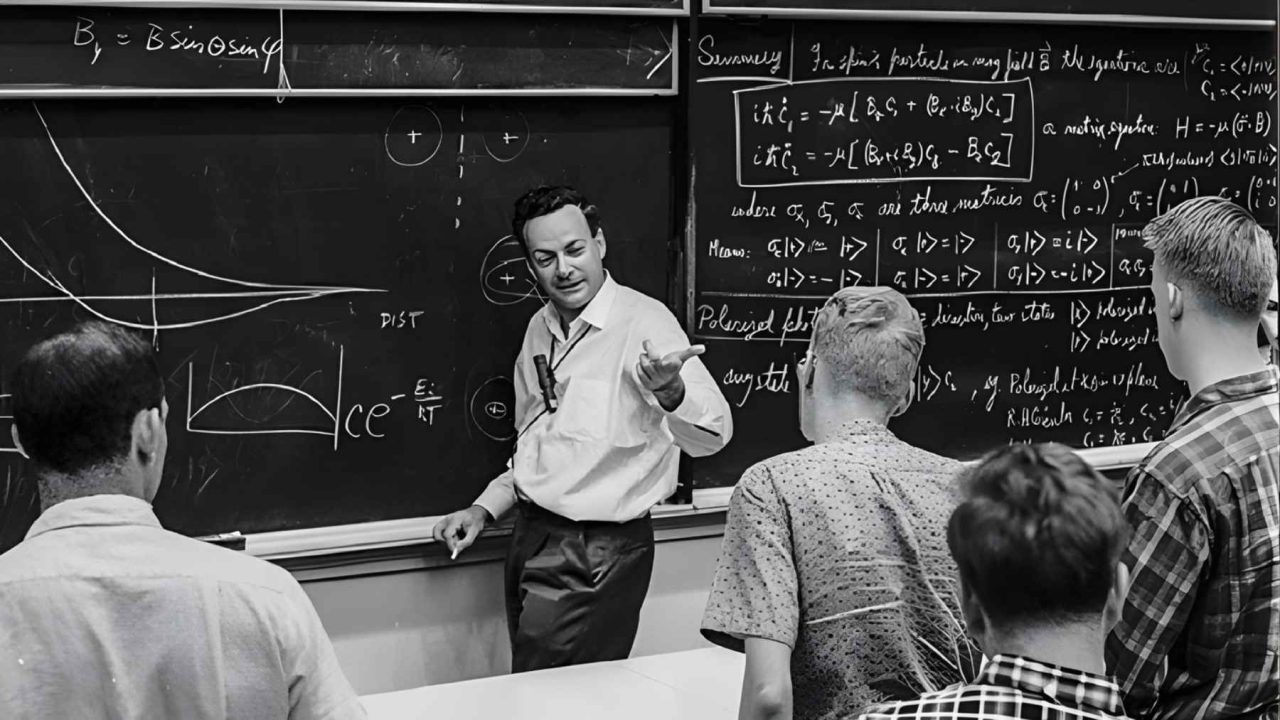
What if the most important scientific lecture of the twentieth century was dismissed as an after-dinner joke?
That is precisely what happened on December 29, 1959, when Nobel Prize-winning physicist Richard Feynman took the stage at the annual American Physical Society meeting at Caltech in Pasadena. His talk, There’s Plenty of Room at the Bottom, proposed something that made the room chuckle and then go quiet. He suggested that the entire Encyclopaedia Britannica could be written on the head of a pin.
Not metaphorically. Mathematically.
More than six decades later, scientists, historians, and engineers still argue about what Feynman actually meant, whether he was right, and whether his vision launched nanotechnology or simply predicted it from a safe distance.
The Pinhead Calculation That Split the Scientific Community
Feynman’s argument was precise. A pinhead, he noted, is about one-sixteenth of an inch across. The Encyclopaedia Britannica contains millions of characters. If you reduced the scale of writing by roughly 25,000 times, every letter would still be readable under an electron microscope, and the entire encyclopedia would fit comfortably on that tiny metal surface.
He didn’t stop there. Feynman estimated there were approximately 24 million volumes of interest across major libraries worldwide. He calculated that all of them, every page of every book, could fit on roughly one million pinheads, occupying only a few square yards of space.
“There is enough room on the head of a pin to put all the information that man has ever written down.”
— Richard Feynman, December 29, 1959
The reaction was split. Some physicists found it thrilling. Others found it irrelevant. The talk was published in 1960, largely ignored for two decades, and then suddenly rediscovered as nanotechnology began to emerge as a real discipline.
That rediscovery is where the debate gets interesting.
| Year | Event | Significance |
|---|---|---|
| 1959 | Feynman delivers his Caltech lecture | First serious proposal for atomic-scale manipulation |
| 1960 | William McLellan claims the motor prize | Built a working motor inside a 1/64-inch cube using a toothpick and watchmaker’s lathe |
| 1974 | Norio Taniguchi coins “nanotechnology” | The field finally gets a name, 15 years after Feynman’s vision |
| 1985 | Tom Newman writes a page at nanoscale | Stanford grad student claims Feynman’s writing prize, 26 years later |
The Case That Feynman Was a Genuine Prophet of Nanotechnology
The strongest argument for Feynman as visionary is simply the timeline. He described atomic-scale data storage in 1959. The term nanotechnology wasn’t even coined until 1974, when Japanese engineer Norio Taniguchi introduced it. The tools Feynman imagined took decades to build.
His prizes tell the same story. He offered $1,000 to anyone who could build a working motor small enough to fit inside a cube one sixty-fourth of an inch on each side. William McLellan claimed that prize in 1960, using a microscope, a watchmaker’s lathe, and a toothpick. The motor worked. It was extraordinary for its time.
The writing challenge was harder. Feynman offered another $1,000 to anyone who could reduce a page of text by 25,000 times. That prize sat unclaimed for 26 years. Then, in November 1985, Tom Newman, a graduate student at Stanford University, used electron beam lithography to write the first page of A Tale of Two Cities at the required scale. He collected the check.
Supporters argue that Feynman didn’t just predict nanotechnology. He defined its core logic: that information can be stored at scales far smaller than anything humans had previously attempted, and that the laws of physics permit it.
A nanometer, for context, is one-billionth of a meter, approximately forty billionths of an inch. Feynman was describing manipulations at scales that wouldn’t be routinely achieved for another generation. That’s not a lucky guess. That’s a framework.
The Skeptical Case: Inspiration Is Not the Same as Invention
Critics of the Feynman-as-founder narrative make a pointed distinction. Describing something is not the same as building it. And being right about physics doesn’t mean you launched a field.
Historian of science Cyrus Mody and others have argued that the nanotechnology revolution of the 1980s and 1990s emerged from separate, parallel developments in surface science, chemistry, and materials engineering. Feynman’s 1959 talk was not widely cited in the technical literature until well after those developments were underway.
In other words, the scientists who actually built nanoscale tools weren’t necessarily reading Feynman. They were solving specific engineering problems in their own disciplines. The rediscovery of the 1959 lecture may have been more of a retroactive origin story than a genuine causal chain.
There is also the question of what Feynman was actually proposing. His talk was speculative and playful. He was an after-dinner speaker making bold claims to entertain a room of physicists. He offered no experimental roadmap, no funding proposal, no research agenda. He was lighting a fuse, not building the bomb.
Skeptics also note that the pinhead claim, while mathematically sound, was not original in spirit. The idea that matter could be manipulated at atomic scales had been discussed in theoretical physics for years. Feynman gave it drama. He didn’t give it birth.
Feynman's 1959 Predictions
Nanotechnology by 2000
Nanotechnology by 2024
| Metric | Feynman's 1959 Predictions | Nanotechnology by 2000 | Nanotechnology by 2024 |
|---|---|---|---|
| Miniaturization Scale |
85 |
72 |
99 |
| Data Storage Density |
78 |
65 |
97 |
| Precision Engineering |
70 |
68 |
95 |
| Scientific Impact |
95 |
80 |
92 |
| Public Recognition |
45 |
60 |
85 |
| Practical Application |
30 |
55 |
90 |
| Theoretical Accuracy |
88 |
74 |
96 |
What the Evidence Actually Shows About Feynman’s Influence
The honest picture is more complicated than either camp admits.
Feynman’s calculations were correct. A nanometer-scale reduction of 25,000 times is physically achievable, as Tom Newman proved in 1985 using electron beam lithography. Modern hard drives store data at densities that would have seemed fantastical in 1959. Flash memory, DNA data storage, and quantum computing all operate in conceptual territory Feynman sketched that December evening.
But the historical record also shows that the modern nanotechnology field drew more directly from the invention of the scanning tunneling microscope in 1981 by Gerd Binnig and Heinrich Rohrer, and from K. Eric Drexler’s 1986 book Engines of Creation, than from Feynman’s lecture. Feynman was cited as a forefather partly because the field needed one, and he was the most luminous name available.
That doesn’t diminish what he said. It just clarifies what he did. He was a cartographer of possibility, not a builder of roads.
Why the Feynman Debate Still Matters for Science Communication
The argument about Feynman’s pinhead is, at its core, an argument about how science actually advances. Does a single visionary speech change the direction of a field? Or do fields change through slow, anonymous accumulation of experimental data, and then borrow famous names to tell a cleaner story afterward?
The evidence suggests both things happen simultaneously, and that’s the uncomfortable truth. Feynman’s 1959 lecture did not directly cause nanotechnology. But it created a cultural permission structure. It told physicists and engineers that atomic-scale manipulation was a legitimate subject for serious people to pursue, not science fiction.
That kind of permission matters more than it gets credit for. Science has gatekeepers. A Nobel laureate standing before the American Physical Society and saying, in effect, “this is real and worth doing” carries weight that a graduate student’s paper cannot.
The pinhead was never just about storage density. It was about ambition. And ambition, it turns out, is also a form of data.
The real question Feynman left behind isn’t whether the encyclopedia fits on a pin. It’s whether we have the courage to keep asking what else does.
Frequently Asked Questions

You Might Also Like

Birdwatching May Literally Rewire Your Brain, Study Finds
A 2026 study reveals expert birdwatchers have measurably different brain structures than novices, sparking debate…
5 Reasons Supershear Earthquakes Could Blindside California
Four of the last six major strike-slip earthquakes were supershear events. California's building codes may…

First Footage of a Colossal Squid Rewrites the Abyss
On March 9, 2025, ROV SuBastian filmed a juvenile colossal squid alive for the first…
Leave a Reply