
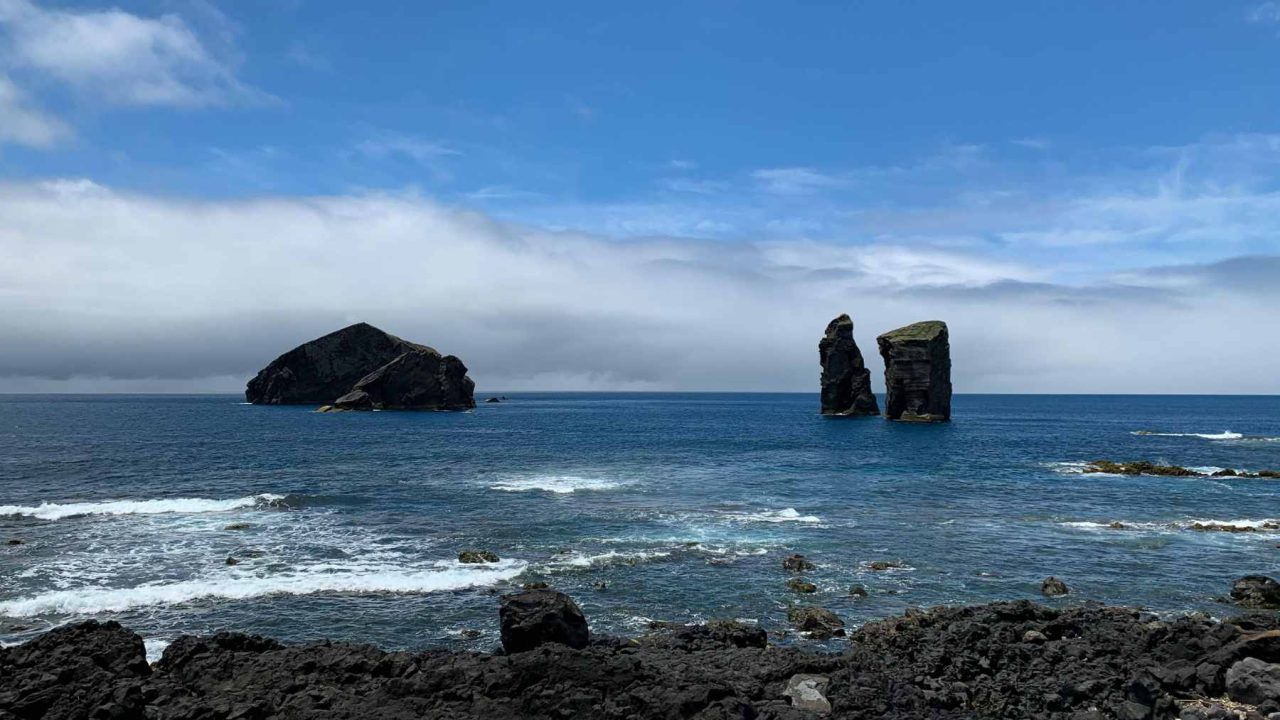
The drill ship JOIDES Resolution cut through dark Atlantic water in the summer of 2025, its drill string reaching down through hundreds of meters of ocean and then deeper still, into the seafloor itself. Scientists on board held their breath as the first core samples came up. What they found inside the sediment was not what most people expect to find beneath an ocean: fresh water.
Not a trickle. Not a seep. A zone nearly 200 meters thick, saturated with low-salinity groundwater, buried beneath the Atlantic floor off the New England coast.
The discovery confirmed something researchers had suspected for decades, but never proven at this scale. Beneath one of the world’s busiest ocean corridors lies a hidden freshwater system so immense it strains comprehension.
What IODP³-NSF Expedition 501 Actually Found 2,861 Feet Down
The offshore drilling phase of IODP³-NSF Expedition 501 ran from May through August 2025. During that time, the team drilled and recovered 872 meters of core samples — roughly 2,861 feet of sediment pulled from beneath the Atlantic seafloor.
Inside those cores, scientists documented a freshened water zone nearly 200 meters thick. The water is not sitting in a cavern or flowing in underground rivers. It is dispersed through porous sediment and rock, the way a sponge holds water, spread across an enormous subseafloor formation.
Those cores are now being processed at a research facility in Bremen, Germany, during the onshore science phase. Analysis is ongoing, but the initial findings have already reshaped how scientists understand the Atlantic margin.
The 1976 Clue That Took 50 Years to Fully Understand
Scientists did not stumble onto this blindly. The first hints that offshore freshened groundwater existed beneath the Atlantic appeared as far back as 1976. Early ocean drilling programs detected anomalous low-salinity readings in sediment cores, but the data was incomplete and the scale was unclear.
For decades, the discovery sat in the literature, noted but not fully mapped or explained. Then, in 2019, a study published in Scientific Reports changed the conversation entirely.
That research identified low-salinity aquifers extending as far as 90 kilometers offshore near New Jersey and Martha’s Vineyard. More significantly, the study suggested the system spanned at least 350 kilometers of the U.S. Atlantic margin. The estimated volume: approximately 2,800 cubic kilometers of low-salinity groundwater.
| Milestone | Year | Significance |
|---|---|---|
| First offshore freshwater signals detected | 1976 | Early drilling programs note anomalous low-salinity readings |
| Scientific Reports study maps the system | 2019 | Aquifers confirmed 90 km offshore; system estimated at 350 km along U.S. coast |
| IODP³-NSF Expedition 501 drills Atlantic floor | 2025 | 872 meters of core samples; 200-meter freshwater zone physically confirmed |
| Onshore analysis in Bremen | 2025–ongoing | Core samples processed; full chemical and geological analysis underway |
The 2019 study was compelling, but it relied heavily on indirect geophysical data. Expedition 501 was designed to go further: to physically drill into the formation and pull out proof.
2,800 Cubic Kilometers: A Number That Needs Context
Numbers this large tend to slide past us without sticking. So consider this: New York City, one of the most water-intensive metropolitan areas on Earth, consumes roughly 3.5 cubic kilometers of water per year. The Atlantic offshore system is estimated to hold 2,800 cubic kilometers.
The water is not pristine drinking water straight from the tap. It is described as low-salinity, meaning it is far fresher than seawater but would still require treatment before human consumption. Think of it less as a ready-made reservoir and more as a geological bank account, one that has been accumulating deposits for thousands of years.
Scientists believe much of this water was originally trapped during the last ice age, when sea levels were dramatically lower and the continental shelf was exposed land. Rainwater and glacial melt percolated into the sediment and rock. As seas rose, the water became sealed beneath layers of impermeable clay and ocean floor.
Why the Atlantic Seafloor Became a Freshwater Vault
The geological story behind this system is as striking as the discovery itself. During the last glacial maximum, roughly 20,000 years ago, sea levels sat about 120 meters lower than today. What is now the continental shelf was dry land, crossed by rivers and soaked by rainfall.
As glaciers melted and seas rose, those ancient freshwater deposits did not simply disappear. They were buried under accumulating marine sediment, effectively capped and preserved. Over millennia, the overlying layers of fine-grained clay became a near-impermeable seal, locking the water in place.
“Offshore freshened groundwater is a global phenomenon. Understanding its extent and origin could reshape how we think about coastal water security.”
— Researchers affiliated with offshore Atlantic groundwater studies
Similar offshore freshwater systems have since been identified in other parts of the world, from the coasts of Australia and Namibia to parts of the North Sea. The Atlantic discovery is notable for its confirmed scale and its proximity to one of the most densely populated coastlines on Earth.
A Planet Running Dry: Why This Discovery Lands So Hard Right Now
The timing of this confirmation is not incidental. Current projections suggest that by 2040, more than half the world’s population will be experiencing water shortages. Aquifers that have supplied drinking water for generations are being drawn down faster than they can recharge.
Coastal cities face a particular bind. As populations grow and inland water sources strain under demand, the ocean sits just offshore, vast and useless for drinking. Desalination plants exist, but they are expensive, energy-intensive, and generate concentrated brine that poses its own environmental problems.
An offshore freshwater system changes that calculus, at least in theory. The water is already there, already low in salinity, already relatively close to the populations that need it most. The question is not whether it exists. Expedition 501 settled that. The question is what comes next.
Extracting water from beneath the ocean floor is not simple. It would require purpose-built offshore infrastructure, careful management to avoid saltwater intrusion, and rigorous environmental review. Scientists are cautious about framing this as a solution. It is, for now, a resource that needs to be understood before it can be responsibly used.
But the existence of 2,800 cubic kilometers of low-salinity groundwater beneath the Atlantic, confirmed by physical cores and nearly 50 years of building scientific understanding, is not a footnote. It is a reminder that the planet still holds secrets large enough to matter, buried in places we have only recently learned to look.
The cores in Bremen are still being analyzed. More answers are coming. And somewhere beneath the grey Atlantic swells, a hidden ocean waits, patient and enormous, older than any city that might one day drink from it.
Frequently Asked Questions

You Might Also Like

JWST’s ‘Little Red Dots’ Aren’t Galaxies. They’re Infant Black Holes on a Feeding Frenzy
JWST's mysterious 'little red dots' aren't early galaxies. A new Nature study reveals they're rapidly…

The Aluminum Breakthrough That Could End Our Addiction to Rare Metals
Scientists at King's College London created cyclotrialumane, a new aluminum form that could replace platinum…
The Sun’s Solar Maximum Is Turning Space Into a Minefield
The Sun's solar maximum is supercharging space debris risks. Scientists warn satellites, GPS, and communications…
Leave a Reply