
▶ Read transcript
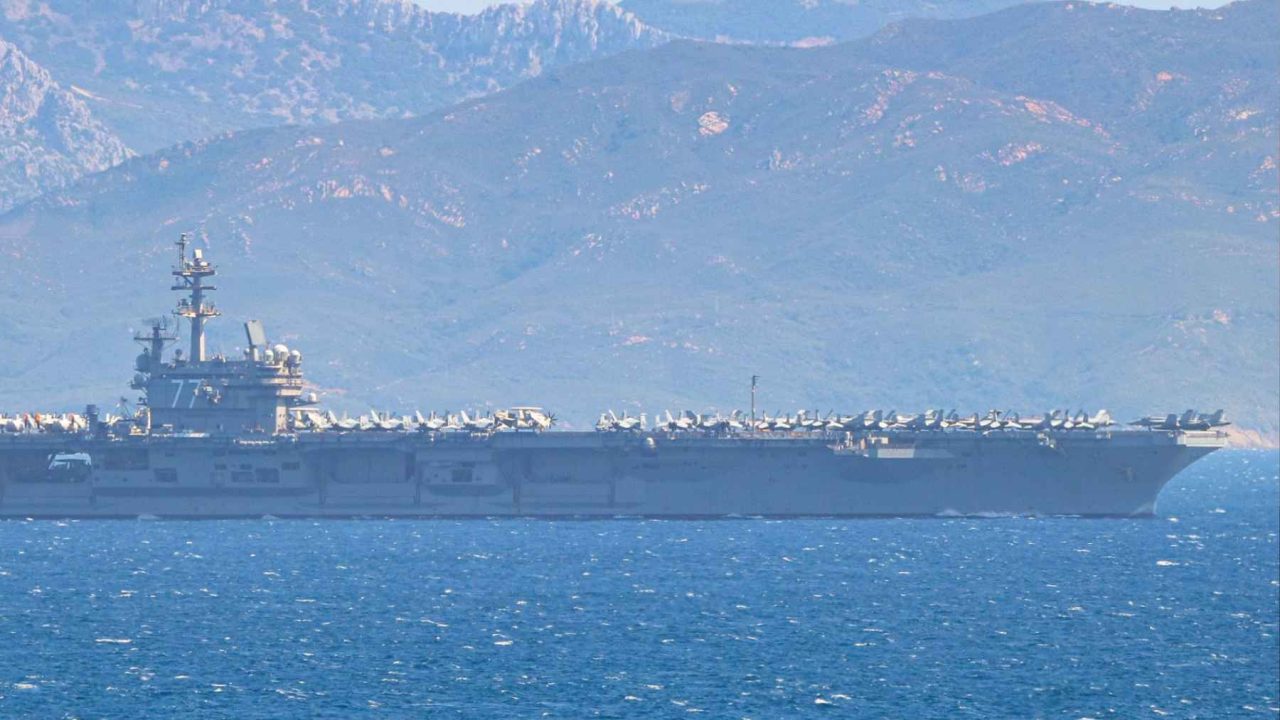
Here’s what you need to know about the USS George H.W. Bush and its final Atlantic certification test.
The Bush, known as CVN-77, is the tenth and last Nimitz-class nuclear supercarrier ever built. Named for the 41st president, who flew 58 combat missions in World War Two, the ship carries over 5,000 sailors and roughly 90 aircraft, powered by just two nuclear reactors that can run for more than 20 years without refueling.
Before deploying, the entire carrier strike group had to pass COMPTUEX, the Composite Training Unit Exercise. This is a multi-week, high-intensity stress test involving simulated combat, electronic warfare, anti-submarine operations, and cyberattack scenarios, all happening simultaneously.
It’s essentially a live-fire exam for a floating city. If you want to understand American naval power, look up COMPTUEX. Knowing what that certification actually demands gives you a much clearer picture of what these ships are truly capable of.
What would it take to prove that 100,000 tons of nuclear-powered steel, 5,000 sailors, and dozens of aircraft are truly ready for war?
That question sits at the heart of one of the most rigorous certification processes in modern military science. And it just played out again, quietly, somewhere in the Atlantic Ocean.
The USS George H.W. Bush (CVN-77) recently returned to Naval Station Norfolk in Virginia after completing a series of critical maneuvers in the Atlantic. Those maneuvers were not routine drills. They were the final, high-stakes phase of a process that determines whether a nuclear-powered aircraft carrier and its entire strike group are fit to deploy into real-world conflict zones.
The exercise is called COMPTUEX. And understanding what it actually involves changes how you think about naval power entirely.
CVN-77: The Last of a Nuclear Dynasty
The USS George H.W. Bush holds a specific place in American naval history. She is the tenth and final Nimitz-class supercarrier, a line of warships that defined U.S. naval dominance for over five decades.
She was commissioned on January 10, 2009, at a ceremony attended by the 41st president himself. The ship is named for George H.W. Bush not just because of his presidency, but because of his service as a naval aviator during World War II. Bush flew 58 combat missions and was shot down over the Pacific in 1944. Few ships carry a namesake with that kind of direct connection to naval combat.
CVN-77 displaces approximately 104,000 tons when fully loaded. Her flight deck stretches over 1,000 feet. Two nuclear reactors power four propeller shafts, driving the ship at speeds exceeding 30 knots. She can carry roughly 90 aircraft and support more than 5,000 personnel.
Comparing her to the ship that started it all underscores just how far nuclear carrier technology has advanced.
| Feature | USS Enterprise (CVN-65) | USS George H.W. Bush (CVN-77) |
|---|---|---|
| Commissioned | November 25, 1961 | January 10, 2009 |
| Class | Enterprise-class (unique) | Nimitz-class (final unit) |
| Nuclear Reactors | 8 reactors | 2 reactors |
| Displacement | ~93,970 tons | ~104,000 tons |
| Aircraft Capacity | ~90 aircraft | ~90 aircraft |
The USS Enterprise, commissioned in 1961 at Newport News, Virginia, was the world’s first nuclear aircraft carrier. CVN-77 represents the culmination of everything the Navy learned from six decades of nuclear carrier operations.
What COMPTUEX Actually Tests — and Why It Matters
Before any carrier strike group deploys, it must pass the Composite Training Unit Exercise, known as COMPTUEX. This is not a graduation ceremony. It is closer to a live-fire stress test applied to an entire floating city.
The exercise takes place over several weeks at sea, typically in the Atlantic for East Coast-based carriers. It involves simulated combat scenarios, electronic warfare, anti-submarine operations, air defense drills, and coordinated strike missions. Every element of the carrier strike group is tested simultaneously.
The science behind COMPTUEX draws from fields most people never associate with military operations. Human factors engineering studies how crews perform under sustained cognitive load. Systems reliability testing measures how mechanical and electronic systems behave under simultaneous stress. Network resilience analysis evaluates how well the strike group’s communications survive deliberate jamming and cyberattack simulations.
The exercise is overseen by the U.S. Fleet Forces Command, which certifies the strike group only after evaluators confirm that every major warfare area has met required performance thresholds. Failing sections of COMPTUEX means repeating them. There is no shortcut.
The Bush began its Atlantic preparations for this COMPTUEX cycle in early February 2026, according to reporting from Zona Militar. The return to Norfolk marks the completion of that certification arc.
The Nuclear Science That Makes It All Possible
It is easy to focus on the tactical drama of COMPTUEX and overlook the physics that makes the entire enterprise possible. Nuclear propulsion is not just a fuel choice. It is a strategic capability with profound scientific implications.
Restricted to training exercises only
Individual unit drills, not integrated
Unverified — no formal assessment
Untested against simulated adversaries
Partial — aircraft and pilots not war-certified
Procedures rehearsed but not stress-tested
Ineligible for real-world conflict zones
Functional but not battle-integrated
Operational but not certified under combat tempo
Escorts and carrier operating independently
Cleared for global deployment in conflict zones
Fully integrated multi-ship combat operations
Formally certified by independent evaluators
Validated against simulated near-peer adversaries
All squadrons certified for combat sorties
Stress-tested under 72+ hours of continuous pressure
Authorized for real-world operational tasking
Proven battle-ready as a unified fighting force
Sustained at full combat operational tempo
Escorts, submarines, and carrier operating as one
A Nimitz-class carrier’s two A4W nuclear reactors generate enough steam to power the ship’s four main turbines, produce electricity for the entire vessel, and support catapult launch systems for aircraft. The reactors use highly enriched uranium fuel. Under normal operations, they can run for over 20 years before requiring refueling.
This matters enormously for COMPTUEX and for deployment. A conventionally powered carrier must plan its operations around fuel logistics. A nuclear carrier does not. It can sustain high-speed operations, maintain full power to weapons and sensors, and remain on station indefinitely as long as it receives food, aviation fuel, and ordnance from supply ships.
“Thousands of sailors call ships home for months at a time, and some of these ships, such as the USS George H.W. Bush, are named after figures whose own lives were shaped by the sea.”
— U.S. Navy documentary context on CVN-77
During COMPTUEX, the nuclear reactors are pushed through operational profiles that simulate real deployment demands. Engineers monitor reactor performance, thermal output, and system redundancies. If anything behaves unexpectedly in the Atlantic, it is far better to discover it there than in the Persian Gulf or the South China Sea.
Norfolk’s Role as the Nerve Center of Atlantic Naval Power
Naval Station Norfolk in Virginia is the largest naval base in the world. Its role in the Bush’s pre-deployment cycle is not merely logistical. It is scientific and operational.
Between COMPTUEX phases, the carrier returns to Norfolk for what the Navy calls sustainment periods. During these windows, maintenance crews address any mechanical findings from the at-sea exercises. Reactor technicians conduct inspections. Aviation squadrons rotate personnel and equipment.
The data collected during COMPTUEX feeds directly into post-exercise analysis. Every simulated engagement, every system failure, every communication breakdown gets reviewed by analysts. The findings shape training adjustments before the ship crosses into a real operational theater.
This iterative feedback loop between sea trials and shore-based analysis is itself a form of applied science. It borrows from aerospace test protocols, industrial reliability engineering, and organizational psychology research on high-performance teams under stress.
What a Carrier’s Return Signals About Readiness
When the Bush returned to Norfolk after completing its Atlantic maneuvers, the event carried specific meaning beyond the visible image of a massive ship entering port.
A successful COMPTUEX completion means the strike group’s warfare commanders have demonstrated proficiency across every required domain. Anti-air warfare. Anti-submarine warfare. Surface warfare. Strike operations. Electronic warfare. Logistics under fire. Each domain has measurable performance standards. Each must be certified independently.
The timing matters too. The Bush departed Norfolk on March 31, 2026, to begin its scheduled deployment, with more than 5,000 personnel assigned to the strike group. That departure followed the completion of the Atlantic exercises, confirming that the certification arc closed successfully.
For the sailors aboard, the return and subsequent departure represent months of preparation compressed into a final proof of readiness. For the Navy’s strategic planners, it represents one more nuclear-powered strike group certified and positioned to project power wherever it is needed.
The science of naval readiness rarely makes headlines. But every time a carrier like the Bush completes its Atlantic trials and sails toward a deployment, it carries the weight of decades of engineering refinement, human performance research, and hard-won operational knowledge.
The ocean does not grade on a curve. And neither does COMPTUEX.
Frequently Asked Questions
Frequently Asked Questions

You Might Also Like

Ice, Secrets, and a Nuclear Bunker Found 240 km Off Greenland
A NASA flight 240 km off Greenland detected Cold War nuclear bunker tunnels from 1959.…

Ukraine’s Starlink Whitelist Rewrites the Rules of Satellite Warfare
Ukraine's 2026 Starlink whitelist blocks Russian terminals mid-war, sparking a global battle over who controls…
The 13,000-Pound Mystery: How Neolithic People Moved Scotland’s Stone to Stonehenge
How did Neolithic people move a 13,000-pound stone 500 miles from Scotland to Stonehenge? The…
Leave a Reply