
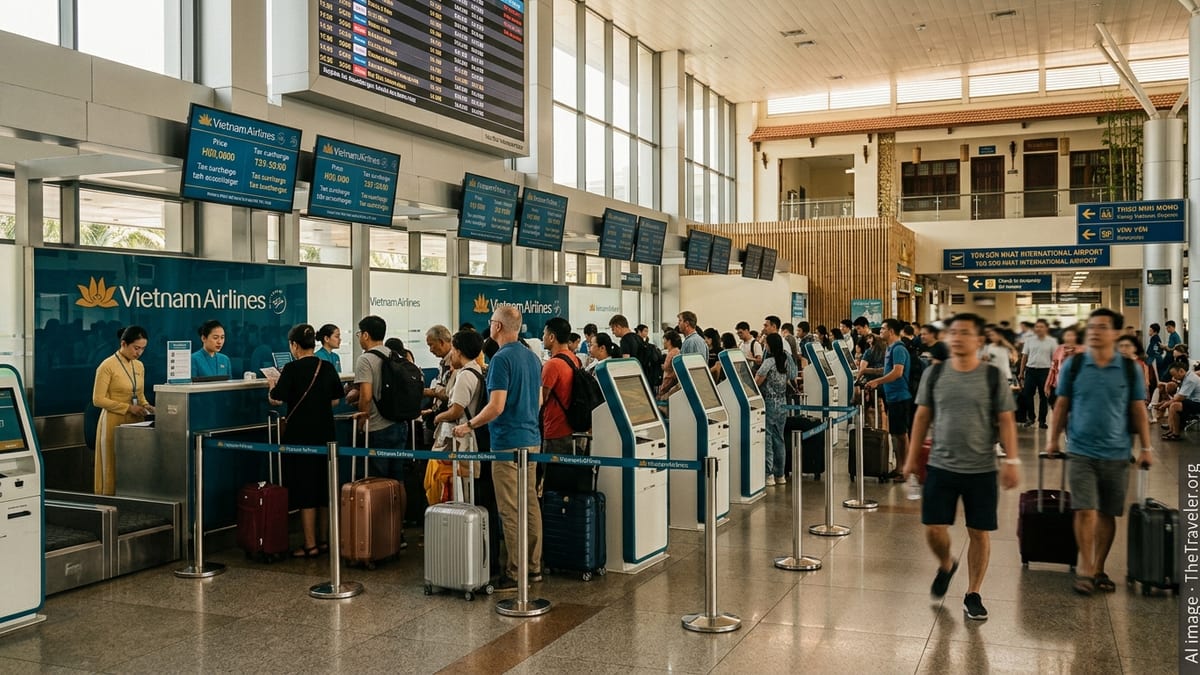
More than 60% of foreign and regional airlines operating international routes to and from Vietnam have either imposed new fuel surcharges or raised existing fares since mid-March 2026 — and many travellers are only finding out at the final checkout screen, where the total has quietly climbed by as much as $400.
For families who priced out summer holidays to Hanoi, Ho Chi Minh City, or Da Nang just weeks ago, the numbers they’re seeing now look nothing like what they planned for. The extra costs aren’t hidden exactly — they appear in the fare breakdown — but they’re easy to miss until you’re already committed to a booking.
This isn’t a minor adjustment. It’s a structural shift in how airlines are pricing routes into Vietnam, and it’s happening fast enough that regulators have already launched a formal review.
(function(){var wrp=document.getElementById(“paap_stat_69c47227828be7.35413653”);if(!wrp)return;var ids=[“paap_stat_69c47227828be7.35413653_c0″,”paap_stat_69c47227828be7.35413653_c1”];var dur=1800;function ease(t){return 1-Math.pow(1-t,3);}function anim(){ids.forEach(function(id){var el=document.getElementById(id);if(!el)return;var tgt=parseFloat(el.getAttribute(“data-target”))||0;var pfx=el.getAttribute(“data-prefix”)||””;var sfx=el.getAttribute(“data-suffix”)||””;var dec=parseInt(el.getAttribute(“data-decimals”))||0;var st=null;function step(ts){if(!st)st=ts;var p=Math.min((ts-st)/dur,1);var v=ease(p)*tgt;el.textContent=pfx+v.toFixed(dec)+sfx;if(p<1)requestAnimationFrame(step);}requestAnimationFrame(step);});}if("IntersectionObserver" in window){var obs=new IntersectionObserver(function(e){e.forEach(function(en){if(en.isIntersecting){anim();obs.disconnect();}});},{threshold:0.2});obs.observe(wrp);}else{anim();}})();
What Vietnam’s Aviation Regulator Found When It Looked Closely
Vietnam’s Civil Aviation Authority — known as the CAAV, the state regulator operating under the Ministry of Transport — conducted a rapid assessment of nearly 40 foreign and regional airlines flying international routes to and from Vietnam. What it found was striking.
More than 60% of those carriers had moved on pricing since mid-March 2026. Some introduced entirely new fuel surcharge line items. Others simply raised base fares, achieving the same effect without making the fuel component explicit. In both cases, the result for passengers is the same: the ticket costs more than it did a few weeks ago.
The stated reason from airlines is a sudden spike in jet fuel costs. Whether that explanation fully accounts for the scale of the increases is a separate question — one that regulators appear to be actively asking.
Breaking Down the New Fees on Vietnam Flights
The surcharges aren’t uniform. They vary by airline, route length, and cabin class — which makes comparison shopping more difficult than usual. What travellers are consistently reporting is that the fees appear late in the booking process, after the headline fare has already anchored their expectations.
| What’s Changed | Detail |
|---|---|
| Proportion of airlines raising costs | More than 60% of nearly 40 surveyed carriers |
| Maximum additional fee reported | Up to $400 per ticket |
| Timing of changes | From mid-March 2026 onward |
| Methods used | New fuel surcharge line items, or direct base fare increases |
| Routes affected | International flights to and from Vietnam, including Hanoi, Ho Chi Minh City, and Da Nang |
| Regulatory body reviewing the situation | Vietnam’s Civil Aviation Authority (CAAV), under the Ministry of Transport |
The two-track approach — some airlines adding explicit surcharges, others raising base fares — makes it harder for travellers to identify the increases at a glance. A fuel surcharge listed separately at least tells you what you’re paying for. A higher base fare offers no such transparency.
Who This Hits Hardest — and Why It Matters Right Now
The timing is particularly painful. Summer travel planning is already underway for millions of households, and Vietnam has become an increasingly popular destination for both leisure and family visits. People who locked in rough budget estimates weeks ago are now facing a gap between what they expected to pay and what airlines are actually charging.
The impact isn’t evenly distributed. Travellers on longer international routes — where fuel costs are a larger share of operating expenses — are likely seeing bigger surcharges than those on shorter regional hops. And passengers who booked early at lower fares may find those prices are no longer available if they need to rebook or change their plans.
There’s also a transparency problem embedded in how these fees are presented. When a surcharge appears only at the final stage of checkout, it disrupts the comparison process that most travellers rely on when choosing between airlines and dates. The headline price becomes unreliable as a shopping tool.
- Families planning summer trips to Vietnam are among the most directly affected groups
- Travellers who priced routes in early March may find those fares no longer available
- Passengers on longer international routes face proportionally larger fuel fee additions
- The late-stage disclosure of surcharges makes accurate budget planning significantly harder
- Both leisure travellers and those visiting family in Hanoi, Ho Chi Minh City, and Da Nang are affected
What the CAAV Review Could Mean Going Forward
The fact that the CAAV moved quickly to assess the situation suggests regulators are not treating this as routine market fluctuation. A formal survey of nearly 40 carriers is a significant undertaking, and the findings — that a clear majority have adjusted pricing in a short window — give the authority a documented baseline to work from.
What happens next depends on what powers the CAAV chooses to exercise and whether the Ministry of Transport decides the situation warrants intervention. Regulators could push for greater transparency in how surcharges are disclosed, require airlines to justify fee levels, or take a more hands-off approach if they conclude the increases reflect genuine cost pressures.
For travellers, the practical advice right now is straightforward: don’t rely on the headline fare when budgeting for a Vietnam trip. Factor in the full checkout total, compare that number across carriers, and check whether the fee structure has changed since you last searched. Prices that looked reasonable a few weeks ago may look very different today.
Frequently Asked Questions
How much are the new fuel surcharges adding to Vietnam flight tickets?
The additional fees can reach up to $400 per ticket, depending on the airline, route, and booking class involved.
Which airlines are affected?
The CAAV survey covered nearly 40 foreign and regional carriers operating international routes to and from Vietnam, with more than 60% found to have raised costs since mid-March 2026. Specific airline names were not detailed in the available information.
Which Vietnamese cities are seeing the price increases?
International routes serving Hanoi, Ho Chi Minh City, and Da Nang are all affected by the broader pricing changes.
Why are airlines citing fuel costs as the reason?
Airlines have pointed to a sudden spike in jet fuel prices as the justification for the surcharges and fare increases introduced from mid-March 2026 onward.
Is the Vietnamese government doing anything about it?
Yes — the Civil Aviation Authority of Vietnam, operating under the Ministry of Transport, has conducted a formal review of the pricing practices and is aware of the scale of the changes across affected carriers.
How can travellers protect themselves from surprise fees?
Always compare the final checkout total — not the headline fare — when searching for flights to Vietnam, as surcharges may only appear at the last stage of the booking process.



Leave a Reply